Raccoon dogNyctereutes procyonoides — habitat, diet and reproduction
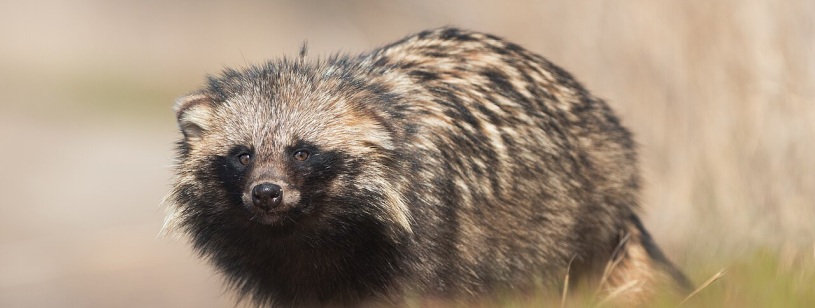
A mainland raccoon dog, Nyctereutes procyonoides, photographed in Ukraine. · Ryzhkov Sergey / CC BY-SA 4.0 (https://creativecommons.org/licenses/by-sa/4.0). Cropped and resized.
The raccoon dog is a stocky canid with dark markings around its eyes. It resembles a raccoon but belongs to a different family. Mainland raccoon dogs, Nyctereutes procyonoides, originated in Asia and reached Europe through human introductions. They now occur in Romania as well.
Quick facts
| Common name | Raccoon dog; mainland raccoon dog |
| Scientific name | Nyctereutes procyonoides |
| Diet | Opportunistic omnivore |
| Main predators | Wolves, lynx and other large predators; varies regionally |
| Conservation context | Invasive alien species of European Union concern |
| Distribution | Native to Asia; introduced and spreading in Europe |
| Habitat | Woodland, dense cover, wetlands and agricultural landscapes |
| Length | Head and body: approximately 50–68 cm; tail 13–25 cm |
| Weight | Seasonally variable; approximately 4–10 kg |
| Family | Canidae |
| Reproduction | Pregnancy around two months; both parents care for pups |
| Winter strategy | May alternate extended rest with activity |
- Primary category:Canids
- Explore this animal's categories:
Interesting facts
- The facial mask does not make it a raccoon: it is a canid.
- Body weight can rise considerably before winter.
- Both members of a pair may help raise pups.
- Winter rest does not mean every animal remains inactive all season.
Characteristics
Dense fur and relatively short legs produce a compact outline. Small rounded ears and a pointed muzzle become clearer in profile.
Head-and-body length is approximately 50–68 cm, excluding the tail. Fat accumulation before cold weather changes body mass and appearance. The dark eye markings explain the resemblance to a raccoon, but identification and relationships cannot be based on facial colour alone.
Behaviour
Raccoon dogs explore ground vegetation and habitat edges for food. They are often active at night or twilight but are not exclusively nocturnal.
In cold regions, resting periods reduce energy use. Finnish studies show continued winter activity and strong weather effects on recorded tracks. Ice can enable movement between islands, so water barriers may become passable in particular seasons.
Habitat and distribution
The native range lies in Asia. Introductions associated with the fur trade during the previous century were followed by expansion across much of Europe.
Dense woodland, reedbeds, watersides and agricultural mosaics provide food and shelter. Burrows and spaces beneath structures can serve as resting sites. Romania forms part of the introduced European range; these animals are not recently escaped domestic dogs.
Diet and feeding
This opportunistic omnivore eats invertebrates, rodents, amphibians, eggs, fruit and other available resources. Their proportions change with season and place.
Careful searching matters more than fast long-distance pursuit. Carrion and human-associated food may also be used. In wetlands, predation on eggs and amphibians can affect native wildlife, although effects must be assessed locally rather than assuming every population has the same diet.
Reproduction and life cycle
Pairs frequently share parental work. The male may attend pups while the female forages, and both parents contribute to their early survival.
Pregnancy lasts around two months. Young are born in shelter and initially depend on their parents, later exploring and feeding independently. Dispersing juveniles and moving adults help colonise new areas where suitable routes and habitat are available.
Name and history
The common name combines its canid identity with its raccoon-like appearance. It is not a cross between a dog and a raccoon. Similar facial markings do not indicate hybrid origins.
Its European history illustrates how a human introduction can shape ecosystems long after the original release. Scientific naming helps distinguish the species from superficially similar mammals.
Conservation and threats
The raccoon dog is listed as an invasive alien species of European Union concern. Attention therefore focuses on its effects in introduced ecosystems.
Researchers study movement, population density and interactions with ground-nesting birds. Track data require weather information because winter activity varies. Protecting wetland wildlife depends on monitoring and coordinated management; moving animals elsewhere can extend their spread.
Frequently asked questions
Is a raccoon dog a raccoon?
No. It is a canid, related to foxes and dogs rather than the raccoon family.
Does it occur in Romania?
Yes. Romania is part of its introduced European range.
Does it sleep throughout winter?
Not necessarily. In cold climates it may alternate rest with activity according to conditions.
Is it a dog–raccoon hybrid?
No. It is a distinct species; the common name describes its appearance.