European flat oysterOstrea edulis — habitat, diet and reproduction
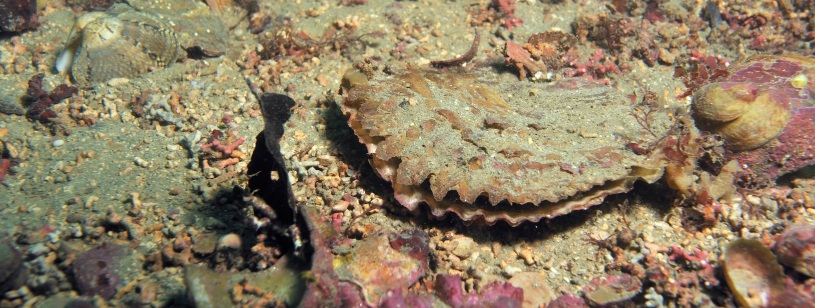
European flat oyster (Ostrea edulis) with a rough shell on the seabed. · Olivier Dugornay / Ifremer / Wikimedia Commons / CC BY 4.0 (https://creativecommons.org/licenses/by/4.0/). Cropped and resized. Source: https://commons.wikimedia.org/wiki/File:Hu%C3%AEtre_plate_(Ostrea_edulis)_en_rade_de_Brest_(Ifremer_00565-67729_-_43616).jpg
The European flat oyster (Ostrea edulis) is a bivalve mollusc protected by two shell valves. Adults remain attached to a surface and filter food from the water. Their shells can build reef structures that shelter many other organisms.
Quick facts
| Common name | European flat oyster |
| Scientific name | Ostrea edulis |
| Lifespan | Often 5–10 years; some individuals exceed 20 years |
| Size | Often up to 11 cm; large individuals can exceed 20 cm |
| Diet | Microalgae and suspended organic particles |
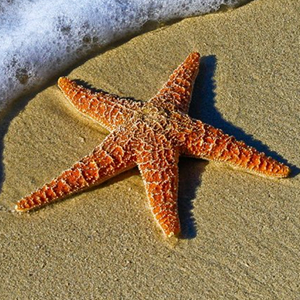
| Predators | Starfish, crabs, fish and predatory snails |
| Conservation status | Species globally not assessed; reef habitats severely depleted |
| Distribution | Northeast Atlantic, Mediterranean and Black Sea |
| Habitat | Coastal waters with firm surfaces or shells |
| Family | Ostreidae |
| Lifestyle | Attached adult; planktonic larval stage |
| Reproduction | Can alternate between male and female phases |
- Primary category:Molluscs
- Explore this animal's categories:
Interesting facts
- The left valve attaches permanently to the substrate.
- Larvae disperse in the water before settling.
- One individual can function as male and female at different times.
- Spaces among oyster shells shelter many other marine animals.
Records and extremes
UHI Shetland documented an oyster measuring 20.1 cm and weighing just over one kilogram. This illustrates the size of a large individual rather than a typical adult.
MarLIN describes 5–10 years as a common lifespan, while larger individuals may live beyond 20 years.
Characteristics
The rounded or oval shell has a rough, layered surface. Its deeper left valve attaches to the bottom, while the flatter right valve acts as a lid.
An adductor muscle closes the valves against the pull of a ligament. Inside are the soft body and gills, used in respiration and feeding.
Behaviour
Adults stay where they settled. Slightly open valves allow water circulation, while closure protects the animal during disturbance.
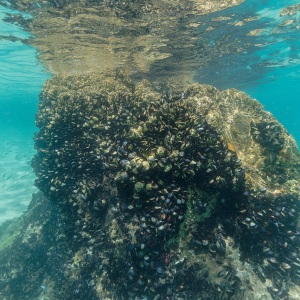
Young oysters may attach to older shells. Living oysters and accumulated shells can create complex structures with hiding places and surfaces for other species.
Habitat and distribution
The native range extends from Norway towards Morocco and includes the Mediterranean and Black Sea. Many remaining populations are fragmented.
Firm surfaces, stones and shell-rich sediments provide attachment sites. Excessive sediment deposition can interfere with feeding and survival.
Diet and feeding
Gills retain microalgae and other suspended organic particles, which are transported towards the mouth. This is filter feeding.
Oyster activity can improve local water clarity, depending on abundance, currents and environmental conditions. Some retained material is deposited on the seabed.
Reefs also provide habitat, making their ecological role broader than filtration alone.
Reproduction and life cycle
European flat oysters can alternate between male and female reproductive phases. Sperm carried in water fertilises eggs held inside an oyster in the female phase.
Early development lasts around 8–10 days within the shell, depending on temperature. Released larvae then spend a planktonic period in the water.
Larvae eventually settle on suitable surfaces. Food, temperature, substrate and predators influence successful recruitment.
Name and history
Linnaeus described Ostrea edulis in 1758. It is also known as the native oyster in parts of Europe.
FAO records Roman use of ponds for holding and sorting oysters. Centuries of harvesting form part of the history behind depleted natural beds.
Conservation and threats
NatureScot reports no global IUCN species assessment. Oyster beds and reefs nevertheless face substantial documented losses.
An assessment presented by the IUCN Red List of Ecosystems in 2026 classifies European native oyster reef ecosystems as Collapsed. This refers to lost functioning reef systems at historical scales, while individual oysters and remnant populations survive.
Overharvesting, seabed damage and disease have contributed to decline. Restoration requires suitable settlement surfaces, surviving adults, healthy stock and long-term monitoring.
Frequently asked questions
Does this oyster produce jewellery pearls?
Most marine jewellery pearls come from other oyster groups. Ostreidae can form small, irregular pearls.
Why is one valve deeper?
The left valve forms the attached base, while the right covers the body like a lid.
Can adults move across the seabed?
Adults remain attached; dispersal occurs during the larval stage.
Why are shells used in restoration?
They provide surfaces where larvae can settle.
What is an oyster reef?
A structure of living oysters and shells that also supports other organisms.
Does an unassessed species automatically have secure populations?
It means a global species assessment is absent; population and habitat problems can still be well documented.