Miniature PinscherCharacteristics, history, training and care
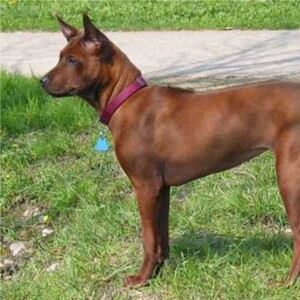
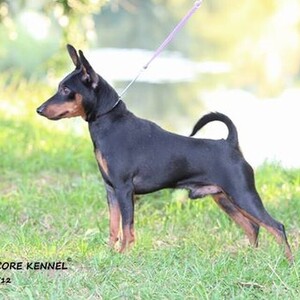
Miniature Pinscher. · Sanacorekennel / Wikimedia Commons, CC BY-SA 3.0. Cropped and resized.
The Miniature Pinscher (Zwergpinscher) is a small, elegant German dog with a square body and a short, glossy coat, red or black and tan. It is a smaller copy of the German Pinscher, without a dwarf appearance. The standard describes it as lively, spirited, self-assured and even-tempered, a pleasant family and companion dog.
Quick facts
| Common name | Miniature Pinscher (Zwergpinscher) |
| Scientific name | Canis lupus familiaris |
| Country of origin | Germany |
| Official recognition | FCI, definitively since 14 July 1955 (group 2, pinscher and schnauzer type; standard no. 185); also recognised by the AKC |
| Lifespan | 12–16 years, according to the AKC |
| Size (males) | 25–30 cm at the withers; 4–6 kg |
| Size (females) | 25–30 cm at the withers; 4–6 kg |
| Coat type | Short, dense, smooth, glossy |
| Common colours | Stag red, reddish brown; black and tan |
| Energy level | Very high |
| Suited to an apartment? | Yes |
| Temperament | Lively, spirited, self-assured, even-tempered |
| Tendency to aggression | Low; an alert watchdog |
| Good with children | Average |
| Good with other animals | Good with other dogs, according to the AKC |
| Genetic predispositions | Patellar luxation, Legg-Calvé-Perthes disease, demodicosis |
- Primary category:Dog breeds
- Explore this animal's categories:
History and origin
The FCI standard says Miniature Pinschers were kept in large numbers as early as the end of the 19th century, and the 1925 stud book listed no fewer than 1,300 entries. As with the German Pinscher, of the many colours only black with lighter markings and solid red to reddish brown were kept.
Wikipedia says these dogs were traditionally used to catch mice, lizards, small birds, rabbits and vermin. A drawing by Jean Bungartz from 1888 compares the Miniature Pinscher with the German Pinscher.
How the breed developed
- 1888 – Jean Bungartz draws it alongside the German Pinscher.
- Around 1900 – It is kept in large numbers.
- 1925 – The stud book has 1,300 entries.
- 14 July 1955 – The FCI recognises the breed.
Breed rating
| Feature | Stars |
|---|---|
| Training and intelligence | ★★★☆☆ |
| Easy to train | ★★★☆☆ |
| Intelligence | ★★★★☆ |
| Independence | ★★★★☆ |
| Stubbornness | ★★★★☆ |
| Behaviour and temperament | ★★★★☆ |
| Affectionate with family | ★★★★★ |
| Friendly with children | ★★★☆☆ |
| Good with other dogs | ★★★★☆ |
| Good with cats and other animals | ★★★☆☆ |
| Loyalty | ★★★★★ |
| Tendency to be aggressive | ★★☆☆☆ |
| Tendency to bark | ★★★★★ |
| Needs and care | ★★★☆☆ |
| Shedding | ★★★☆☆ |
| Needs frequent grooming | ★☆☆☆☆ |
| Activity and lifestyle | ★★★★★ |
| Energy level | ★★★★★ |
| Daily exercise needs | ★★★★☆ |
| Suited to apartment life | ★★★★☆ |
| Health and longevity | ★★★★☆ |
| Life expectancy | ★★★★★ |
| Predisposition to genetic diseases | ★★☆☆☆ |
| Working abilities and uses | ★★★★☆ |
| Good guard dog | ★★★★☆ |
| Good companion dog | ★★★★★ |
Indicative rating: 5 stars means the highest level. It is based on the ratings the American Kennel Club gives the breed and on the FCI standard.
Physical characteristics
The standard describes it as a reduced image of the German Pinscher, without the drawbacks of a dwarf appearance. Its elegant, square build shows clearly thanks to its short, smooth coat.
General appearance
The skull is strong and elongated, with a flat forehead. The AKC says the dark, slightly oval eyes and high-set ears give it a “big dog” personality, and its high-stepping gait, like that of a carriage horse, makes it easy to recognise.
| Feature | Miniature Pinscher |
|---|---|
| Size | Small |
| Height at the withers | 25–30 cm |
| Weight | 4–6 kg |
| Coat | Short, glossy |
| Body | Square |
| Gait | High-stepping |
The accepted colours are solid (stag red, reddish brown to dark reddish brown) and black and tan (lacquer black with red or brown markings, as dark and clearly defined as possible).
Training and socialisation
The standard describes it as lively, spirited, self-assured and even-tempered, qualities that make it a pleasant family and companion dog.
The AKC says it is very clever and loves its family, but it can be independent and may try to test its limits, so obedience training is a good idea. Early socialisation and puppy classes are recommended.
Tips for effective training
- Set clear rules. It tests its limits.
- Go to puppy classes. The AKC recommends them.
- Teach it not to bark at everything. The AKC gives it top marks for barking.
- Keep its mind busy. It has a great need for mental activity.
Activity needs and lifestyle
The AKC says it is very active and athletic and needs plenty of exercise: a few good walks a day. It relaxes on the sofa, but can hardly wait to chase balls or play outdoors.
| Activity | How often | Why it matters |
|---|---|---|
| Good walks | twice a day | Very high energy |
| Ball games | daily | Activity |
| Brain games | daily | Great need for stimulation |
Tips for a balanced life
- It suits a flat, with daily exercise.
- In winter, its short coat does not protect it from the cold.
- The fence must have no gaps: it is small and quick.
Care and health
Coat and skin care
The AKC says the short, hard coat is very easy to look after: a weekly brush with a soft brush or a grooming mitt makes it shine. The nails are trimmed regularly.
Common health problems
The AKC says it is a fairly healthy, hardy breed. The main problems are:
| Condition | Description | Common symptoms |
|---|---|---|
| Patellar luxation | The kneecap slips out of place | Suddenly holds a hind leg up for a few steps, then uses it again |
| Legg-Calvé-Perthes disease | The head of the thigh bone deteriorates because of poor blood supply | Limping, pain in the hip |
| Demodicosis | Skin disease caused by Demodex mites | Patchy hair loss, red skin |
Other care
- Brush its teeth often, with dog toothpaste.
- Trim the nails regularly.
- Go for regular check-ups.
Diet and nutrition
The AKC says some dogs gain weight easily, so calories and weight should be watched.
Tips for a healthy diet
The table gives a starting estimate, calculated with the formula from the Merck Veterinary Manual. The first two calorie columns show the calories per day for a healthy adult dog. The last column shows what this means in dry food with 3,500–4,000 kcal per kilogram.
| Dog's weight | Calories per day (neutered) | Calories per day (not neutered) | Dry food per day (approximate) |
|---|---|---|---|
| 4 kg | 320 kcal | 360 kcal | 80–103 g |
| 5 kg | 370 kcal | 420 kcal | 92–120 g |
| 6 kg | 430 kcal | 480 kcal | 110–140 g |
- Feed it two small meals a day.
- Treats count towards the daily portion.
- Choose small kibble suited to small breeds.
Foods to avoid
Some human foods are dangerous for dogs: chocolate, coffee, grapes and raisins, onions, garlic, xylitol (a sweetener used in chewing gum), macadamia nuts and alcohol.
Reproduction and development
Physical and emotional maturity
In dogs, sexual maturity usually comes between 6 and 12 months. Small breeds become adults faster than large ones, usually at around one year.
Mating and pregnancy
Pregnancy lasts about 63 days, counted from ovulation. Mating a female on her first heat is not recommended. The FCI standard requires that only healthy dogs of typical breed appearance are used for breeding.
Caring for the puppies
In small breeds, a litter has 3–4 puppies on average. The puppies are very small and fragile in the first weeks, so they must be kept warm and handled with care. Socialisation starts early: gentle handling, everyday noises and new people.
Interesting facts
- A carriage horse's step. The AKC says its high-stepping gait is a hallmark of the breed.
- It is not a small Dobermann. It is an old German breed, related to the German Pinscher.
- A big dog's personality. The AKC says it behaves like a big dog.
- A mouse hunter. Wikipedia says it caught mice, lizards and vermin.
- 1,300 dogs in 1925. The stud book had 1,300 entries.
Frequently asked questions
Is the Miniature Pinscher a small Dobermann?
No. It is a smaller copy of the German Pinscher.
How big does it get?
It measures 25–30 cm and weighs 4–6 kg.
Does it bark a lot?
It can bark quite a lot; the AKC gives it top marks for barking.
How long does it live?
The AKC gives 12–16 years.