Tasmanian devilInteresting facts and information
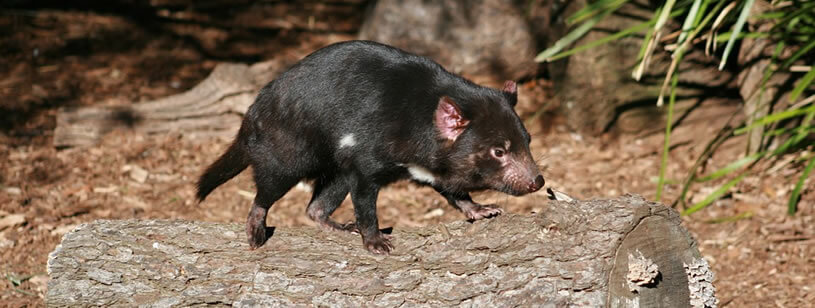
The Tasmanian devil (Sarcophilus harrisii) is the largest living carnivorous marsupial. Wild devils now live only on the island of Tasmania, where they hunt live prey and also eat a lot of carrion. Despite their loud screeches and fierce reputation, devils are shy and avoid people.
Tasmanian devils once lived across mainland Australia but disappeared there about 3,000 years ago. Today the species is Endangered, mainly because of devil facial tumour disease, a cancer spread by bites, as well as road deaths and other pressures.
By eating carcasses, including bones and fur, Tasmanian devils help clean up their environment.
Quick facts
| Common name | Tasmanian devil |
| Scientific name | Sarcophilus harrisii |
| Typical lifespan | About 5-6 years in the wild, up to about 7-8 years in captivity |
| Maximum speed | Trots at about 10-13 km/h; faster in short bursts |
| Length | About 50-65 cm (without tail) |
| Weight | About 6-12 kg (males are larger than females) |
| Diet type | Carnivore (scavenger and hunter) |
| Main predators | Adults have few; young may be taken by quolls, owls, eagles and other devils |
| Conservation status | Endangered |
| Distribution | Wild only in Tasmania, Australia; a small reintroduced population in a sanctuary in New South Wales |
| Habitat | Forests, woodlands, farmland, coastal areas |
- Primary category:Mammals
- Explore this animal's categories:
Interesting facts
- A record-breaking bite - For its size, the Tasmanian devil has one of the strongest bites of any living mammal, strong enough to crush bones.
- Scary noises - Devils screech, growl and scream, especially when several of them feed together on a carcass.
- Climbers and swimmers - Young devils climb trees well, and devils of all ages can swim across rivers.
- Fat in the tail - Healthy devils have thick tails, because they store fat there.
- Huge appetites - A devil can eat up to about 40% of its body weight in one meal.
- Red ears - When a devil is stressed or excited, its ears can turn bright red.
- Shy of people - Despite their fierce reputation, devils avoid people, but they may bite if cornered or handled.
- Tiny babies - Newborn devils are about the size of a grain of rice and stay in their mother's pouch for about 4 months.
- A cartoon star - Taz, the whirling Looney Tunes character, is based on the Tasmanian devil.
Records and remarkable features
- The Tasmanian devil is the largest living carnivorous marsupial.
- Its bite is one of the strongest of any mammal, compared with its body size.
- Devil facial tumour disease is one of the very few cancers known to spread from animal to animal.
Characteristics
The Tasmanian devil is a stocky carnivorous marsupial, about the size of a small dog. Its powerful jaws, loud calls and black coat make it one of the most distinctive mammals in the world.
Main physical characteristics:
- Size - Tasmanian devils are about 50-65 cm long, plus a tail of about 25 cm, and weigh about 6-12 kg; males are larger than females.
- Black fur - Most devils are black, often with white patches on the chest and rump.
- Big head and very strong jaws - Their powerful bite lets them crush bones and eat almost every part of a carcass, including fur and bones.
- Thick tail - Devils store fat in their tail, which shows how healthy they are.
- Short, strong legs - Their front legs are slightly longer than their back legs, giving them a rolling gait.
- Long whiskers - These help them find their way and sense other devils in the dark.
Special adaptations for survival:
- A wide gape - Devils can open their jaws very wide, to about 75-80 degrees.
- A keen nose - Their excellent sense of smell lets them find carrion from far away.
- Big meals - Their body is adapted to eat a lot when food is available, up to about 40% of their body weight in one meal.
- Tasmanian devils are not generally immune to disease or snake venom. Facial tumour disease is a major conservation threat.
- Threat displays - Growling, screeching and gaping are used to warn off rivals without fighting.
Habits and behaviour
Tasmanian devils live alone, but they will gather around a carcass to feed. They are mainly nocturnal and rely on their sense of smell and hearing to find food.
Social behaviour:
- Overlapping home ranges - Devils do not defend territories, but they mark their areas with scent and droppings.
- Group feeding - Although they live alone, several devils may feed together on a carcass, making a lot of noise.
- Noisy communication - Growls, screeches and screams help sort out who feeds first, usually without serious fighting.
- Threat postures - They open their mouths wide in a "yawn", which looks aggressive but is often a sign of fear or uncertainty.
- Rough mating - Males fight for females during the breeding season, and many devils carry bite scars.
Breeding season:
- Devils breed once a year, mainly in March, in the southern autumn.
- A female gives birth to 20 or more tiny young, but she has only four teats, so at most four can survive.
- The young stay in the pouch for about 4 months, then are left in a den while their mother hunts.
Defence and survival methods:
- Running - Devils can trot for long distances at about 10-13 km/h and run faster in short bursts.
- Dens - They rest in burrows, hollow logs, caves and thick vegetation.
- Hiding in the day - They are active mostly at night and spend the day hidden.
Habitat and geographic distribution
Wild Tasmanian devils live only on the island of Tasmania, south of mainland Australia. They once lived on the mainland too, but died out there about 3,000 years ago.
Habitat types:
- Forests and woodlands - Give them shelter and dens.
- Farmland - Devils often visit farms, where they find carrion and dead livestock.
- Mountains and rocky areas - They use burrows and caves for shelter.
- Coastal areas - Devils search beaches for dead fish, birds and other animals washed up by the waves.
Geographic distribution and estimated population:
| Region | Estimated population |
|---|---|
| Tasmania (Australia) | About 15,000-20,000 animals (estimate around 2020), down from well over 100,000 in the 1990s |
Impact of climate change and human activities:
- Devil facial tumour disease is a transmissible cancer that has caused major population declines; the scale differs between places and dates.
- Road deaths - Devils are often hit by cars, especially when they feed on animals killed on roads.
- Habitat loss - Clearing land reduces the places where devils can find dens.
- Conflict with farmers - In the past, devils were killed because farmers wrongly believed they killed many sheep.
The Tasmanian devil plays an important role in its ecosystem, cleaning up carcasses and helping to limit introduced predators such as feral cats.
Diet and feeding
The Tasmanian devil is a carnivore that both hunts and scavenges. By eating carcasses, it helps keep Tasmania's forests and fields clean.
Main food:
- Mammals - Wombats, wallabies, possums and small mammals, often as carrion.
- Birds and reptiles - Birds, snakes and lizards.
- Fish and invertebrates - Fish, frogs, insects and other small animals.
- Carrion - Dead animals are a large part of their diet, especially in winter.
Diet by season:
| Season | Type of food consumed |
|---|---|
| Spring | Young animals and birds, carrion |
| Summer | Carrion, small mammals, reptiles, insects |
| Autumn | Carrion, small marsupials, reptiles |
| Winter | Mainly carrion and larger prey |
Feeding methods:
- Efficient scavenging - Eating carrion helps them survive when prey is hard to catch.
- Bone crushing - Their strong jaws let them eat bones, fur and skin.
- Group feeding - Several devils may share a carcass, settling who eats first with noise and posturing.
- Fast eating - A devil can eat up to about 40% of its body weight in one meal.
Reproduction and life cycle
Tasmanian devils have short lives. Females give birth to many tiny young, but only the first four to reach a teat can survive.
Mating:
- Breeding season - Mainly March.
- Fights between males - Males compete aggressively for females.
- Guarding females - A male may stay with a female in her den for several days to keep other males away.
Gestation and birth:
- Pregnancy - About 21 days.
- Many young - Females give birth to about 20-30 tiny young, but only up to 4 can survive.
- Born blind and hairless - Newborns are about the size of a grain of rice and weigh less than half a gram.
The development of the young:
- The pouch is essential - Only 4 young can survive, because the female has only 4 teats.
- The young stay in the pouch for about 4 months, then are left in a den.
- Independence - At about 9 months, in the southern summer, they leave their mother.
- Sexual maturity - At about 2 years, they are ready to breed.
Longevity:
- In the wild - Usually about 5-6 years.
- In captivity - Up to about 7-8 years.
Name and history
Aboriginal Tasmanians have known the devil for thousands of years. Europeans first described it in the early 19th century.
Origin and etymology of the name:
- The name "Tasmanian devil" comes from its scary night-time screeches, which early European settlers thought sounded devilish.
- The scientific name Sarcophilus harrisii means "Harris's meat lover", after George Harris, who first described it.
Taxonomic classification:
| Taxonomic category | Name |
|---|---|
| Kingdom | Animalia |
| Phylum | Chordata |
| Class | Mammalia |
| Order | Dasyuromorphia |
| Family | Dasyuridae |
| Genus | Sarcophilus |
| Species | Sarcophilus harrisii |
Discovery and Documentation:
- Aboriginal knowledge - Aboriginal Tasmanians have lived alongside devils for tens of thousands of years; in the palawa kani language, the devil is called purinina.
- Scientific description - The surveyor George Harris described the devil in 1807, soon after the British settled Tasmania.
- Bounties - From the 1830s, devils were trapped and poisoned as pests, and bounties were paid for killing them.
- Protection - The Tasmanian devil was protected by law in 1941, and its numbers recovered.
The role of the Tasmanian devil in mythology and culture:
- Aboriginal culture - The devil is part of the traditional knowledge and stories of Aboriginal Tasmanians.
- Looney Tunes - Taz, first seen in 1954, is one of the most famous characters based on a real animal.
- A symbol of Tasmania - The devil appears on the logo of the Tasmania Parks and Wildlife Service and is widely used as a symbol of the island.
The Tasmanian devil is one of Australia's most iconic animals and a symbol of the fight to save threatened wildlife.
Cultural significance and mythology
The Tasmanian devil is important to Aboriginal Tasmanians, and in modern times it has become a symbol of Tasmania and of Australian wildlife conservation.
Tasmanian devil in mythology and beliefs:
- Aboriginal traditions - Aboriginal Tasmanians have their own names and stories for the devil, which they have known for thousands of years.
- Ancient mainland past - Fossils show that devils once lived across mainland Australia, where they disappeared about 3,000 years ago.
- A "devilish" reputation - European settlers feared the devil because of its screams, black colour and red ears, and wrongly thought it was very dangerous.
Tasmanian devil symbolism:
- Strength - The devil is seen as a tough animal that can survive hard conditions.
- Fearlessness - In modern culture, the devil is a symbol of Tasmania's bold, independent spirit.
- Survival - Its fight against facial tumour disease has made it a symbol of conservation.
Conservation status and threats
The Tasmanian devil is listed as Endangered. Facial tumour disease is a major threat, alongside other pressures.
Conservation status
- Once common - In the mid-1990s, there were probably well over 100,000 Tasmanian devils.
- Big decline - Since the disease was first seen in 1996, the population has fallen by about 80% overall, and by more in some areas.
Main threats:
- Facial tumour disease can be transmitted through biting and has caused severe declines in affected populations.
- Habitat loss - Clearing land for farms and towns reduces the space devils need.
- Road deaths - Many devils are hit by cars while feeding on roadkill.
- Persecution - Some devils are still killed illegally, although they are protected.
- Climate change - Changes in weather and more bushfires can affect their habitat and food.
Conservation efforts:
- Breeding programmes - The Save the Tasmanian Devil Program and zoos, including Aussie Ark (Devil Ark) in New South Wales, keep healthy devils to protect the species.
- Island populations - In 2012, healthy devils were released on Maria Island, off Tasmania, to create a disease-free population.
- Research - Scientists are studying the disease and working on a vaccine.
- Back to the mainland - In 2020, devils were released into a large fenced sanctuary in New South Wales, their first return to the mainland in about 3,000 years.
In popular culture
The Tasmanian devil is one of Australia's most famous animals and appears in cartoons, games, logos and sport.
Tasmanian devils in literature:
- Tasmanian Devil: A Unique and Threatened Animal (David Owen and David Pemberton, 2005) - A book about the devil's biology, history and threats.
- Children's books - Devils often appear in Australian children's books about wildlife.
Tasmanian devils in cinematography and television:
- Taz-Mania (1991-1995, Warner Bros.) - An animated series about Taz and his family.
- Documentaries - Many wildlife documentaries have shown the fight against devil facial tumour disease.
Tasmanian devils in video games and comic books:
- Taz: Wanted (2002) - A video game starring Taz.
- Looney Tunes - Taz, the Tasmanian Devil, first appeared in the cartoon Devil May Hare (1954) and became one of the most popular characters.
- Comics - Taz has also appeared in many Looney Tunes comics.
Tasmanian devils in sports and emblem:
- A symbol of Tasmania - The devil appears on souvenirs, logos and tourist materials.
- Tasmania Devils - Tasmania's new Australian rules football club, due to join the AFL in 2028, is named after the devil.
- Tourism - Wildlife parks in Tasmania show devils to visitors and teach them about conservation.
Tasmanian devils in music and art:
- Wildlife art - Devils are popular subjects for Australian artists and photographers.
- Conservation campaigns - Devil images are used to raise money for the fight against facial tumour disease.