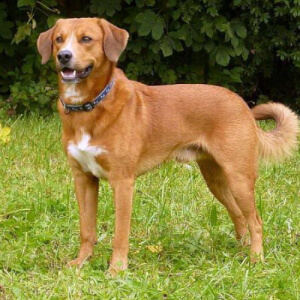
Austrian PinscherCharacteristics, history, training and care
The Austrian Pinscher (Österreichischer Pinscher) is a medium-sized, stocky, powerful dog. For centuries it guarded farms in Austria and kept them free of rats. The FCI standard describes it as lively, alert, playful and very devoted to its family. With strangers it is suspicious and an unshakeable guard.
Quick facts
| Common name | Austrian Pinscher (Österreichischer Pinscher) |
| Scientific name | Canis lupus familiaris |
| Country of origin | Austria |
| Official recognition | FCI, definitively since 4 September 1954 (group 2, pinschers and schnauzers; standard no. 64) |
| Lifespan | No published data for the breed; medium-sized breeds usually live 12–14 years |
| Size (males) | 44–50 cm at the withers |
| Size (females) | 42–48 cm at the withers |
| Coat type | Double, dense, short or medium-length, smooth |
| Common colours | Golden yellow, brownish yellow, stag red, black and tan; with white markings |
| Energy level | High |
| Suited to an apartment? | Better suited to a house with a yard |
| Temperament | Lively, alert, playful, devoted, suspicious of strangers |
| Tendency to aggression | Average towards strangers; a determined guard |
| Good with children | Good with the family's children |
| Good with other animals | Good; its hunting instinct is weak |
| Genetic predispositions | No health data for the breed |
- Primary category:Dog breeds
- Explore this animal's categories:
History and origin
The FCI standard says the breed comes from the old Austrian country pinschers, modest all-round farm dogs. They were still widespread in the second half of the 19th century. They kept stables free of rats, guarded the house and helped drive cattle.
When their work was no longer needed, the dogs began to disappear. In 1921, Emil Hauck began planned breeding of the breed. On 16 October 1928, the Austrian kennel club recognised it under the name Austrian Short-haired Pinscher.
In 2000, the breed was given its present name, Austrian Pinscher. According to Wikipedia, the Arche Austria association considers it highly endangered, with a small number of breeding animals. The breed is related to the German Pinscher.
How the breed developed
- Second half of the 19th century – Country pinschers are still widespread.
- 1921 – Planned breeding begins.
- 16 October 1928 – Recognised by the Austrian kennel club.
- 4 September 1954 – Definitive FCI recognition.
- 2000 – It is given the name Austrian Pinscher.
Breed rating
| Feature | Stars |
|---|---|
| Training and intelligence | ★★★☆☆ |
| Easy to train | ★★★☆☆ |
| Intelligence | ★★★★☆ |
| Independence | ★★★☆☆ |
| Stubbornness | ★★★☆☆ |
| Behaviour and temperament | ★★★★☆ |
| Affectionate with family | ★★★★★ |
| Friendly with children | ★★★★☆ |
| Good with other dogs | ★★★☆☆ |
| Good with cats and other animals | ★★★☆☆ |
| Loyalty | ★★★★★ |
| Tendency to be aggressive | ★★★☆☆ |
| Tendency to bark | ★★★★☆ |
| Needs and care | ★★★☆☆ |
| Shedding | ★★★☆☆ |
| Needs frequent grooming | ★★☆☆☆ |
| Activity and lifestyle | ★★★☆☆ |
| Energy level | ★★★★☆ |
| Daily exercise needs | ★★★★☆ |
| Suited to apartment life | ★★☆☆☆ |
| Health and longevity | ★★★☆☆ |
| Life expectancy | ★★★★☆ |
| Predisposition to genetic diseases | ★★☆☆☆ |
| Working abilities and uses | ★★★★★ |
| Good guard dog | ★★★★★ |
| Good companion dog | ★★★★☆ |
Indicative rating: 5 stars means the highest level. The breed has no AKC profile; the rating is based on the FCI standard and on Wikipedia.
Physical characteristics
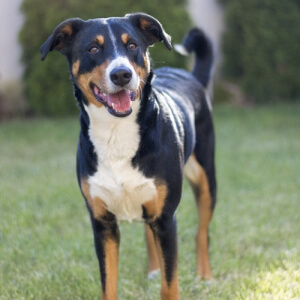
The FCI standard describes it as a stocky, medium-sized dog with a lively, bright expression. The head is pear-shaped, with a broad skull. The ears are small and carried as button or rose ears. The chest is broad and deep.
General appearance
The coat is double and dense. The outer coat is short or medium-length, dense, smooth and close-lying, and the undercoat is dense and short. On the thighs, the hair forms small “trousers”.
| Feature | Austrian Pinscher |
|---|---|
| Size | Medium |
| Height at the withers | males: 44–50 cm; females: 42–48 cm (FCI) |
| Weight | Not given in the FCI standard |
| Coat | Double, short or medium-length |
| Colour | Shades of yellow and red, or black and tan |
| Ears | Small, button ears |
The standard accepts golden yellow, brownish yellow, stag red and black and tan. White markings on the chest, muzzle, throat, nape, feet and tail tip are allowed, but not required.
Training and socialisation
The standard describes it as determined, lively, alert and playful, very devoted and friendly with the people it knows. It learns quickly, but has a strong personality and needs a consistent owner.
As it is suspicious of strangers, early socialisation matters a great deal. Used to new people from an early age, it remains an alert watchdog, but without overreacting.
Tips for effective training
- Socialise it early. It is suspicious of strangers.
- Be consistent. It has a strong personality.
- Use rewards. It learns quickly.
- Teach it a command to settle. It announces every visitor.
Activity needs and lifestyle
It was created for farm work, so it needs exercise and activity every day. It enjoys long walks, play and simple tasks. According to Wikipedia, it is “a pleasant companion” for rural areas and the edges of towns.
| Activity | How often | Why it matters |
|---|---|---|
| Long walks | daily | Fitness |
| Play and training | daily | A busy mind |
| Guarding the yard | daily | Watchdog instinct |
Tips for a balanced life
- Ideal for a house with a yard.
- A secure fence.
- Include it in family life.
Care and health
Coat and skin care
The short, dense coat is brushed once a week. During the moult, when the undercoat falls out, it needs brushing more often.
Common health problems
According to Wikipedia, no health data have been collected for the breed, but good health is a stated aim of breeders in Austria. Because of the small number of animals, breeders try to avoid mating close relatives. As with any medium-sized breed, it is worth watching for:
| Condition | Description | Common symptoms |
|---|---|---|
| Hip dysplasia | The hip joint forms incorrectly and, over time, arthritis develops | Limping, difficulty getting up or jumping, hip pain |
Other care
- Ask for the parents' hip tests.
- Check its teeth.
- Go for yearly check-ups.
Diet and nutrition
An active farm dog needs good-quality food suited to its age and activity.
Tips for a healthy diet
The table gives a starting estimate, calculated with the formula from the Merck Veterinary Manual. The first two calorie columns show the calories per day for a healthy adult dog. The last column shows what this means in dry food with 3,500–4,000 kcal per kilogram.
| Dog's weight | Calories per day (neutered) | Calories per day (not neutered) | Dry food per day (approximate) |
|---|---|---|---|
| 12 kg | 720 kcal | 810 kcal | 180–230 g |
| 15 kg | 850 kcal | 960 kcal | 210–270 g |
| 18 kg | 980 kcal | 1,100 kcal | 240–310 g |
- Split the food into two meals a day.
- The weights in the table are a guide only; the standard does not give a weight.
- A dog is at the right weight when you can feel its ribs under the coat without pressing hard.
Foods to avoid
Some human foods are dangerous for dogs: chocolate, coffee, grapes and raisins, onions, garlic, xylitol (a sweetener used in chewing gum), macadamia nuts and alcohol.
Reproduction and development
Physical and emotional maturity
In dogs, sexual maturity usually comes between 6 and 12 months. Most breeds become adults at around 13–15 months.
Mating and pregnancy
Pregnancy lasts about 63 days, counted from ovulation. Mating a female on her first heat is not recommended. The FCI standard requires that only healthy dogs of typical breed appearance are used for breeding.
Caring for the puppies
In dogs, a litter has 5–6 puppies on average, and the number rises with the size of the breed. Socialisation starts in the first weeks: gentle handling, everyday noises and new people.
Interesting facts
- A very rare breed. Arche Austria considers it highly endangered.
- It changed its name. Until 2000 it was called the Austrian Short-haired Pinscher.
- It hunts little. The standard says its hunting instinct is weak.
- An incorruptible guard. That is how the standard describes it.
- An all-round farm dog. It caught rats, kept guard and drove cattle.
Frequently asked questions
Is it a good guard dog?
Yes; the standard calls it an incorruptible guard towards strangers.
Does it get on with other animals?
Usually yes; its hunting instinct is weak.
How big does it get?
Males measure 44–50 cm at the withers and females 42–48 cm.
Is it hard to find?
Yes; it is a rare breed, bred mainly in Austria.