HyenaInteresting facts and information
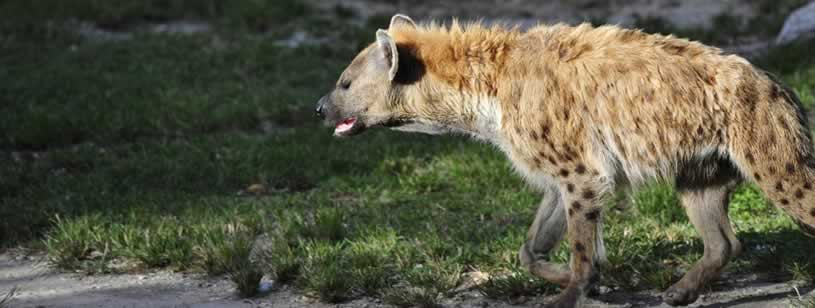
Hyenas are carnivorous mammals in the family Hyaenidae. The family includes spotted, striped and brown hyenas and the aardwolf. Their diets and social lives differ; the aardwolf feeds mainly on termites.
There are four living species in the hyena family:
- The spotted hyena (Crocuta crocuta) - The largest and most powerful, it lives in Africa and is known for its complex social life.
- The striped hyena (Hyaena hyaena) - Smaller, found in North and East Africa, the Middle East and India.
- The brown hyena (Parahyaena brunnea) - Lives in southern Africa and is shy and secretive.
- The aardwolf (Proteles cristata) — an insect-eating member of the hyena family that feeds mainly on termites.
Hyenas play a key role in their ecosystems, cleaning up carcasses and helping to keep nature in balance. Despite their bad reputation, they are intelligent, organised and highly adaptable.
Quick facts
| Common name | Hyena |
| Scientific name | Hyaenidae |
| Typical lifespan | About 12-25 years in the wild, depending on species; up to about 30 years in captivity |
| Maximum speed | Up to about 60 km/h (spotted hyena) |
| Dimensions | About 85 - 165 cm long, 65 - 90 cm tall at the shoulder |
| Weight | About 25 - 85 kg (depending on species); the aardwolf is much smaller |
| Diet type | Carnivore (hunter and scavenger); the aardwolf eats termites |
| Main predators | Lions, humans |
| Conservation status | Spotted hyena and aardwolf: Least Concern; striped and brown hyenas: Near Threatened |
| Distribution | Africa, the Middle East, Central and South Asia |
| Habitat | Savanna, dry woodland, semi-desert |
- Primary category:Mammals
- Explore this animal's categories:
Interesting facts
- Spotted hyenas have strong jaws and teeth adapted to processing animal food, including bones.
- Females are in charge - Unlike most carnivores, spotted hyenas live in female-led groups, and females are usually larger and more aggressive than males.
- Their "laughter" has a purpose - The famous giggling calls are made in situations of excitement or frustration and can reveal an animal's age and social rank.
- They have extremely efficient stomachs - Spotted hyenas can digest bones and even skin, leaving very little of their prey behind.
- They are not dogs - Although they look dog-like, hyenas are more closely related to cats, civets and mongooses.
- They compete with lions - Hyenas are not just scavengers: they often steal food from lions, but lions also steal many kills from hyenas.
- They adapt quickly - Some hyenas live close to towns and villages, where they feed on rubbish and sometimes livestock.
- Female spotted hyenas have unusual anatomy - Their external genitals look very similar to a male's, which makes it hard to tell the sexes apart.
Records and remarkable features
- Hyenas are carnivorous mammals in the family Hyaenidae. The family includes spotted, striped and brown hyenas and the aardwolf. Their diets and social lives differ; the aardwolf feeds mainly on termites.
Characteristics
Hyenas are sturdy, adaptable carnivores with bodies built both for hunting and for scavenging. Although they look like dogs, they are more closely related to cats and mongooses.
Main physical features:
| Feature | Spotted hyena (Crocuta crocuta) | Striped hyena (Hyaena hyaena) | Brown hyena (Parahyaena brunnea) | Aardwolf (Proteles cristata) |
|---|---|---|---|---|
| Length (head and body) | About 95 - 165 cm | About 85 - 130 cm | About 110 - 135 cm | About 55 - 80 cm |
| Height at the shoulder | About 70 - 90 cm | About 60 - 80 cm | About 70 - 80 cm | About 40 - 50 cm |
| Weight | About 40 - 85 kg | About 25 - 55 kg | About 35 - 50 kg | About 7 - 12 kg |
| Lifespan in the wild | Up to about 20-25 years | About 12 - 16 years | About 12 - 18 years | About 10 - 15 years |
Special adaptations:
- Powerful jaws - Hyenas can crush and digest bones, getting calcium and other nutrients from them.
- A sloping back - Their front legs are longer than their back legs, which gives them a distinctive shape and an efficient, tireless gait.
- Coats for different purposes - Spotted hyenas have spots, while striped and brown hyenas have long hair along the neck and back, which they raise to look bigger.
- Scent glands - A gland under the tail produces a strong-smelling paste used for marking territory and communication.
- Dominant females - In spotted hyenas, females are larger and higher-ranking than males, which is very unusual among mammals.
Habits and behaviour
Hyenas are social animals, but their behaviour varies between species. Spotted hyenas form large clans, while striped and brown hyenas usually forage alone.
Social behaviour:
- Spotted hyenas live in large clans - These groups can include more than 80 animals, with a hierarchy dominated by females.
- Striped and brown hyenas forage alone - They may live in small family groups but usually search for food on their own.
- Females lead spotted hyena clans - They control access to food and outrank every male.
Hunting and feeding:
- Skilled group hunters - Contrary to their reputation, spotted hyenas are excellent hunters and catch most of their own food.
- They eat almost all of their prey - Their powerful digestion lets them eat bones, tendons and skin, leaving very little behind.
- They steal food - Hyenas can steal prey from lions and leopards, but lions also steal food from hyenas.
Defence and survival:
- Endurance runners - Spotted hyenas can run at up to about 60 km/h and keep up a steady pace over long distances, tiring out their prey.
- Strength in numbers - A large group of hyenas can even drive lions away from a carcass.
- Scent marking - Hyenas mark their territory with paste from their scent glands and with dung, which helps avoid conflicts with neighbouring clans.
Hyenas are extremely tough and adaptable, living in savannas, mountains and even on the edges of towns.
Habitat and geographic distribution
Hyenas live in Africa, the Middle East and parts of Asia, in habitats ranging from open savanna to dry woodland and semi-desert.
Habitat types:
| Habitat | Main species |
|---|---|
| Open savanna | Spotted hyena (Crocuta crocuta) |
| Semi-desert | Brown hyena (Parahyaena brunnea), striped hyena (Hyaena hyaena) |
| Mountains and dry woodland | Striped hyena (Hyaena hyaena) |
| Edges of towns and villages | Spotted hyena (often seen near people, for example in Ethiopia) |
Geographic distribution:
- Sub-Saharan Africa - Spotted hyenas live in savannas from Kenya and Tanzania to Namibia and South Africa.
- North Africa and the Middle East - Striped hyenas live in dry areas from Morocco and Egypt to Arabia and Iran.
- South Asia - Striped hyenas also live in India and Pakistan, but in small numbers.
- Southern Africa - Brown hyenas live in deserts and semi-deserts, including the Kalahari and the Namib coast.
Impact of climate change and human activities:
- Habitat loss - Towns and farms reduce the space available to hyenas.
- Killing and poisoning - Farmers sometimes kill hyenas because they see them as a threat to livestock.
- Drought - Droughts reduce prey numbers and so the food available to hyenas.
- Conflict with people - Spotted hyenas are attracted to rubbish dumps and villages, which increases the risk of dangerous encounters.
Although hyenas are tough animals, their numbers are falling in some regions, and conservation measures are needed to prevent further declines.
Diet and feeding
Hyenas are opportunistic carnivores with a varied diet: they are both active hunters and scavengers. Although they are known for eating carrion, spotted hyenas are very efficient predators.
Types of food:
| Food group | Examples |
|---|---|
| Large mammals | Zebras, wildebeest, antelopes, buffalo calves |
| Smaller animals and birds | Hares, porcupines, birds such as flamingos |
| Carrion | Leftovers from other predators' kills |
| Bones and tendons | Eaten thanks to their powerful jaws |
| Fruit and plants | Occasionally; brown hyenas eat wild melons for water |
| Insects | Termites are the main food of the aardwolf (Proteles cristata). |
Feeding methods:
- Group hunting - Spotted hyenas work as a team to chase and tire out their prey.
- Eating bones - Unlike most other carnivores, hyenas can eat almost an entire animal, including much of the skeleton.
- Competitive feeding - In a clan, social rank decides who eats first.
- Feeding at night - Hyenas often hunt and look for food after dark.
Reproduction and life cycle
Hyenas have complex breeding systems, especially spotted hyenas, in which females dominate males and choose their mates.
Life cycle stages:
| Stage | Approximate timing | What happens |
|---|---|---|
| Pregnancy | About 90 - 110 days | Females give birth in dens, often in burrows. |
| Newborn cubs | 0 - 3 months | Spotted hyena cubs are born with their eyes open and their front teeth already through. |
| Young | 3 - 12 months | They start learning to hunt and to find their place in the clan. |
| Young adult | 1 - 3 years | They take their place in the social hierarchy. |
| Maturity | About 2 - 4 years | Females choose their mates; young males usually leave to join another clan. |
Reproductive behaviour:
- Female spotted hyenas are dominant - They are larger and more aggressive than males and decide when and with whom they mate.
- Cubs are born with open eyes and teeth - Unlike most carnivores.
- Sibling rivalry - Spotted hyena cubs often fight each other from birth to establish dominance, and the weaker cub sometimes dies.
Hyenas breed slowly and many cubs die young, which makes their populations vulnerable to decline.
Name and history
Hyenas have been known since ancient times and are described in Egyptian, Greek and Roman texts. Their name comes from Greek.
Origin of the name:
- The word "hyena" comes from the Greek hyaina, which is related to hys, "pig", perhaps because of the bristly mane along its back.
- The scientific name Hyaenidae is used for the whole hyena family.
Taxonomic classification:
| Taxonomic rank | Name |
|---|---|
| Kingdom | Animalia |
| Phylum | Chordata |
| Class | Mammalia |
| Order | Carnivora |
| Family | Hyaenidae |
| Genera | Crocuta, Hyaena, Parahyaena, Proteles |
The hyena in history and culture:
- Ancient Egypt - Egyptian tomb pictures show hyenas being kept and force-fed, possibly to be eaten.
- Ancient Greece and Rome - Hyenas were seen as mysterious animals, and writers recorded many strange beliefs about them.
- The European Middle Ages - People believed hyenas could imitate the human voice to lure victims.
- African traditions - In some cultures, hyenas are linked with witchcraft and evil, while in others they are respected as cleaners of the land.
Hyenas have often been misunderstood, but modern research has shown their intelligence and ecological importance.
Cultural significance and mythology
Throughout history, hyenas have been viewed with superstition and fascination and have a mixed reputation in many cultures. Some peoples see them as symbols of cleverness and survival, while others link them with treachery and greed.
The hyena in myths and beliefs:
- Ancient Egypt - Hyenas were kept by people and were also linked with death and the desert.
- Africa - In some traditions, hyenas are seen as evil spirits or witches' mounts, while in others they are respected as animals that clean the land of carcasses. In Harar, Ethiopia, people have fed hyenas by hand for generations.
- The Middle East and Persia - People believed hyenas could hypnotise humans and that parts of their bodies had magical powers.
- Medieval Europe - It was said that hyenas imitated the human voice to lure people into the wild.
- India and Pakistan - The striped hyena appears in folk tales as a mysterious and cunning creature.
What the hyena symbolises:
- Cleverness and opportunism - It is often seen as a survivor in difficult environments.
- Two sides - Sometimes seen as a treacherous villain, sometimes as an intelligent strategist.
- Strength and endurance - The ability to survive in harsh conditions.
Conservation status and threats
Hyenas are important predators and scavengers in African ecosystems, but they face serious threats from habitat loss and conflict with people.
Conservation status
| Species | Status (IUCN) |
|---|---|
| Spotted hyena (Crocuta crocuta) | Least Concern (declining outside protected areas) |
| Striped hyena (Hyaena hyaena) | Near Threatened |
| Brown hyena (Parahyaena brunnea) | Near Threatened |
| Aardwolf (Proteles cristata) | Least Concern |
Main threats:
- Habitat loss - The spread of farms and settlements reduces the natural areas hyenas need.
- Killing and poisoning - Farmers kill hyenas because they see them as a danger to livestock.
- Hunting for body parts - In some cultures, hyena body parts are used in traditional medicine and rituals.
- Less prey - Declines in wild herbivores also affect hyenas.
Conservation efforts:
- National parks and reserves - Protected areas in countries such as Kenya, Tanzania and South Africa protect hyena habitat.
- Legal protection - Killing hyenas is illegal or restricted in many countries.
- Community programmes - Farmers are helped to protect their livestock without killing predators, for example with stronger night enclosures.
Hyenas are not in immediate danger of extinction, but their numbers are falling, especially outside protected areas.
In popular culture
Hyenas in literature:
- Folk tales - In many African stories, the hyena is a greedy, foolish character who is often tricked by the hare.
- Nature books - Hyenas often appear in books about wildlife behaviour, which have helped correct their bad reputation.
Hyenas in film and television:
- The Lion King (Disney, 1994) - Shenzi, Banzai and Ed are the villainous hyenas who serve Scar.
- Wildlife documentaries - Films about the African savanna often show the rivalry between hyenas and lions.
Hyenas in video games:
- World of Warcraft - Hyenas appear as enemies and as companions for hunters.
The hyena as a cultural symbol:
- A symbol of cunning and opportunism - In many cultures, the hyena is cast as a villain.
- A respected animal in some African communities - It stands for strategy and survival.
- Online culture - Videos of "laughing" hyenas are popular on the internet.