OcelotLeopardus pardalis — habitat, diet and reproduction
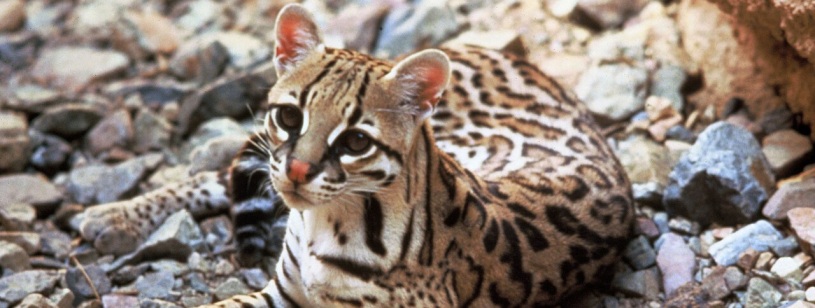
Ocelot with elongated black-bordered spots and rounded ears. · Tom Smylie / U.S. Fish and Wildlife Service / Wikimedia Commons / Public domain (https://commons.wikimedia.org/wiki/Template:PD-USGov-FWS). Cropped and resized. Source: https://commons.wikimedia.org/wiki/File:Ocelot.jpg
The ocelot (Leopardus pardalis) is an American wild cat with dark spots and streaks. It moves through dense vegetation, hunting mostly at night. Small mammals and birds form much of its varied diet. Although an able climber, it often searches for food on the ground.
Quick facts
| Common name | Ocelot |
| Scientific name | Leopardus pardalis |
| Lifespan | Can reach around 10 years in the wild and 20 in captivity |
| Length | Approximately 65–97 cm head and body; tail 30–50 cm |
| Weight | Approximately 8.5–16 kg |
| Diet | Mammals, birds, reptiles and other animals |
| Predators | Jaguars, pumas, harpy eagles and large snakes, depending on region |
| Conservation status | Least Concern globally; some local populations are threatened |
| Distribution | Southern USA through Mexico and Central America into South America |
| Habitat | Tropical forest, dense scrub, mangroves and wetland edges |
| Family | Felidae |
| Reproduction | Usually 1–2 kittens; gestation around 2.5–3 months |
- Primary category:Felids
- Explore this animal's categories:
Interesting facts
- Individual coat patterns help researchers recognise different cats.
- Ocelots are capable swimmers and may hunt near water.
- Tree branches sometimes provide daytime resting sites.
- Scent marks along trails convey information to other ocelots.
Records and extremes
The ocelot is the largest member of Leopardus, a genus of American wild cats. Males are usually larger than females. Broad paws support climbing and quiet movement.
Conservation sources describe captive lifespans reaching around 20 years. Wild survival depends on habitat, food and local hazards.
Characteristics
Short fur ranges from greyish to yellowish or reddish brown. Black-bordered spots often form elongated chains, blending with light and shade among leaves.
The pale underside contrasts with dark cheek stripes. Rounded ears have dark backs and pale markings. Rings or bars cross the tail.
A flexible, sturdy body and retractile claws support climbing and prey capture. Hearing, vision and smell help locate food.
Behaviour
Adults generally live alone, though interactions also occur outside breeding. Male ranges tend to be larger, and both sexes leave scent marks.
Activity is mainly nocturnal but varies with prey and disturbance. Cloudy conditions may encourage daytime activity. Resting sites include thickets, ground shelters and trees.
Slow walking and pauses allow careful scanning. An ocelot may wait beside a prey route before approaching and attacking.
Habitat and distribution
The range extends from the southern USA through Mexico and Central America into much of South America. Northern populations are small and isolated.
Tropical forests, mangroves and dense scrub provide essential cover. Vegetated waterways and other narrow connections can link suitable areas.
Amazonian forests support ocelots within a diverse predator community. In Texas, remaining thornscrub is particularly important for movement and shelter.
Diet and feeding
Mice, rats, opossums, birds, lizards and snakes are common foods. Larger prey can include agoutis, pacas and armadillos. Regional and seasonal variation is substantial.
Fish and crabs may be caught near water. Small prey is frequent, while larger animals can contribute considerable food.
Hunting combines slow searches, waiting and stalking. A large kill may be covered and revisited for another meal.
Reproduction and life cycle
Birth occurs in a hollow tree, rocky shelter or secluded thicket. Gestation lasts roughly two and a half to three months, usually producing 1–2 kittens.
Kittens already have spotted coats. Their eyes open at around two weeks, and the mother may move them between dens.
Exploration and play develop into hunting practice. Young may remain associated with the maternal territory towards two years. Slow development influences population recovery.
Name and history
Carl Linnaeus described the species in 1758 as Felis pardalis. It is now classified in Leopardus within the cat family, Felidae.
Regional names such as tigrillo may refer to several spotted cats. Body size, tail proportions and coat pattern help distinguish the species.
Conservation and threats
The global status is Least Concern, but habitat loss and isolation affect local populations. Conservation in the southern USA focuses on a very small population.
Roads kill animals and separate habitat patches. Historical fur hunting caused heavy losses, while capture and conflict remain concerns in some regions.
Recovery plans include restoring scrub and reconnecting habitat. Wildlife crossings, suitable fencing and vegetation can offer safer routes across roads.
Frequently asked questions
Is it a young jaguar?
It is a separate, smaller species in the genus Leopardus.
Where does it find food?
Mostly on the ground, but also in trees and near water.
What do the markings do?
They help conceal the animal among light and shadow in vegetation.
How many kittens are born?
Usually 1–2, raised by the female.
Can it climb?
Yes. Ocelots climb well and sometimes rest in trees.
Is it rare everywhere?
Its global status is Least Concern, but some populations are small and isolated.