WhippetCharacteristics, history, training and care
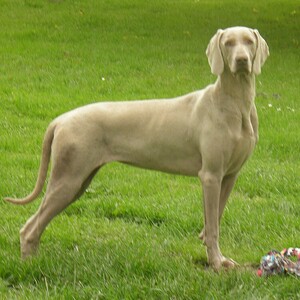
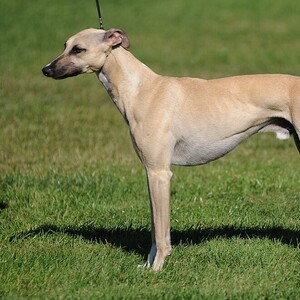
Whippet. · Winky / Wikimedia Commons, CC BY 2.0. Cropped and resized.
The Whippet is a medium-sized British sighthound, between the Greyhound and the Italian Greyhound in size. Wikipedia says it has the highest speed for its weight and size and the fastest acceleration of any dog, and in the 19th century it was called “the poor man's racehorse”. The FCI standard describes it as an ideal companion, highly adaptable, gentle, affectionate and even-tempered.
Quick facts
| Common name | Whippet |
| Scientific name | Canis lupus familiaris |
| Country of origin | United Kingdom |
| Official recognition | FCI, definitively since 27 April 1955 (group 10, sighthounds; standard no. 162); also recognised by the AKC |
| Lifespan | 12–15 years, according to the AKC |
| Size (males) | 47–51 cm at the withers; 11–18 kg according to the AKC |
| Size (females) | 44–47 cm at the withers |
| Coat type | Fine, short and close, without undercoat |
| Common colours | Any colour or mixture, except merle |
| Energy level | High outdoors, calm in the house |
| Suited to an apartment? | Yes, with regular running |
| Temperament | Gentle, affectionate, even-tempered, adaptable |
| Tendency to aggression | Very low |
| Good with children | Very good, according to the AKC |
| Good with other animals | Very good with dogs; chases small animals |
| Genetic predispositions | A generally healthy breed; sensitive to cold |
- Primary category:Dog breeds
- Explore this animal's categories:
History and origin
Wikipedia says sighthounds of different sizes have been mentioned since the Middle Ages. At the beginning of the 15th century, Edward of Norwich, second Duke of York, wrote about the usefulness of “great, middle and small” greyhounds. In the 16th century, the physician John Caius described the “tumbler”, a small crossbred sighthound, excellent at catching rabbits, which is linked to the Whippet.
The name “Whippet” comes from a 17th-century term meaning “to move briskly”. In the Victorian era, English writers described the new breed, also called the “snap-dog” because it quickly “snapped up” its prey, used for catching rabbits, for coursing and straight-track racing, and at shows.
How the breed developed
- Beginning of the 15th century – Edward of Norwich writes about small greyhounds.
- 16th century – John Caius describes the “tumbler”.
- Victorian era – The modern breed takes shape.
- 27 April 1955 – The FCI recognises the breed.
Breed rating
| Feature | Stars |
|---|---|
| Training and intelligence | ★★★☆☆ |
| Easy to train | ★★★★★ |
| Intelligence | ★★★★★ |
| Independence | ★★★★☆ |
| Stubbornness | ★★★★☆ |
| Behaviour and temperament | ★★★☆☆ |
| Affectionate with family | ★★★★★ |
| Friendly with children | ★★★☆☆ |
| Good with other dogs | ★★★☆☆ |
| Good with cats and other animals | ★★★☆☆ |
| Loyalty | ★★★★☆ |
| Tendency to be aggressive | ★★☆☆☆ |
| Tendency to bark | ★★★★★ |
| Needs and care | ★★★☆☆ |
| Shedding | ★★★★☆ |
| Needs frequent grooming | ★★★☆☆ |
| Activity and lifestyle | ★★★☆☆ |
| Energy level | ★★★★☆ |
| Daily exercise needs | ★★★★☆ |
| Suited to apartment life | ★★★☆☆ |
| Health and longevity | ★★★★☆ |
| Life expectancy | ★★★★☆ |
| Predisposition to genetic diseases | ★☆☆☆☆ |
| Working abilities and uses | ★★★★★ |
| Good companion dog | ★★★★☆ |
| Good companion dog | ★★★★☆ |
Indicative rating: 5 stars means the highest level. It is based on the ratings the American Kennel Club gives the breed and on the FCI standard.
Physical characteristics
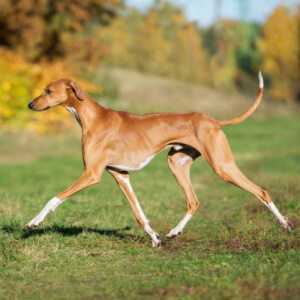
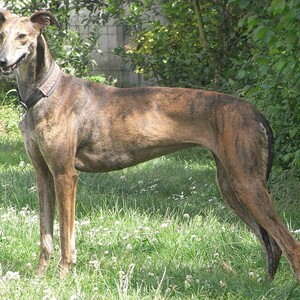
The standard describes it as a balanced combination of muscular power and elegance. The AKC says it looks like a smaller Greyhound, with the classic sighthound “reverse S” lines: a deep chest, a slim waist, a lean head on a long, arched neck and slender but solid legs.
General appearance
The coat is fine, short and close. Wikipedia says it has no undercoat and sheds little, but its short coat and low body fat make it sensitive to cold.
| Feature | Whippet |
|---|---|
| Size | Medium |
| Height at the withers | males: 47–51 cm; females: 44–47 cm |
| Weight | 11–18 kg (AKC) |
| Coat | Fine, short |
| Speed | Very high |
| Type | Sighthound |
The standard accepts any colour or mixture of colours, except merle.
Training and socialisation
The standard describes it as an ideal companion, highly adaptable at home and in sport, gentle, affectionate and even-tempered. The AKC says it is calm at home and saves its energy for explosive bursts of running.
The AKC says the puppies are clever, agile and mischievous, jumping and climbing, so they must be kept safe when unsupervised. Early socialisation and puppy classes are recommended.
Tips for effective training
- Always keep it on a lead. The AKC says: on a lead outside fenced areas.
- Be gentle. It is sensitive.
- Supervise the puppies. They jump and climb.
- Give it a coat in winter. It is sensitive to cold.
Activity needs and lifestyle
The AKC says the Whippet is a born sprinter. A few sessions a week of brisk fetch with a ball or disc, regular walks or play with another dog in a well-fenced area are enough. Lure coursing and agility suit it very well.
| Activity | How often | Why it matters |
|---|---|---|
| Walks | daily | Fitness |
| Sprinting in a fenced area | several times a week | Sighthound instinct |
| Lure coursing or agility | occasionally | Fun |
Tips for a balanced life
- It can also live in an apartment.
- A coat in cold weather.
- The fence must be high.
Care and health
Coat and skin care
The AKC says the short, smooth coat needs little grooming: a weekly brush and the occasional bath. The ears should be checked regularly, and the nails trimmed often if they do not wear down naturally.
Common health problems
The AKC says the Whippet is generally healthy and robust. Wikipedia adds that it is free of many of the hereditary diseases of other breeds. Things to watch for:
| Condition | Description | Common symptoms |
|---|---|---|
| Sensitivity to cold | Short coat and little fat | Shivering, seeking warmth |
| Running injuries | The thin skin tears easily | Scratches, cuts |
Other care
- Tell the vet it is a sighthound before any anaesthetic.
- Trim the nails regularly.
- Check the skin after running.
Diet and nutrition
The AKC says its build is not made for extra kilos. An adult should not look emaciated, but two to four vertebrae should be visible, and the hip bones should not be buried in fat.
Tips for a healthy diet
The table gives a starting estimate, calculated with the formula from the Merck Veterinary Manual. The first two calorie columns show the calories per day for a healthy adult dog. The last column shows what this means in dry food with 3,500–4,000 kcal per kilogram.
| Dog's weight | Calories per day (neutered) | Calories per day (not neutered) | Dry food per day (approximate) |
|---|---|---|---|
| 11 kg | 680 kcal | 760 kcal | 170–220 g |
| 14 kg | 810 kcal | 910 kcal | 200–260 g |
| 18 kg | 980 kcal | 1,100 kcal | 240–310 g |
- Do not let it run right after a meal.
- Treats count towards the daily portion.
- In a sighthound, some vertebrae may be easy to see; this is normal.
Foods to avoid
Some human foods are dangerous for dogs: chocolate, coffee, grapes and raisins, onions, garlic, xylitol (a sweetener used in chewing gum), macadamia nuts and alcohol.
Reproduction and development
Physical and emotional maturity
In dogs, sexual maturity usually comes between 6 and 12 months. Most breeds become adults at around 13–15 months.
Mating and pregnancy
Pregnancy lasts about 63 days, counted from ovulation. Mating a female on her first heat is not recommended. The FCI standard requires that only healthy dogs of typical breed appearance are used for breeding.
Caring for the puppies
In dogs, a litter has 5–6 puppies on average, and the number rises with the size of the breed. Socialisation starts in the first weeks: gentle handling, everyday noises and new people.
Interesting facts
- “The poor man's racehorse”. That is what it was called in the 19th century.
- The fastest acceleration. Wikipedia says it gets off the mark faster than any other dog.
- “Snap-dog”. It snapped up its prey quickly.
- Calm in the house. It saves its energy for sprinting.
- Painted by Batoni. A portrait from 1758 shows an early Whippet.
In popular culture
The portrait of the Earl of Northampton
Wikipedia says the portrait of the Earl of Northampton painted by Pompeo Batoni in 1758 shows a dog that looks like an early form of Whippet.
Frequently asked questions
How fast is it?
Wikipedia says it is the fastest dog for its size.
Can it live in a flat?
Yes; it is calm at home, but needs regular sprints.
Does it feel the cold?
Yes, it is sensitive to cold.
How long does it live?
The AKC gives 12–15 years.