Griffon BelgeCharacteristics, history, training and care
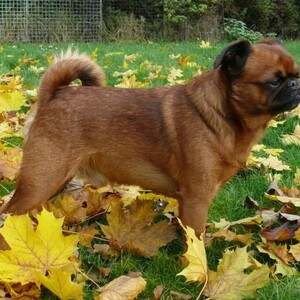
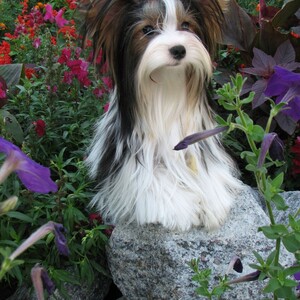
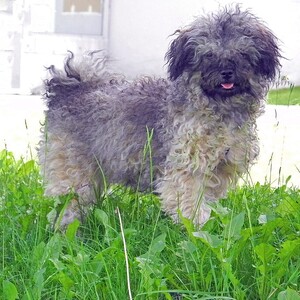
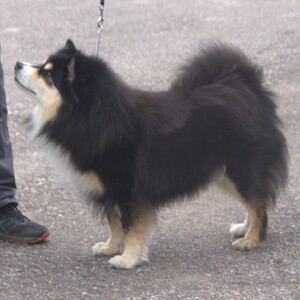
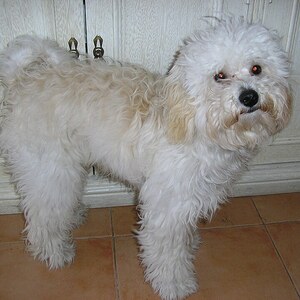
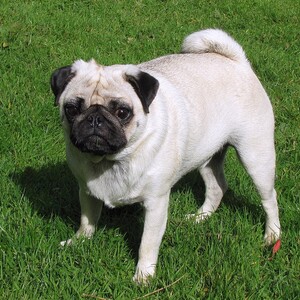
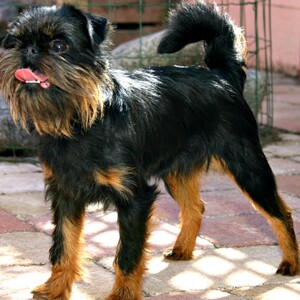
Griffon Belge. · Ger Dekker / Wikimedia Commons, CC BY-SA 2.0. Cropped and resized.
The Belgian Griffon (Griffon Belge) is a toy companion dog from Belgium, with a rough coat, a beard and an almost human expression. It is a close relative of the Brussels Griffon and the Petit Brabançon and differs from them in colour, being black or black and tan. It is well balanced, alert, proud and very attached to its owner.
Quick facts
| Common name | Griffon Belge |
| Scientific name | Canis lupus familiaris |
| Country of origin | Belgium |
| Official recognition | FCI, definitively since 26 October 1954 (group 9, small Belgian dogs; common standard no. 80–82); the AKC treats it as a variety of the Brussels Griffon |
| Lifespan | 12–15 years, according to the AKC |
| Size (males) | 3.5–6 kg |
| Size (females) | 3.5–6 kg |
| Coat type | Harsh, slightly wavy, with an undercoat; trimmed by stripping |
| Common colours | Black, black and tan; black mixed with reddish brown |
| Energy level | Moderate |
| Suited to an apartment? | Yes |
| Temperament | Well balanced, alert, proud, very attached to its owner |
| Tendency to aggression | Low; neither shy nor aggressive |
| Good with children | Average; it is very small |
| Good with other animals | Average |
| Genetic predispositions | Heart problems, cataracts, luxating patella, hip dysplasia; laboured breathing in the heat |
- Primary category:Dog breeds
- Explore this animal's categories:
History and origin
The FCI standard says that the three breeds, the Griffon Bruxellois, the Griffon Belge and the Petit Brabançon, descend from a small, rough-haired dog called the “Smousje”, found for centuries in the Brussels area. In the 19th century, crosses with the Ruby King Charles Spaniel and the Pug brought the short, black coat and fixed today's type. These dogs guarded carriages and kept stables free of rodents.
In 1883 the first Brussels Griffons, Topsy and Foxine, were registered. By around 1900 they had become very popular, thanks to the interest of Queen Marie-Henriette of Belgium. Wikipedia says the small, rough-haired dog in Jan van Eyck's painting “The Arnolfini Portrait” is considered an early form of the breed.
How the breed developed
- 1434 – Jan van Eyck paints “The Arnolfini Portrait”, with a small dog considered an ancestor of the breed.
- 19th century – Crosses with the King Charles Spaniel and the Pug fix the type.
- 1883 – The first Brussels Griffons are registered.
- Around 1900 – The breed becomes popular thanks to Queen Marie-Henriette.
- 26 October 1954 – The FCI recognises the breed.
- 25 March 2003 – The current common FCI standard is published.
Breed rating
| Feature | Stars |
|---|---|
| Training and intelligence | ★★★★☆ |
| Easy to train | ★★★★☆ |
| Intelligence | ★★★★☆ |
| Independence | ★★★☆☆ |
| Stubbornness | ★★★☆☆ |
| Behaviour and temperament | ★★★★☆ |
| Affectionate with family | ★★★★☆ |
| Friendly with children | ★★★☆☆ |
| Good with other dogs | ★★★☆☆ |
| Good with cats and other animals | ★★★☆☆ |
| Loyalty | ★★★★★ |
| Tendency to be aggressive | ★☆☆☆☆ |
| Tendency to bark | ★★★★☆ |
| Needs and care | ★★★★☆ |
| Shedding | ★★★☆☆ |
| Needs frequent grooming | ★★☆☆☆ |
| Activity and lifestyle | ★★★★☆ |
| Energy level | ★★★☆☆ |
| Daily exercise needs | ★★☆☆☆ |
| Suited to apartment life | ★★★★★ |
| Health and longevity | ★★★★☆ |
| Life expectancy | ★★★★☆ |
| Predisposition to genetic diseases | ★★★☆☆ |
| Working abilities and uses | ★★★☆☆ |
| Good watchdog | ★★★☆☆ |
| Good companion dog | ★★★★★ |
Indicative rating: 5 stars means the highest level. The rating is based on the American Kennel Club scores for the Brussels Griffon and on the common FCI standard.
Physical characteristics
The standard describes it as a small companion dog that is intelligent, well balanced, alert, proud and sturdy, almost square, with good bone, yet elegant in movement.
General appearance
The head is its most characteristic feature: quite large in relation to the body, with an almost human expression. The harsh, raised, tousled hair is longer above the eyes, on the muzzle and on the cheeks, where it forms the beard.
| Feature | Griffon Belge |
|---|---|
| Size | Dwarf |
| Weight | 3.5–6 kg |
| Coat | Harsh, slightly wavy, with an undercoat; trimmed by stripping |
| Head | Large, with an almost human expression |
| Shape | Almost square |
| Eyes | Large, dark |
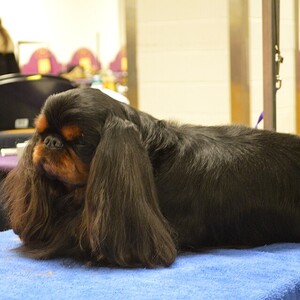
The Belgian Griffon is black or black and tan, with clean tan markings on the legs, chest, cheeks, chin, above the eyes, inside the ears and under the tail. Black mixed with reddish brown is allowed, but pure black and black and tan are preferred.
Training and socialisation
The standard describes it as a small dog that is well balanced, alert, proud, very attached to its owner and very watchful, neither shy nor aggressive.
The AKC says griffons are very intelligent and bond strongly with their owners, which makes them easy to train. As with many toy breeds, house-training can take longer.
Tips for effective training
- Be patient with house-training. The AKC says it can take longer.
- Socialise it as a puppy. The AKC recommends puppy classes.
- Keep it out of the heat. Its short face makes breathing harder in hot weather.
- Try dog sports. Many excel at obedience and agility.
Activity needs and lifestyle
The AKC says griffons need at least half an hour of moderate exercise a day. They love to play and are happiest when doing activities together with their people.
| Activity | How often | Why it matters |
|---|---|---|
| Walk | daily, at least 30 minutes | Moderate exercise |
| Ball games | daily | It loves them |
| Obedience or agility | weekly | Mental activity |
Tips for a balanced life
- In summer, keep it cool.
- Be careful with stairs and jumps off furniture.
- It is well suited to flat life.
Care and health
Coat and skin care
The AKC says rough-coated griffons need regular brushing and combing, plus stripping, to keep their coat. The standard asks for the coat to be trimmed and long enough to show the dog's structure.
Common health problems
The AKC says griffons are generally healthy, but they should be checked, as puppies and as adults, for:
| Condition | Description | Common symptoms |
|---|---|---|
| Heart problems | Congenital or hereditary heart conditions | Tiredness, laboured breathing |
| Cataracts | Clouding of the lens | Cloudy eyes, poor vision |
| Patellar luxation | The kneecap slips out of place | Suddenly holds a hind leg up for a few steps, then uses it again |
| Hip dysplasia | The hip joint forms incorrectly and, over time, arthritis develops | Limping, difficulty getting up or jumping, hip pain |
Other care
- Brush its teeth regularly.
- Clean the area around the eyes.
- Trim the nails regularly.
Diet and nutrition
The AKC says some griffons put on weight easily, so calories and weight should be watched. Treats should be given in moderation.
Tips for a healthy diet
The table gives a starting estimate, calculated with the formula from the Merck Veterinary Manual. The first two calorie columns show the calories per day for a healthy adult dog. The last column shows what this means in dry food with 3,500–4,000 kcal per kilogram.
| Dog's weight | Calories per day (neutered) | Calories per day (not neutered) | Dry food per day (approximate) |
|---|---|---|---|
| 3.5 kg | 290 kcal | 320 kcal | 72–91 g |
| 4.5 kg | 350 kcal | 390 kcal | 88–111 g |
| 6 kg | 430 kcal | 480 kcal | 110–140 g |
- Feed puppies several times a day.
- Choose small kibble suited to toy breeds.
- A dog is at the right weight when you can feel its ribs without pressing hard.
Foods to avoid
Some human foods are dangerous for dogs: chocolate, coffee, grapes and raisins, onions, garlic, xylitol (a sweetener used in chewing gum), macadamia nuts and alcohol.
Reproduction and development
Physical and emotional maturity
In dogs, sexual maturity usually comes between 6 and 12 months. Small breeds become adults faster than large ones, usually at around one year.
Mating and pregnancy
Pregnancy lasts about 63 days, counted from ovulation. Mating a female on her first heat is not recommended. The FCI standard requires that only healthy dogs of typical breed appearance are used for breeding.
Caring for the puppies
In small breeds, a litter has 3–4 puppies on average. The puppies are very small and fragile in the first weeks, so they must be kept warm and handled with care. Socialisation starts early: gentle handling, everyday noises and new people.
Interesting facts
- Three breeds, one standard. The Brussels Griffon, the Belgian Griffon and the Petit Brabançon share a common FCI standard.
- A queen's dog. Queen Marie-Henriette of Belgium made the breed popular.
- In a famous painting. An ancestor appears in Jan van Eyck's “The Arnolfini Portrait”.
- It guarded carriages. In the past it guarded carriages and caught rodents in stables.
- An almost human expression. The standard says its face has an almost human expression.
In popular culture
“The Arnolfini Portrait” and “As Good as It Gets”
Wikipedia says the small, rough-haired dog in Jan van Eyck's painting “The Arnolfini Portrait” (1434) is considered an early form of the Belgian griffons. More recently, interest in griffons grew in the United States after one appeared in the film “As Good as It Gets”.
Frequently asked questions
What is the difference between the Belgian Griffon and the Brussels Griffon?
Only the colour: the Belgian is black or black and tan, while the Brussels is red.
How much does it weigh?
Between 3.5 and 6 kg.
Is it easy to train?
Yes, the AKC says it is intelligent and very attached to its owner.
How long does it live?
The AKC gives 12–15 years.