Common moorhenGallinula chloropus — habitat, diet and reproduction
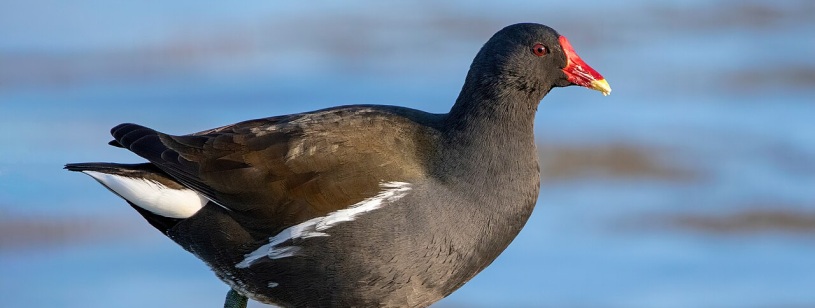
Adult common moorhen (Gallinula chloropus) on a bank. · Alexis Lours / CC BY 4.0 (https://creativecommons.org/licenses/by/4.0). Cropped and resized.
The common moorhen lives among dense plants at the water’s edge. It has dark plumage, a red forehead and a red bill with a yellow tip. Long toes help it move across soft ground and among stems. It swims well but also forages on grassy banks.
Quick facts
| Common name | Common moorhen |
| Scientific name | Gallinula chloropus |
| Length | 30–38 cm |
| Wingspan | 50–55 cm |
| Diet | Omnivore: plants, seeds and small animals |
| Conservation status | Least Concern (LC), globally |
| Distribution | Europe, Asia and Africa |
| Habitat | Ponds, channels and slow waters with dense vegetation |
| Family | Rallidae |
| Reproduction | Usually 5–7 eggs, with variation |
| Occurrence in Romania | Breeding species and partial migrant |
| Identification mark | Red forehead and red bill with a yellow tip |
- Primary category:Birds
- Explore this animal's categories:Animals of AfricaAnimals of AsiaAnimals of EuropeAnimals of RomaniaAnimals of Romania’s gardens and parksAnimals of the Danube DeltaAquatic animalsBirdsBirds of RomaniaBirds that winter in RomaniaCEgg-laying animalsFeathered animalsFlying animalsFreshwater animalsMigratory animalsOmnivoresSemi-aquatic animalsVertebratesWaterbirdsWetland animalsWild animals
Interesting facts
- It frequently flicks its tail, revealing white undertail feathers.
- Vegetated park ponds can provide suitable habitat.
- Older young sometimes help feed chicks from a later brood.
- Its long toes lack duck-like webbing.
Characteristics
The head is very dark and the body grey-brown, with a white line along each side. Adults have a conspicuous red frontal shield and bill, tipped yellow.
Greenish legs carry elongated toes that spread weight on soft surfaces and support movement among plants. White undertail feathers become visible during tail movements. The sexes look similar, with females usually smaller. Juveniles lack all the adults’ strong colours.
Behaviour
A moorhen can vanish rapidly into cover, but in quiet places it swims openly or feeds on the bank. Calls may reveal a hidden bird.
Tail flicking exposes the white undertail as a visual signal. Pairs defend space during breeding. Some park birds tolerate passing people, but nests still need distance and accessible vegetation cover.
Habitat and distribution
The species occurs across Europe, Asia and Africa. In Romania it uses lowland and hilly areas containing vegetated water. Small lakes, channels and ponds can provide food and shelter.
Large expanses of open water are not essential. A mixture of water, reeds and other plants may support a pair, including in parks. It is partially migratory: freezing can prompt movement, while some birds remain in milder areas.
Diet and feeding
Foods include aquatic plants, seeds and other vegetation, along with invertebrates and occasionally small fish or amphibians. Food is collected from water, plants and banks.
This flexibility allows use of different habitats, although bare water without plants or small animals offers fewer resources. Parents deliver suitable food to young, making safe feeding areas and invertebrate availability important.
Reproduction and life cycle
Both partners build a nest from stems, leaves and twigs, supported by floating plants or concealed above the water.
Clutches often contain five to seven eggs, with considerable variation. Both parents incubate for about 17–22 days. Chicks leave early and begin swimming but still receive parental food. In some families, older juveniles help care for young from a later brood.
Name and history
Gallinula is a Latin diminutive linked to hen. Chloropus combines Greek roots for greenish-yellow and foot.
The species belongs to Rallidae rather than the duck family. It is related to the coot, but adults have a red forehead and toes without the coot’s broad lobes.
Conservation and threats
The global category is Least Concern. Loss of small ponds and degradation of banks can nevertheless produce local declines.
Drainage, vegetation burning and fishing nets are threats. Planted margins provide nest sites and refuge. Conserving small wetlands matters alongside protecting larger waterbird sites.
Frequently asked questions
Is a moorhen the same as a coot?
No. They are related species. Adult moorhens have a red forehead, while coots have a white one.
Can it live in a park?
Yes, if water, food and enough vegetation for shelter and nesting are available.
Does it migrate in winter?
It is partially migratory. Some remain while others move when water freezes or conditions worsen.
Are chicks immediately independent?
They leave the nest and swim early but continue receiving food and care.