Norwegian BuhundCharacteristics, history, training and care
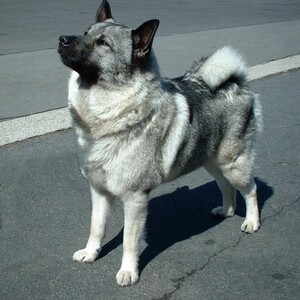
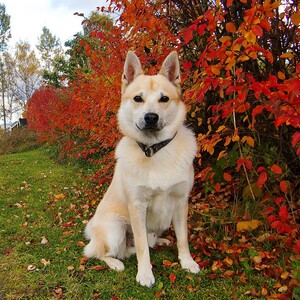
Norwegian Buhund. · Canossa / Wikimedia Commons, CC BY-SA 4.0. Cropped and resized.
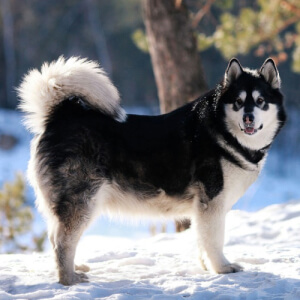
The Norwegian Buhund is a spitz slightly under medium size, square in build, with erect, pointed ears and a tail curled over the back. Its name means “farm dog”, and its type is probably older than the Viking age. The standard describes it as courageous, energetic and friendly.
Quick facts
| Common name | Norwegian Buhund (Norsk Buhund) |
| Scientific name | Canis lupus familiaris |
| Country of origin | Norway |
| Official recognition | FCI, definitively since 25 February 1963 (group 5, Nordic watchdogs and herders; standard no. 237); also recognised by the AKC |
| Lifespan | 12–15 years, according to the AKC |
| Size (males) | 43–47 cm at the withers; about 14–18 kg |
| Size (females) | 41–45 cm at the withers; about 12–16 kg |
| Coat type | Double: dense, hard, smooth topcoat; soft, dense undercoat |
| Common colours | Wheaten (biscuit), black |
| Energy level | High |
| Suited to an apartment? | Only with plenty of exercise |
| Temperament | Courageous, energetic, friendly |
| Tendency to aggression | Low |
| Good with children | Average |
| Good with other animals | Average |
| Genetic predispositions | Hip dysplasia, von Willebrand disease, eye diseases |
- Primary category:Dog breeds
- Explore this animal's categories:
History and origin
The FCI standard says the Buhund can be traced far back in Norwegian history: its type probably existed before the Viking age, so it is more than a thousand years old. Remains of a small spitz that lived alongside people have been found in Viking burial mounds.
The word “buhund” means farm dog, and it appears in Snorri Sturluson's sagas of the Norse kings. One of the stories tells how King Olav Tryggvason met a farmer in Ireland with a very clever Buhund, Vige, and received the dog as a gift, giving the farmer a gold ring and his friendship. The first standard was approved in 1926.
How the breed developed
- Before the Viking age – Small spitz dogs live alongside people in Norway.
- Viking age – Dogs of this type are buried in burial mounds.
- 1926 – The Norwegian Kennel Club approves the first standard.
- 25 February 1963 – The FCI recognises the breed.
Breed rating
| Feature | Stars |
|---|---|
| Training and intelligence | ★★★☆☆ |
| Easy to train | ★★★☆☆ |
| Intelligence | ★★★★☆ |
| Independence | ★★★★☆ |
| Stubbornness | ★★★★☆ |
| Behaviour and temperament | ★★★★☆ |
| Affectionate with family | ★★★★★ |
| Friendly with children | ★★★☆☆ |
| Good with other dogs | ★★★☆☆ |
| Good with cats and other animals | ★★★☆☆ |
| Loyalty | ★★★★★ |
| Tendency to be aggressive | ★★☆☆☆ |
| Tendency to bark | ★★★★☆ |
| Needs and care | ★★★☆☆ |
| Shedding | ★★★☆☆ |
| Needs frequent grooming | ★★☆☆☆ |
| Activity and lifestyle | ★★★★☆ |
| Energy level | ★★★★★ |
| Daily exercise needs | ★★★★☆ |
| Suited to apartment life | ★★★☆☆ |
| Health and longevity | ★★★★☆ |
| Life expectancy | ★★★★☆ |
| Predisposition to genetic diseases | ★★☆☆☆ |
| Working abilities and uses | ★★★★☆ |
| Good farm dog | ★★★★☆ |
| Good companion dog | ★★★★☆ |
Indicative rating: 5 stars means the highest level. It is based on the ratings the American Kennel Club gives the breed and on the FCI standard.
Physical characteristics
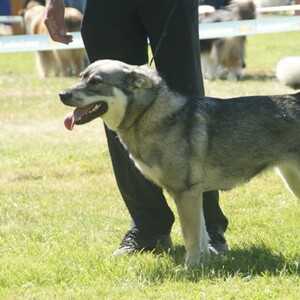
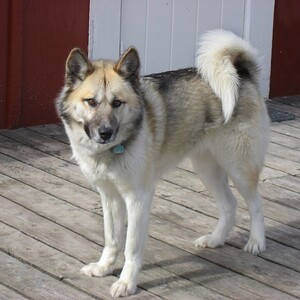
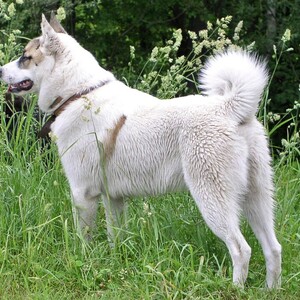
The standard describes it as a typical spitz, slightly under medium size, square in build, with an alert, open expression, erect, pointed ears and a tail curled tightly over the back.
General appearance
The head is well balanced, wedge-shaped and not too heavy. The outer coat is dense, hard and smooth, shorter on the head and the front of the legs and longer on the neck, chest, backs of the thighs and tail. The undercoat is soft and dense.
| Feature | Norwegian Buhund |
|---|---|
| Size | Medium |
| Height at the withers | males: 43–47 cm; females: 41–45 cm |
| Weight | males: ~14–18 kg; females: ~12–16 kg |
| Coat | Double, hard |
| Ears | Erect, pointed |
| Tail | Curled over the back |
The accepted colours are wheaten (biscuit), from fairly light to yellowish red, with or without dark tips, and black, preferably solid. In both colours, there should be as little white as possible.
Training and socialisation
The AKC says that, compared with other spitz and Nordic dogs, the Buhund is easier to train, but it keeps its independence. It wants to please, but its independence is often stronger, so it can be hard to hold its attention.
Fortunately, most Buhunds are highly food-motivated, which helps with training.
Tips for effective training
- Use food rewards. It is highly food-motivated.
- Keep sessions short. Its attention can wander.
- Teach it not to bark at everything. It is an alert watchdog.
- Be consistent. It keeps its independence.
Activity needs and lifestyle
The AKC says it was bred to work and herd for hours on end, so it needs sustained exercise that lets it run fast, twice a day. It loves running alongside a bicycle, fetching balls or going on day-long hikes.
| Activity | How often | Why it matters |
|---|---|---|
| Running or cycling | twice a day | High energy |
| Ball fetching | daily | Activity |
| Long hikes | weekly | Stamina |
Tips for a balanced life
- It suits active people.
- It copes well with cold.
- The fence must be solid.
Care and health
Coat and skin care
The AKC says it does not need much grooming. It is naturally clean and almost odourless, even when wet. The coat sheds dirt easily and dries by itself after a bath.
Common health problems
The AKC says it is generally healthy and hardy, and responsible breeders screen their dogs for:
| Condition | Description | Common symptoms |
|---|---|---|
| Hip dysplasia | The hip joint forms incorrectly and, over time, arthritis develops | Limping, difficulty getting up or jumping, hip pain |
| Von Willebrand disease | An inherited blood-clotting disorder | Bleeding that is hard to stop |
| Eye diseases | Inherited eye conditions | Watery eyes, poor vision |
Other care
- Ask for the parents' test results.
- Trim the nails regularly.
- Go for regular check-ups.
Diet and nutrition
The AKC says some dogs gain weight easily, so calories and weight should be watched, especially as they are so food-motivated.
Tips for a healthy diet
The table gives a starting estimate, calculated with the formula from the Merck Veterinary Manual. The first two calorie columns show the calories per day for a healthy adult dog. The last column shows what this means in dry food with 3,500–4,000 kcal per kilogram.
| Dog's weight | Calories per day (neutered) | Calories per day (not neutered) | Dry food per day (approximate) |
|---|---|---|---|
| 12 kg | 720 kcal | 810 kcal | 180–230 g |
| 15 kg | 850 kcal | 960 kcal | 210–270 g |
| 18 kg | 980 kcal | 1,100 kcal | 240–310 g |
- Give it its food in two meals a day.
- Training treats count towards the daily portion.
- A dog is at the right weight when you can feel its ribs under the coat without pressing hard.
Foods to avoid
Some human foods are dangerous for dogs: chocolate, coffee, grapes and raisins, onions, garlic, xylitol (a sweetener used in chewing gum), macadamia nuts and alcohol.
Reproduction and development
Physical and emotional maturity
In dogs, sexual maturity usually comes between 6 and 12 months. Most breeds become adults at around 13–15 months.
Mating and pregnancy
Pregnancy lasts about 63 days, counted from ovulation. Mating a female on her first heat is not recommended. The FCI standard requires that only healthy dogs of typical breed appearance are used for breeding.
Caring for the puppies
In dogs, a litter has 5–6 puppies on average, and the number rises with the size of the breed. Socialisation starts in the first weeks: gentle handling, everyday noises and new people.
Interesting facts
- A farm dog. That is what “buhund” means in Norwegian.
- In Viking graves. Remains of small spitz dogs have been found in Viking burial mounds.
- Given for a gold ring. King Olav Tryggvason gave a gold ring for the Buhund Vige.
- No smell. The AKC says it does not smell even when wet.
- Nordic relatives. Wikipedia says it is related to the Icelandic Sheepdog and the Jämthund.
In popular culture
Vige, in the sagas of the Norse kings
The FCI standard recalls the story from Snorri Sturluson's sagas: King Olav Tryggvason was so impressed by the Buhund Vige, which was gathering the flock, that he received it as a gift from the farmer, giving him a gold ring and his friendship in return.
Frequently asked questions
What does “buhund” mean?
Farm dog.
How big does it get?
Males measure 43–47 cm and weigh ~14–18 kg; females measure 41–45 cm and weigh ~12–16 kg.
Is it easy to train?
More easily than other spitz breeds, but it remains independent.
How long does it live?
The AKC gives 12–15 years.