Czechoslovakian WolfdogCharacteristics, history, training and care
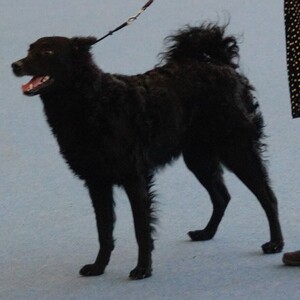
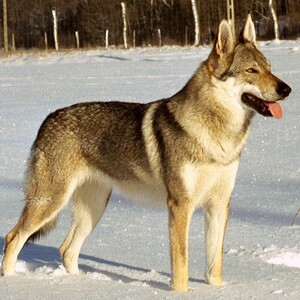
Czechoslovakian Wolfdog. · Margo-CzW / Wikimedia Commons, CC BY-SA 3.0. Cropped and resized.
The Czechoslovakian Wolfdog was born of an experiment carried out in Czechoslovakia in 1955: crossing the German Shepherd with the Carpathian wolf. It looks strikingly like a wolf. It is lively, very active, hardy, brave and extremely loyal to its owner, but suspicious and independent. It is not a breed for beginners.
Quick facts
| Common name | Czechoslovakian Wolfdog (Československý vlčák) |
| Scientific name | Canis lupus familiaris |
| Country of origin | Former Czechoslovakia; patronage: Slovakia |
| Official recognition | FCI, definitively since 30 May 1999 (group 1, sheepdogs, with working trial; standard no. 332); also recognised by the AKC |
| Lifespan | 12–16 years, according to the AKC |
| Size (males) | at least 65 cm at the withers; at least 26 kg |
| Size (females) | at least 60 cm at the withers; at least 20 kg |
| Coat type | Straight, close-lying; in winter with a very abundant undercoat |
| Common colours | Yellowish-grey to silver-grey, with a light mask; dark grey with a light mask |
| Energy level | Very high |
| Suited to an apartment? | No |
| Temperament | Lively, brave, suspicious, very loyal to its owner |
| Tendency to aggression | Low with the family; very reserved with strangers |
| Good with children | Average |
| Good with other animals | Average; prey drive |
| Genetic predispositions | Hip and elbow dysplasia |
- Primary category:Dog breeds
- Explore this animal's categories:
History and origin
In 1955, Colonel Karel Hartl began a scientific experiment in the Czechoslovak army kennels: crossing a Carpathian grey wolf with a German Shepherd. The first puppies, from the she-wolf Brita and the German Shepherd Cézar z Březového háje, were born on 26 May 1958, at Libějovice.
The FCI standard says the experiment showed that puppies from both combinations could be raised and had the qualities needed for further breeding. The AKC says the aim was a hardier dog for the Czechoslovak border guards. In 1965 the breeding plan for the new breed was drawn up, and in 1982 it was recognised as a national breed.
How the breed developed
- 1955 – Karel Hartl begins the crossbreeding experiment.
- 26 May 1958 – The first puppies are born, at Libějovice.
- 1965 – The breeding plan for the breed is drawn up.
- 1982 – The breed is recognised as a national breed of Czechoslovakia.
- 30 May 1999 – The FCI definitively recognises the breed.
- 2024 – The AKC publishes the breed standard.
Breed rating
| Feature | Stars |
|---|---|
| Training and intelligence | ★★★☆☆ |
| Easy to train | ★★☆☆☆ |
| Intelligence | ★★★★★ |
| Independence | ★★★★★ |
| Stubbornness | ★★★★★ |
| Behaviour and temperament | ★★★★☆ |
| Affectionate with family | ★★★★★ |
| Friendly with children | ★★★☆☆ |
| Good with other dogs | ★★★☆☆ |
| Good with cats and other animals | ★★☆☆☆ |
| Loyalty | ★★★★★ |
| Tendency to be aggressive | ★★★☆☆ |
| Tendency to bark | ★☆☆☆☆ |
| Needs and care | ★★★★☆ |
| Shedding | ★★★☆☆ |
| Needs frequent grooming | ★☆☆☆☆ |
| Activity and lifestyle | ★★★★★ |
| Energy level | ★★★★★ |
| Daily exercise needs | ★★★★★ |
| Suited to apartment life | ★☆☆☆☆ |
| Health and longevity | ★★★★☆ |
| Life expectancy | ★★★★☆ |
| Predisposition to genetic diseases | ★★☆☆☆ |
| Working abilities and uses | ★★★★☆ |
| Good working and guard dog | ★★★★★ |
| Good companion dog | ★★★☆☆ |
Indicative rating: 5 stars means the highest level. It is based on the ratings the American Kennel Club gives the breed and on the FCI standard.
Physical characteristics
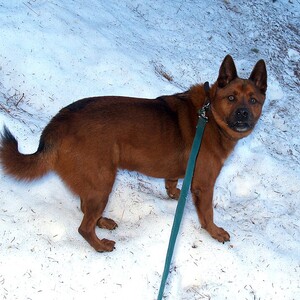
The standard describes it as a sturdy, above-medium-sized dog with a rectangular body. In its body shape, movement, coat, colour and mask, it resembles the wolf.
General appearance
The small, slanting eyes are amber. The erect, thin, triangular ears are short. The high-set tail hangs straight, and when the dog is excited it raises it in a sickle shape.
| Feature | Czechoslovakian Wolfdog |
|---|---|
| Size | Large |
| Height at the withers | males: at least 65 cm; females: at least 60 cm |
| Weight | males: at least 26 kg; females: at least 20 kg |
| Coat | Straight, very dense in winter |
| Eyes | Small, slanting, amber |
| Ears | Erect, short, triangular |
The coat is yellowish-grey to silver-grey, with a characteristic light mask. The hair is also light on the underside of the neck and on the chest. Dark grey with a light mask is also allowed.
Training and socialisation
The AKC says it is a primitive breed with a dominant, independent personality, which calls for a different kind of training. Consistency and patience are a must. It is very intelligent, curious and versatile.
Early socialisation and training are very important. Well trained, it excels at many activities, but it must understand the point of the exercise.
Tips for effective training
- Start socialisation early. It is suspicious by nature.
- Be patient and consistent. Commands repeated for no reason bore it.
- Give it a job. The AKC says it needs an activity with a purpose.
- Do not leave it alone in the yard. The AKC says this does not work with this breed.
Activity needs and lifestyle
The AKC says it has boundless energy, especially as a puppy and adolescent. It needs long walks or runs every day, combined with mental activity: swimming, hiking, retrieving or frisbee.
| Activity | How often | Why it matters |
|---|---|---|
| Long walks or running | daily | Very high energy |
| Hiking or swimming | weekly | Exceptional stamina |
| Tracking or agility | several times a week | Activity with a purpose |
Tips for a balanced life
- The fence must be very solid and high.
- It is not suited to beginners.
- It needs to spend a lot of time with its owner.
Care and health
Coat and skin care
The AKC says the weather-resistant coat sheds mud by itself and rarely needs a bath. It sheds twice a year, and then it must be brushed daily. The nails grow quickly and should be trimmed regularly.
Common health problems
It is generally considered hardy. As with any large, active dog, it is worth watching for:
| Condition | Description | Common symptoms |
|---|---|---|
| Hip dysplasia | The hip joint forms incorrectly and, over time, arthritis develops | Limping, difficulty getting up or jumping, hip pain |
| Elbow dysplasia | The elbow joint develops incorrectly and arthritis appears | Limping on the front legs, especially after exercise |
Other care
- Trim the nails regularly: they grow quickly.
- Check the ears and teeth weekly.
- Check for ticks after outings in nature.
Diet and nutrition
The AKC says good-quality food for medium and large breeds is suitable. The portion size and number of meals should be set together with the vet or the breeder.
Tips for a healthy diet
The table gives a starting estimate, calculated with the formula from the Merck Veterinary Manual. The first two calorie columns show the calories per day for a healthy adult dog. The last column shows what this means in dry food with 3,500–4,000 kcal per kilogram.
| Dog's weight | Calories per day (neutered) | Calories per day (not neutered) | Dry food per day (approximate) |
|---|---|---|---|
| 20 kg | 1,060 kcal | 1,190 kcal | 260–340 g |
| 26 kg | 1,290 kcal | 1,450 kcal | 320–410 g |
| 32 kg | 1,510 kcal | 1,700 kcal | 380–490 g |
- Split the food into two meals a day.
- Adjust the portion to its daily activity.
- A dog is at the right weight when you can feel its ribs without pressing hard.
Foods to avoid
Some human foods are dangerous for dogs: chocolate, coffee, grapes and raisins, onions, garlic, xylitol (a sweetener used in chewing gum), macadamia nuts and alcohol.
Reproduction and development
Physical and emotional maturity
In dogs, sexual maturity usually comes between 6 and 12 months, but in large breeds it can be delayed until about two years. The body also reaches its adult form later than in small breeds.
Mating and pregnancy
Pregnancy lasts about 63 days, counted from ovulation. Mating a female on her first heat is not recommended. The FCI standard requires that only healthy dogs of typical breed appearance are used for breeding.
Caring for the puppies
In large breeds, a litter has around 7 puppies on average. Socialisation starts in the first weeks: gentle handling, everyday noises and new people.
Interesting facts
- Born of an experiment. The breed started from a scientific experiment by the Czechoslovak army.
- A border guard dog. The AKC says it was bred for patrols on the Czechoslovak border.
- It rarely barks. The AKC gives it the lowest score for barking.
- Exceptional senses. It has very good sight, hearing and sense of smell.
- A rescuer. Some dogs work in search and rescue in Great Britain.
Frequently asked questions
Is the Czechoslovakian Wolfdog half wolf?
No. It started from crossing the wolf with the German Shepherd in 1955, but today it is a dog breed recognised by the FCI.
How big does it get?
Males measure at least 65 cm and weigh at least 26 kg; females at least 60 cm and 20 kg.
Is it suitable for a family?
Only for an active, experienced family. It is very loyal, but independent and suspicious.
Does it bark a lot?
No, it rarely barks.
How long does it live?
The AKC gives 12–16 years.