PugCharacteristics, history, training and care
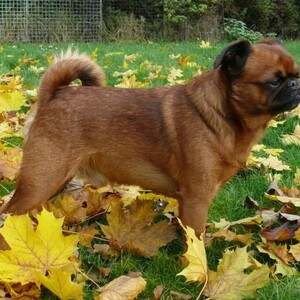
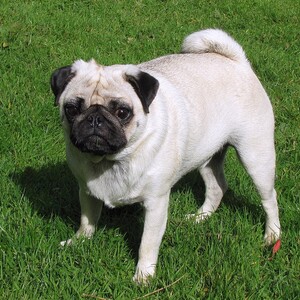
Pug. · Abuk SABUK / Wikimedia Commons, CC BY-SA 3.0. Cropped and resized.
The Pug is a small companion dog, square and cobby, with a short, wrinkled face, large eyes and a curled tail. The breed's motto is “multum in parvo” (“much in little”). The standard describes it as charming, dignified and intelligent, with an even, cheerful and lively disposition.
Quick facts
| Common name | Pug (Mops) |
| Scientific name | Canis lupus familiaris |
| Country of origin | China |
| Official recognition | FCI, definitively since 4 November 1966 (group 9, small molossian type dogs; standard no. 253); also recognised by the AKC |
| Lifespan | 13–15 years, according to the AKC |
| Size (males) | ideally 6.3–8.1 kg; 25–33 cm at the withers according to the AKC |
| Size (females) | ideally 6.3–8.1 kg; 25–33 cm at the withers according to the AKC |
| Coat type | Fine, smooth, soft, short, glossy |
| Common colours | Silver, apricot, fawn (with a black mask) or black |
| Energy level | Moderate |
| Suited to an apartment? | Yes |
| Temperament | Charming, dignified, intelligent, cheerful, even-tempered |
| Tendency to aggression | Very low |
| Good with children | Very good, according to the AKC |
| Good with other animals | Good, according to the AKC |
| Genetic predispositions | Brachycephalic syndrome, eye diseases, patellar luxation, hip dysplasia, pug dog encephalitis |
History and origin
The FCI standard says the breed seems to have come from the Orient, and that its country of origin is China, where short-nosed dogs have always been prized. It reached Europe with merchants of the Dutch East India Company and was admired in the Netherlands as early as the 16th century, where it became the symbol of the royalist patriots.
It reached England when William III came to the throne. Until 1877 only fawn Pugs were seen in England; in that year a black pair was brought from the Orient. Wikipedia says that, according to tradition, it became the dog of the House of Orange in 1572, after a Pug named Pompey saved the Prince of Orange by warning him that assassins were approaching.
How the breed developed
- 16th century – It reaches the Netherlands with Dutch merchants.
- 1572 – Pompey saves the Prince of Orange, according to Wikipedia.
- 1688 – It reaches England with William III.
- 1877 – The first pair of black Pugs reaches England.
- 4 November 1966 – The FCI recognises the breed.
Breed rating
| Feature | Stars |
|---|---|
| Training and intelligence | ★★★★☆ |
| Easy to train | ★★★★☆ |
| Intelligence | ★★★★☆ |
| Independence | ★★☆☆☆ |
| Stubbornness | ★★★☆☆ |
| Behaviour and temperament | ★★★★★ |
| Affectionate with family | ★★★★★ |
| Friendly with children | ★★★★★ |
| Good with other dogs | ★★★★☆ |
| Good with cats and other animals | ★★★★☆ |
| Loyalty | ★★★★★ |
| Tendency to be aggressive | ★☆☆☆☆ |
| Tendency to bark | ★☆☆☆☆ |
| Needs and care | ★★★☆☆ |
| Shedding | ★★★★☆ |
| Needs frequent grooming | ★★☆☆☆ |
| Activity and lifestyle | ★★★☆☆ |
| Energy level | ★★★☆☆ |
| Daily exercise needs | ★★☆☆☆ |
| Suited to apartment life | ★★★★★ |
| Health and longevity | ★★★★☆ |
| Life expectancy | ★★★☆☆ |
| Predisposition to genetic diseases | ★★★★☆ |
| Working abilities and uses | ★★★☆☆ |
| Good guard dog | ★★★☆☆ |
| Good companion dog | ★★★★★ |
Indicative rating: 5 stars means the highest level. It is based on the ratings the American Kennel Club gives the breed and on the FCI standard.
Physical characteristics
The standard describes it as decidedly square and cobby, “multum in parvo”: compact, well proportioned and hard of muscle, without looking lean or too fat.
General appearance
The head is relatively large and round, with clear wrinkles on the forehead, without exaggeration. The nose is black, with fairly large, well-opened nostrils. The coat is fine, smooth, soft, short and glossy. The AKC says the wrinkled brow and large eyes give it almost human expressions.
| Feature | Pug |
|---|---|
| Size | Small |
| Weight | ideally 6.3–8.1 kg |
| Height at the withers | 25–33 cm (AKC) |
| Coat | Short, glossy |
| Head | Large, round, wrinkled |
| Tail | Curled |
The accepted colours are silver, apricot, fawn or black. In the light colours, the contrast with the mask, ears, cheek moles, the mark on the forehead and the black line along the back (the “trace”) should be as clear as possible.
Training and socialisation
The AKC says the Pug was bred to be a companion and a joy to its owners. It has an even, stable temperament, great charm and an outgoing, loving nature. Because it lives to please its people, it is usually easy to train.
Its feelings are easily hurt, so harsh methods must never be used. It wants to be with its family and is unhappy if left alone.
Tips for effective training
- Be gentle. Its feelings are easily hurt.
- Use small rewards. It loves food, but gains weight easily.
- Do not leave it alone for long. It wants to be with its family.
- Keep it out of the heat. Its flat face makes breathing harder.
Activity needs and lifestyle
The AKC says that, given the chance, it spends much of the day on the sofa, and this, together with its appetite, can lead to obesity. But it is playful, sturdy and lively, and moderate daily walks or play in the yard keep it fit.
| Activity | How often | Why it matters |
|---|---|---|
| Moderate walks | daily | Prevents weight gain |
| Play | daily | It is very playful |
| Rest somewhere cool | in summer | It copes badly with heat |
Tips for a balanced life
- It suits an apartment very well.
- In summer, walk it only in the morning and evening.
- Watch its weight very carefully.
Care and health
Coat and skin care
The AKC says the short coat needs little grooming, but it does shed. Brushing once a week with a medium brush, a rubber mitt or a hound glove removes dead hair. It does not need frequent baths.
Common health problems
The AKC says the Pug is generally healthy, but, like all flat-faced breeds, it sometimes has breathing problems and copes badly with sunny, hot or humid weather. Its large eyes are also a weak point.
| Condition | Description | Common symptoms |
|---|---|---|
| Brachycephalic syndrome | The airways are narrowed by the short muzzle | Noisy breathing, tires quickly, copes poorly with heat |
| Eye diseases | Corneal ulcers, dry eye | Red eye, watering, frequent blinking |
| Patellar luxation | The kneecap slips out of place | Suddenly holds a hind leg up for a few steps, then uses it again |
| Hip dysplasia | The hip joint forms incorrectly and, over time, arthritis develops | Limping, difficulty getting up or jumping, hip pain |
| Pug dog encephalitis | Serious inflammation of the brain | Seizures, unsteady gait, behaviour changes |
Other care
- Clean the facial wrinkles every day.
- Protect its eyes from knocks.
- Keep it cool in summer.
Diet and nutrition
The AKC says Pugs “live to eat” and gain weight very easily, so calories and weight must be watched closely.
Tips for a healthy diet
The table gives a starting estimate, calculated with the formula from the Merck Veterinary Manual. The first two calorie columns show the calories per day for a healthy adult dog. The last column shows what this means in dry food with 3,500–4,000 kcal per kilogram.
| Dog's weight | Calories per day (neutered) | Calories per day (not neutered) | Dry food per day (approximate) |
|---|---|---|---|
| 6.3 kg | 450 kcal | 500 kcal | 110–140 g |
| 7.2 kg | 490 kcal | 550 kcal | 120–160 g |
| 8.1 kg | 540 kcal | 600 kcal | 140–170 g |
- Feed it two small meals a day.
- Weigh its portions.
- Treats count towards the daily portion.
Foods to avoid
Some human foods are dangerous for dogs: chocolate, coffee, grapes and raisins, onions, garlic, xylitol (a sweetener used in chewing gum), macadamia nuts and alcohol.
Reproduction and development
Physical and emotional maturity
In dogs, sexual maturity usually comes between 6 and 12 months. Small breeds become adults faster than large ones, usually at around one year.
Mating and pregnancy
Pregnancy lasts about 63 days, counted from ovulation. Mating a female on her first heat is not recommended. The FCI standard requires that only healthy dogs of typical breed appearance are used for breeding.
Caring for the puppies
In small breeds, a litter has 3–4 puppies on average. The puppies are very small and fragile in the first weeks, so they must be kept warm and handled with care. Socialisation starts early: gentle handling, everyday noises and new people.
Interesting facts
- “Multum in parvo”. The breed's motto means “much in little”.
- Pompey the rescuer. A Pug is said to have saved the Prince of Orange in 1572.
- Joséphine's messenger. Her dog, Fortune, carried hidden messages to her family.
- The “trace”. The black line along its back is called the “trace”.
- Human expressions. Its wrinkles give it expressions of surprise or happiness.
In popular culture
Pugs in history and art
Wikipedia says the painter William Hogarth painted himself in 1745 with his Pug, Trump, and that Joséphine, before her marriage to Napoleon, sent hidden messages to her family through her Pug, Fortune, while she was imprisoned at Les Carmes. Queen Victoria also owned many Pugs.
Frequently asked questions
Do Pugs have trouble breathing?
They can have breathing problems, like all flat-faced breeds; they cope badly with heat.
How much does it weigh?
Ideally 6.3–8.1 kg.
Is it suited to an apartment?
Yes, very suitable.
How long does it live?
The AKC gives 13–15 years.