CoyoteInteresting facts and information
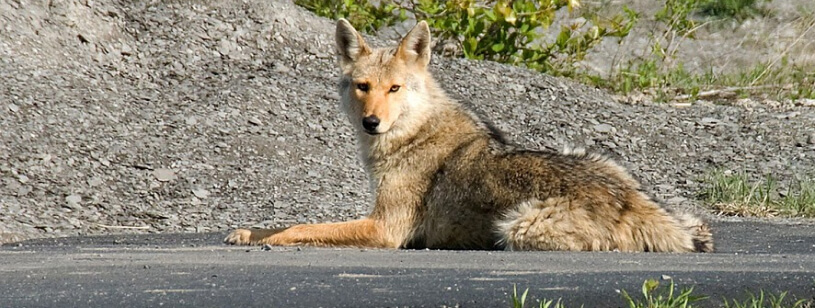
The coyote (Canis latrans) is a North American member of the dog family. It uses a wide range of habitats and feeds opportunistically on animal and plant food. Its behaviour varies with food, season and interactions with other animals and people.
Coyotes communicate through calls, scent and body movements. Their movements and social lives depend on food, territory and season.
Quick facts
| Common name | Coyote |
| Scientific name | Canis latrans |
| Typical lifespan | Usually a few years in the wild, some up to 10-14; up to about 20 years in captivity |
| Maximum speed | Up to about 65 km/h in short bursts |
| Height | About 58 - 66 cm (at the shoulder) |
| Length | About 1 - 1.35 m (including tail) |
| Weight | About 8 - 20 kg (larger in the east) |
| Diet type | Omnivorous carnivore (small mammals, birds, fruit, insects, carrion, food scraps) |
| Main predators | Wolves, cougars, bears, golden eagles (pups), humans |
| Conservation status | Least Concern (IUCN) |
| Distribution | North and Central America; recently reached Colombia |
| Habitat | Grasslands, deserts, forests, mountains, farmland, cities |
- Primary category:Mammals
- Explore this animal's categories:
Interesting facts
- Coyotes can breed with wolves and dogs - Eastern coyotes often carry some wolf genes and are sometimes called "coywolves"; coyote-dog hybrids are called "coydogs".
- A large vocal repertoire - Coyotes make about a dozen different sounds, including howls, yips, barks, growls and whines.
- City dwellers - Coyotes now live in big cities such as Chicago and Los Angeles, where they eat rodents, rabbits, fruit and food scraps.
- Opportunistic feeders - They mainly hunt small mammals, but they also eat fruit, insects, carrion and human food when they can.
- Family life - Coyotes usually live in pairs that stay together for years, often with their grown-up young, and the pair defends a territory together.
- Great jumpers and diggers - Coyotes can leap fences about 1.8-2 metres high and dig under barriers.
- Active at dusk and night - They can be seen in the daytime, but they are most active around dusk, at night and at dawn, when their howling is most often heard.
- Fast runners - Coyotes can run at up to about 65 km/h in short bursts.
- Hard to get rid of - Where many coyotes are killed, the survivors often have larger litters, so their numbers recover quickly.
- Scent marking - They use urine, droppings and scent glands to mark their territory.
Records and remarkable features
- Coyotes use varied habitats and can take different foods as opportunities change.
- Since about 1900, coyotes have spread across almost all of North America, from Alaska to Panama, and have recently reached Colombia.
- They now live in every mainland US state and in many of the continent's largest cities.
Characteristics
Coyotes are members of the dog family (Canidae) and among the most adaptable predators in North and Central America. They are smaller than wolves, but fast, agile and intelligent.
Main physical characteristics:
- Size and weight - Coyotes are about 1-1.35 m long including the tail and usually weigh about 8-20 kg; eastern coyotes are larger than western ones.
- Variable fur - Their coat is a mix of grey, brown, reddish and buff, with paler fur on the throat and belly.
- A bushy tail - Usually carried low, with a black tip.
- A narrow snout and large, pointed ears - Help them hear and smell prey.
- Yellow eyes - Coyotes see well in dim light.
- Strong teeth - Sharp canines grip prey, and the carnassial teeth slice meat.
- Narrow paws with blunt, non-retractable claws - Give them a good grip when running.
Special adaptations for survival:
- Speed and stamina - They can sprint at up to about 65 km/h and travel long distances at a steady trot.
- Excellent hearing - They can hear mice and voles moving under the snow and pounce on them.
- Living almost anywhere - Coyotes live in deserts, grasslands, forests, mountains and cities. Related profile: Desert animals.
- Intelligence - They learn quickly and change their habits to suit their surroundings, for example becoming more nocturnal near people.
Habits and behaviour
Coyotes are intelligent animals with a flexible social life, which helps them survive in many different habitats.
Social behaviour:
- Pairs - A breeding pair can stay together for many years, sometimes for life.
- Family groups - Some coyotes live in family packs with their young from previous years; others live alone or travel as "transients" without a territory.
- Breeding pair - In a pack, usually only the dominant pair breeds, and the other members help raise the pups.
- Territorial marking - Coyotes mark their territories with urine and droppings, and howl to tell other coyotes where they are.
Breeding season:
- Mating takes place in late winter, usually from January to March, and the pups are born in spring.
- Pregnancy - Lasts about 60-63 days.
- Dens - Females give birth in dens dug by themselves or taken over from other animals, or in hollow logs and rock crevices.
Defence and survival methods:
- Speed and agility - They can outrun many predators and dogs.
- Camouflage - Their grizzled fur helps them blend into grass and bushes.
- Caution - Coyotes are wary and quickly learn to avoid traps and dangerous places.
Habitat and geographic distribution
Coyotes live in almost every kind of habitat, from wilderness to cities. Over the last century, they have spread far beyond their original range in the plains and deserts of western North America.
Habitat types:
- Grasslands and open plains - Their original home, where they can see and chase prey.
- Forests and mountains - They now live in many forests, especially where there are clearings and farmland.
- Deserts and dry areas - Coyotes are well adapted to deserts and get some water from their food.
- Cities - In towns, coyotes live in parks, golf courses and green spaces, eating rodents, rabbits, fruit and scraps.
Geographic distribution and estimated population:
| Region | Countries present | Estimated population |
|---|---|---|
| North America | USA, Canada, Mexico | Not known exactly; very widespread and common |
| Central America | From Guatemala to Panama | Spreading south over recent decades |
| South America | Colombia | First confirmed in recent years; still rare |
Impact of climate change and urbanisation:
- Spreading range - Coyotes quickly move into new areas, helped by forest clearing and farming.
- Conflict with people - Coyotes in towns sometimes attack pets, and on farms they may kill sheep and poultry.
- Fewer large predators - Killing off wolves in much of North America helped coyotes spread east and north.
Coyotes are a remarkable example of an animal that thrives in a world changed by people.
Diet and feeding
Coyotes are opportunistic feeders that change their diet according to what is available. They are classed as carnivores, but eat a lot of plant food too.
Main food:
- Small mammals - Mice, voles, rabbits, hares, squirrels and prairie dogs.
- Birds and eggs - Coyotes take eggs from ground nests and catch birds.
- Reptiles and amphibians - Lizards, snakes and frogs.
- Insects - Grasshoppers, crickets and beetles.
- Fruit - Berries, apples, persimmons, melons and cactus fruit.
- Carrion and scraps - They eat dead animals, and in towns they find rubbish and pet food left outside.
Diet by season:
| Season | Main food type |
|---|---|
| Spring | Rodents, birds, eggs, insects, newborn deer |
| Summer | Fruit, insects, small mammals |
| Autumn | Berries and fruit, small mammals, birds |
| Winter | Rodents, rabbits, deer (often as carrion), scraps |
Feeding methods:
- Teamwork - Coyotes sometimes hunt together to catch larger prey, such as deer, especially in winter.
- Pouncing - They leap high and land on mice and voles with their front paws.
- Storing food - They sometimes bury extra food to eat later.
- Changing diet - When their usual prey is scarce, they simply switch to other foods.
Reproduction and life cycle
Coyote pairs usually stay together for years and raise their pups together, sometimes with help from older offspring.
Mating:
- The mating period - About January - March.
- Long-term pairs - Many coyote pairs stay together for several years, some for life.
- Defending the territory - The pair defends its territory, especially in the breeding season.
Gestation and birth:
- Pregnancy - About 60-63 days.
- Number of pups - Usually about 4-7, sometimes many more; litters are often larger where many coyotes are killed.
- Place of birth - Pups are born in a den, often an enlarged burrow of another animal.
The development of the young:
- The pups are born blind and helpless and open their eyes at about 10-14 days.
- At about 3 weeks they start to come out of the den, watched by both parents.
- At about 5-7 weeks they are weaned and eat food brought back by the adults.
- At about 6-9 months, many young coyotes leave to find their own territory, while some stay with their parents.
Longevity:
- In the wild - Usually only a few years, but some live 10-14 years.
- In captivity - Up to about 20 years.
Name and history
Coyotes have long been important in the stories of Indigenous peoples of North America.
Origin and etymology of the name:
- The word "coyote" comes, through Mexican Spanish, from the Nahuatl (Aztec) word coyōtl.
- The scientific name Canis latrans means "barking dog".
Taxonomic classification:
| Taxonomic category | Name |
|---|---|
| Kingdom | Animalia |
| Phylum | Chordata |
| Class | Mammalia |
| Order | Carnivora |
| Family | Canidae |
| Genus | Canis |
| Species | Canis latrans |
Discovery and Documentation:
- Before Europeans - Coyotes were well known to Indigenous peoples, including the Aztecs, who left many images and names of coyotes.
- Lewis and Clark (1804-1806) - Their expedition described the "prairie wolf" of the Great Plains.
- Scientific description - The naturalist Thomas Say gave the coyote its scientific name in 1823.
The role of coyotes in mythology and culture:
- The trickster - In many Native American stories, Coyote is a clever, greedy and funny trickster who often outwits others but also causes trouble.
- A symbol of survival - Today, the coyote is often seen as a symbol of cunning and adaptability.
Coyotes remain one of the most fascinating animals of the Americas, adapting remarkably well to a changing world.
Cultural significance and mythology
Coyote is a central figure in the stories of many Indigenous peoples of North America and Mexico, often as a trickster and sometimes as a creator or helper of the Creator.
Coyotes in mythology and religion:
- Native American stories - Among many peoples, such as the Chinook, Maidu, Paiute, Pawnee and Ute, Coyote is the companion of the Creator, a trickster who uses his wits to overcome challenges.
- Aztec mythology - Huehuecoyotl, "old coyote", was a god of music, dance and mischief; the famous ruler and poet Nezahualcoyotl's name means "fasting coyote".
- Navajo stories - In one Navajo story, Coyote impatiently threw the stars across the sky, which is why they are scattered instead of neatly arranged.
- Place names - Coyoacán, a district of Mexico City, means "place of coyotes".
Coyote symbolism:
- Intelligence and cunning - Because it survives so well in difficult conditions.
- Chaos and change - In many stories, Coyote breaks the rules and upsets order, sometimes bringing useful changes to the world.
- Border slang - In Mexico and the United States, people who smuggle migrants across the border are called "coyotes".
Conservation status and threats
Coyotes are not threatened and are listed as Least Concern by the International Union for Conservation of Nature (IUCN). Conflicts with people, however, mean that many are killed every year.
Conservation status
- Widespread and increasing - Coyotes are common across most of North America and Central America.
- Still spreading - Over the last century, they have moved into eastern North America, Alaska and Central America, and recently into South America.
Main threats:
- Hunting and trapping - Coyotes are hunted, trapped and poisoned in many areas, often as pests, but their numbers usually stay stable.
- Conflicts with farmers - Attacks on sheep, calves and poultry make them targets of control programmes.
- Roads - Many coyotes are killed by cars, especially in towns.
Conservation efforts:
- Research - Studies, such as long-term urban coyote projects in Chicago, look at how coyotes live alongside people.
- Education - Programmes teach people how to live with coyotes, for example by not feeding them and keeping pets safe.
- Protected areas - National parks and reserves provide homes for wild populations.
In popular culture
Coyotes are well-known figures in modern culture, appearing in cartoons, books, music and sport.
Coyotes in cinematography and animations:
- Wile E. Coyote (Looney Tunes) - Probably the most famous coyote in popular culture, he has been chasing the Road Runner, and always failing, since 1949.
- Nature documentaries - Films about urban wildlife often show how coyotes live in cities.
Coyotes in literature:
- Coyote America (Dan Flores, 2016) - A book about the natural history and mythology of the coyote.
- Roughing It (Mark Twain, 1872) - Twain gives a famous, humorous description of a thin, hungry coyote.
- Traditional Native American stories - Many of them feature Coyote as a clever, inventive character.
Coyotes in sport and emblem:
- The Arizona Coyotes - The National Hockey League team was named after the animal until it moved to Utah in 2024.
- Mascots and logos - Many sports teams and brands use the coyote as a symbol of speed and toughness.
Coyotes in music and art:
- Joni Mitchell - "Coyote" (1976) - A song from the album Hejira.
- Art - Coyotes appear in Native American art and in paintings of the American West.