Eurasian magpiePica pica — plumage, food, nests and behaviour
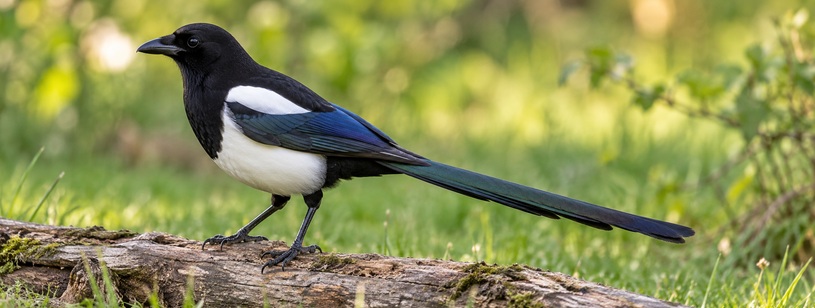
Eurasian magpie (Pica pica), the species found in Romania.
The Eurasian magpie is an omnivorous member of the crow family, recognised by its black-and-white plumage and very long tail. Its scientific name is Pica pica. In good light, the wings and tail show blue and green iridescence.
It inhabits parks, gardens, orchards and farmland with trees. In Romania it is resident, breeding locally and remaining through winter. It forages on the ground and in vegetation and builds a large nest, often roofed with twigs.
Quick facts
| Common name | Eurasian magpie |
| Scientific name | Pica pica |
| Typical lifespan | About 5 years for a bird that has reached breeding age, according to BTO data. |
| Length | Around 44–50 cm, including the tail; published ranges differ between sources and populations |
| Weight | Broadly around 160–270 g; varies with sex and individual |
| Diet type | Omnivorous: Insects and other small animals, seeds, fruit, scraps and carrion |
| Conservation status | Globally Least Concern — low extinction risk |
| Geographical distribution | Europe and parts of Asia; boundaries depend on how magpie species are delimited |
| Habitat | Open spaces mixed with trees and shrubs, including settlements |
| Wingspan | Around 52–60 cm |
| Plumage | Black and white, with blue-green iridescence on dark feathers |
| Male and female | Similar plumage; colour alone does not reliably establish sex |
| Activity | Mainly daytime |
| In Romania | Breeding resident, generally absent from the highest mountain areas |
| Nest | Large twig structure, usually in a tree or tall shrub, often roofed |
| Eggs | Variable: the Romanian SOR account gives 2–8; BTO records typically show 5–6 |
| Incubation | Around three weeks, mainly by the female |
| Leaving the nest | At around four weeks; young still depend on their parents |
- Primary category:Birds
- Explore this animal's categories:Animals of AsiaAnimals of EuropeAnimals of RomaniaAnimals of Romania’s gardens and parksAnimals of Romania’s grasslands and plainsAnimals that live in groupsArboreal animalsBirdsBirds of RomaniaBirds that winter in RomaniaBlack-and-white animalsEEgg-laying animalsFeathered animalsFlying animalsInsect-eating animalsIntelligent animalsOmnivoresPredatory animals of RomaniaVertebratesWild animals
Interesting facts
- It is more than black and white. Good lighting reveals metallic blue and green on dark feathers.
- The nest can have a roof. Twigs often form a dome above the egg chamber.
- Many remain close to where they grew up. Local movements are more typical than long migrations.
- Jewellery is not an irresistible attraction. Experiments have not demonstrated an unconditional preference for shiny objects.
- Leaving the nest does not mean independence. Parents continue feeding their young afterwards.
Records and extremes
How long can a magpie live?
An exceptional individual can far outlive a typical bird. BTO reports a ringed magpie reaching 21 years and 8 months.
| Measure | Age and interpretation |
|---|---|
| Typical BTO reference | Around 5 years for a bird that has reached breeding age |
| BTO ringing record | 21 years and 8 months; an exceptional age rather than a guaranteed lifespan |
Specialists fit identification rings so that later encounters can reveal a bird’s age and movements. Young and adult birds do not have identical survival prospects.
Characteristics
How do you recognise a Eurasian magpie?
The head, neck, chest and back are black, contrasting with the white belly and shoulder patches. A long tail and strong black bill complete the outline. White areas on the wings also become visible in flight.
Iridescence depends on lighting and viewing angle. Tiny feather structures affect how light is reflected. This is not rapid physiological colour change like that of a chameleon.
Magpie, crow or raven?
| Bird | Identification features |
|---|---|
| Eurasian magpie — Pica pica | Conspicuous white belly and shoulders, plus a very long tail |
| Crows — Corvus | Appearance varies by species, including black and grey-and-black birds |
| Common raven — Corvus corax | Large dark adult with a robust bill, without the magpie’s black-and-white pattern |
Magpies are related to crows and the common raven, but belong to Pica rather than Corvus.
Do males and females look different?
Their plumage is very similar. Males may average larger, but measurements overlap. An ordinary photograph does not always allow reliable sex identification.
Habits and behaviour
Movement and communication
Magpies often forage by walking or hopping on the ground, returning to trees and shrubs for cover or a vantage point. They are mainly active by day.
A familiar call is a harsh repeated chatter, which may signal agitation or a predator. Not every sound has the same meaning: context and nearby birds matter.
Alone or in groups?
Breeding pairs defend territories. Non-breeding birds may gather in flocks, so social life changes with age and season.
Seeing a single magpie does not automatically mean it has lost its mate. Another bird may be at the nest, foraging elsewhere or hidden in vegetation.
How intelligent are magpies?
They explore, learn and respond differently to familiar and unfamiliar things. Intelligence cannot be reduced to one test.
A 2008 experiment interpreted some magpies’ mirror responses as evidence of self-recognition. A replication published in 2020 did not confirm that result. It is therefore inaccurate to say that all magpies reliably recognise themselves in mirrors.
Habitat and geographical distribution
Where do Eurasian magpies live?
The species occurs in Europe and parts of Asia. It favours landscapes where open ground alternates with trees, hedges and shrubs. Dense continuous woodland and completely treeless fields are less suitable.
Parks, gardens, orchards and settlement edges provide nesting sites and food, making magpies conspicuous near people.
Magpies in Romania
They breed in Romania and remain through winter. They occur across many regions but generally avoid the highest mountains. In farmland, trees and shrubs provide nest sites and shelter.
SOR observations and biodiversity records confirm their presence. This does not mean that every town has the same number of birds.
Why is not every “magpie” the same species?
The English name covers several birds. North American magpies and some African and Asian forms are treated separately from Eurasian magpie in current classifications.
The name Eurasian magpie identifies Pica pica here and prevents confusion with the Australian bird also called a magpie.
Diet and feeding
What does a magpie eat?
It is an omnivore whose diet changes with season and availability. Eggs and nestlings are not its only food.
- Invertebrates: insects and other small animals found on the ground or in vegetation.
- Plant food: seeds and fruit, particularly useful when other resources are harder to find.
- Other resources: carrion, food scraps and sometimes eggs, nestlings or small vertebrates.
How does it find food?
Magpies inspect lawns, roadsides, farmland and vegetation. Exploiting varied resources helps them live in settlements.
Roadside feeding also carries a risk from vehicles. A bird eating a dead animal did not necessarily kill it.
Do magpies affect other birds?
Magpies can raid nests, with real consequences for an individual nest. However, a local observation alone does not prove that magpies cause general songbird declines.
A long-term British study did not find the presumed general relationship between magpie spread and declines in the bird populations examined. Effects need evaluation in context rather than treating one species as a universal culprit.
Reproduction and life cycle
A roofed nest
Building begins before spring egg laying. The nest is usually in a tree or tall shrub, with a twig framework and finer material inside.
A twig roof is characteristic but should not be assumed identical in every nest. Watch from a distance without moving branches or repeatedly approaching.
Eggs and incubation
Clutch size varies: SOR gives 2–8 eggs, while BTO records commonly show 5–6. Incubation lasts around three weeks and is mainly undertaken by the female, which the male may feed.
These are broad milestones, not a fixed calendar for every pair. Local conditions and the start of incubation affect development.
Growing young
Both parents feed the chicks. Young leave the nest at around four weeks but remain dependent on adults for food and protection.
A well-feathered youngster on the ground is not necessarily abandoned. Keep pets away and observe from a distance. For an injured bird or one in danger, seek advice from a wildlife rehabilitation centre or veterinarian.
Names and history
| Classification level | Name |
|---|---|
| Class | Aves — birds |
| Order | Passeriformes |
| Family | Corvidae — crows, ravens, jays and their relatives |
Where does Pica pica come from?
Pica is the Latin name for a magpie. In the scientific name, the first word identifies the genus and the second distinguishes the species within it. The repetition is intentional.
The species belongs to Corvidae and the order Passeriformes. It is related to crows and ravens despite its contrasting plumage.
Why do some old maps differ?
Several magpie forms were formerly grouped under the same scientific name. Research and taxonomic revisions have separated some into distinct species.
An older map can therefore show a broader range than the one currently assigned to Eurasian magpie. Information about every bird called a magpie cannot automatically be applied to Pica pica.
Cultural significance and mythology
Luck and superstition
In some British traditions, the number of magpies seen is linked with good or bad luck. There is also a custom of greeting a lone magpie.
These are folk beliefs rather than signs that predict the future. Birds may appear alone or in groups for ordinary reasons such as feeding, territory, breeding or movement.
Do magpies steal shiny things?
The jewellery-thief reputation exceeds the evidence. In experiments reported by Exeter researchers, birds showed no unconditional attraction to shiny objects and were cautious around unfamiliar objects.
An individual may occasionally pick something up. This does not mean all magpies compulsively seek rings or routinely decorate nests with jewellery.
Conservation and threats
Is the species threatened?
Eurasian magpie is globally Least Concern, indicating low extinction risk. This applies across the range and does not guarantee that every local population has no problems.
Nest destruction, persecution and removal of trees and shrubs can affect birds locally. Being common does not justify disturbing nesting birds.
Keeping suitable habitat
- Retain trees and shrubs within farmland and green spaces.
- Watch nests from a distance and avoid disturbing birds.
- Keep pets away from young still cared for by their parents.
Magpies form part of ecological relationships: they consume insects and other resources, but also face predators and loss of nesting places.
In popular culture
Rossini’s The Thieving Magpie
La gazza ladra, or The Thieving Magpie, was composed by Gioachino Rossini and premiered at La Scala in Milan in 1817.
Missing objects put a young woman in serious trouble, and the magpie is connected with the mystery’s resolution. The story uses the bird’s reputation within a dramatic conflict.
Opera is fiction rather than a study of every magpie’s behaviour. Its portrayal should be distinguished from observations and experiments involving real birds.
Frequently asked questions
Is a magpie a crow?
It belongs to the crow family, Corvidae, but to the genus Pica. The Eurasian species is Pica pica.
What do magpies eat?
They are omnivores eating insects, other small animals, seeds, fruit, scraps and carrion. They may also take eggs or nestlings.
Do magpies leave Romania in winter?
The Romanian population is resident, breeding locally and remaining through winter. Local movements can occur.
How long does a magpie live?
BTO gives around 5 years for a bird reaching breeding age. The reported ringing record is more than 21 years.
Why do feathers look blue and green?
Microscopic feather structures interact with light. Iridescence varies with viewing angle rather than rapid changes in body colour.
Do magpies inevitably steal jewellery?
No. Experiments did not demonstrate an unconditional attraction to shiny objects, although a bird may occasionally pick one up.
What does a magpie nest look like?
It is a large twig structure in a tree or tall shrub, often with a twig roof and a finer inner lining.
Is a young magpie on the ground abandoned?
Not necessarily. Feathered young may still be fed after leaving the nest. An injured bird or one in danger needs specialist advice.
Did you know? About Eurasian magpies
- Eurasian magpies belong to the crow family.
- They breed in Romania and remain through winter.
- Dark feathers can show blue and green iridescence.
- Shiny objects are not an irresistible attraction.