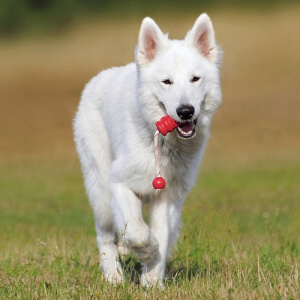
White ShepherdCharacteristics, history, training and care
The White Shepherd is a white-coated herding dog developed from German Shepherd stock and recognised by the United Kennel Club. It is an active working breed that needs exercise, training and social contact. Its registry identity should not be automatically exchanged with that of the White Swiss Shepherd.
Quick facts
| Common name | White Shepherd |
| Scientific name | Canis lupus familiaris |
| Country of origin | USA / Canada |
| Official Recognition | Recognised as a separate breed by the United Kennel Club; other registries use different classifications |
| Typical lifespan | About 12-14 years |
| Dimensions (Male) | About 60-66 cm / 30-40 kg |
| Dimensions (Female) | About 55-61 cm / 25-35 kg |
| Coat type | Double, thick, medium or long |
| Common colours | White |
| Energy Level | High |
| Suitable for an apartment? | Depends on exercise, training, health and the individual dog |
| Temperament | Smart, loyal, protective |
| Behaviour towards unfamiliar people and dogs | Individual behaviour varies; socialisation, training and management matter |
| Compatibility with children | Depends on the individual; adult supervision and suitable handling are essential |
| Compatibility with other animals | Depends on socialisation, prey drive and the animals involved |
| Health considerations | Hip and elbow dysplasia, skin allergies, degenerative myelopathy, bloat |
- Primary category:Dog breeds
- Explore this animal's categories:
History and Origin
The White Shepherd is a descendant of the German Shepherd, bred specifically for its white coat.
Evolution of the breed
- German Shepherd roots - White puppies have appeared in German Shepherd lines since the breed began; Greif, the grandfather of the first registered German Shepherd, Horand von Grafrath, was white.
- Excluded from the show ring - In the 20th century, white coats were banned in German Shepherd standards in Germany and later, in 1968, in the American standard.
- Development in North America - Breeders in the USA and Canada kept breeding white dogs; the White German Shepherd Dog Club of America was founded in 1969.
- Separate recognition - The United Kennel Club (UKC) recognised the White Shepherd as a separate breed in 1999; the AKC does not recognise it as a separate breed.
Breed Evaluation
The White Shepherd is an intelligent, protective and easy-to-train dog, suitable for families, dog sports and working roles. These are general editorial ratings, not measured scores; individual dogs vary.
| Characteristic | Stars |
|---|---|
| Training and Intelligence | ★★★★★ |
| Easy to train | ★★★★★ |
| Intelligence | ★★★★★ |
| Level of independence | ★★★☆☆ |
| Level of stubbornness | ★★★☆☆ |
| Behavior and Temperament | ★★★★★ |
| Affectionate with family | ★★★★★ |
| Friendly with children | ★★★★★ |
| Compatible with other dogs | ★★★★☆ |
| Compatible with cats and other animals | ★★★★☆ |
| Degree of loyalty | ★★★★★ |
| Tendency to be aggressive | ★★☆☆☆ |
| Tendency to bark | ★★★☆☆ |
| Needs and Care | ★★★☆☆ |
| Shedding level | ★★★★☆ |
| Requires frequent care | ★★★☆☆ |
| Activity and Lifestyle | ★★★★★ |
| Energy level | ★★★★★ |
| Daily exercise requirement | ★★★★★ |
| Suitable for apartment living | ★★☆☆☆ |
| Health and Longevity | ★★★★☆ |
| Life expectancy | ★★★★☆ |
| Predisposition to genetic diseases | ★★★☆☆ |
| Work and Utility Features | ★★★★★ |
| Good guard dog | ★★★★★ |
| Good companion dog | ★★★★★ |
Physical Characteristics
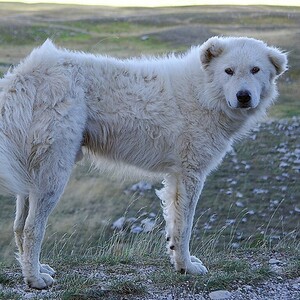
The White Shepherd is an elegant, muscular, well-proportioned dog with a strong, noble look.
General appearance
- An athletic, muscular body, slightly longer than tall, usually with a straighter back than many show-line German Shepherds.
- A white double coat, medium or long, that protects it from cold and heat.
- Large, erect, triangular ears that give it an alert expression.
- A long muzzle and strong jaws, typical of working shepherds.
- A long, bushy tail, hanging in a slight curve.
- Dark, almond-shaped eyes with a gentle, intelligent expression; the nose, lips and eye rims are dark.
| Characteristic | White Shepherd |
|---|---|
| Size | Medium to large (about 55-66 cm at the shoulder) |
| Weight | About 25-40 kg |
| Coat | Double, thick, white |
| Muzzle | Long, strong |
| Shedding tendency | High |
| Build | Strong and athletic |
The White Shepherd is a powerful but elegant dog with an intelligent, trustworthy expression.
Training and Socialization
The White Shepherd is intelligent and easy to train, with a strong wish to learn and please its owner. However, it needs early socialisation and consistent training, as it can become reserved or over-protective with strangers.
Tips for effective training
- Start early - Puppies learn very quickly from about 8-12 weeks old.
- Reward-based training - This breed responds best to praise, play and treats.
- Wide socialisation - It should meet new people, animals and places to prevent shyness or reactivity towards strangers.
- Impulse control - As a working dog, it benefits from learning commands such as "sit", "wait" and "release".
- Avoid boredom - Repetitive training can make it lose interest, so exercises should be varied.
Good training and wide socialisation make the White Shepherd a balanced, obedient and reliable dog.
Activity and Lifestyle Needs
The White Shepherd is an active breed that needs plenty of physical and mental stimulation. Without enough activity, it may become destructive or anxious.
| Activity | Recommended duration |
|---|---|
| Daily walks | About 60-90 min |
| Interactive games | About 30 min |
| Obedience training | About 15-30 min |
| Dog sports (agility, tracking, herding) | Recommended |
Recommendations for a balanced lifestyle
- Needs space - It is happiest with a large garden, but can adapt to an apartment if it gets enough exercise.
- Needs mental challenges - Besides exercise, it needs puzzle toys, obedience training and tasks.
- Good at dog sports - It does very well in agility, canicross, tracking and herding.
- Does not like being alone - If left alone too long, it can develop separation anxiety.
This breed is not for people with a quiet lifestyle, but it suits active families and people who want a working partner.
Care and Health
The White Shepherd is not hard to care for, but it should be monitored for inherited problems shared with the German Shepherd.
Fur and skin care
- Brushing 2-3 times a week - The double coat sheds a lot and should be brushed regularly, daily during seasonal shedding.
- Occasional baths - The coat tends to shed dirt once dry, so frequent baths are not needed.
- Checking ears and claws – Ears should be cleaned regularly and claws trimmed if they don't grow naturally.
Common health problems
| Condition | Description | Common symptoms |
|---|---|---|
| Hip and elbow dysplasia | Abnormal development of the joints | Lameness, stiff gait |
| Degenerative myelopathy | Heritable neurological disorder affecting gait | Gradual loss of control of the hind legs |
| Skin allergies | Sensitivity to some allergens, including foods | Itching, skin irritation |
| Bloat (gastric torsion) | The stomach swells and may twist; more likely after eating quickly or exercising after meals | Swollen belly, restlessness, breathing difficulty |
Other aspects of care
- Weight control - Food should match its activity, as extra weight can make joint problems worse.
- Regular veterinary checks - Yearly check-ups help find inherited problems early.
The White Shepherd is generally healthy and strong, but its joints and diet need attention.
Diet and Nutrition
The White Shepherd needs a balanced diet with good-quality protein to support its activity and muscles.
Recommendations for a healthy diet
Choose a complete, balanced diet suited to age, size and health. Plan home-prepared diets and supplements with a qualified veterinarian; raw pet food can carry harmful bacteria.
| Food type | Daily Amount (Adults) | Frequency |
|---|---|---|
| Premium dry food | Individual amount; follow complete-food guidance and veterinary advice | 2 meals/day |
| Home cooked food | Individual amount; follow a complete diet’s guidance and veterinary advice | 2 meals/day |
| Raw food: bacterial contamination is a concern | Individual amount; follow a complete diet’s guidance and veterinary advice | 2 meals/day |
Forbidden foods
Chocolate, grapes and raisins, onions and xylitol - toxic to dogs. / Cooked bones - can splinter and cause intestinal blockage. / Fatty foods - can lead to digestive problems and pancreatitis. / Overfeeding - can lead to obesity, which affects the joints.
The White Shepherd should be fed properly to keep its energy and healthy joints.
Reproduction and Development
Breeding requires veterinary planning, suitable health screening and care for the mother and puppies. Pregnancy and birth can involve complications.
Physical and emotional maturity
- Physical maturity: It grows quickly in the first year and is usually fully developed at about 18-24 months.
- Emotional maturity: It usually becomes calmer and easier to manage at about 2-3 years.
Mating and Gestation
- Breeding decisions require veterinary assessment of maturity, health and suitable screening; a fixed age does not establish that breeding is appropriate.
- Duration of gestation: Approximately 58-68 days, usually about 63 days.
- Average number of puppies: Usually about 5-10 puppies.
Puppy care
- The first 3 weeks: Puppies depend completely on their mother for warmth, milk and protection.
- Between 4-8 weeks: They begin to play, explore and develop their personality; good socialisation is essential.
- Moving to a new home: When puppies go to their new homes, they should start basic training and learn house rules.
The White Shepherd grows quickly, and early socialisation is essential for a balanced character.
Curiosities and Interesting Facts
- German roots, American breed - Although it descends from the German Shepherd, it was developed and first recognised as a separate breed in North America.
- Banned for its colour - White German Shepherds were excluded from show standards because of their colour, which led breeders to develop them as a separate breed.
- White, but not albino - White Shepherds have dark eyes, nose and skin pigment; their white colour comes from a recessive gene.
- A European cousin - In Europe, a similar breed, the White Swiss Shepherd (Berger Blanc Suisse), is recognised by the FCI.
- Therapy and assistance - Thanks to their calm, gentle nature, some White Shepherds work as therapy, assistance and search-and-rescue dogs.
- Protective but gentle - It is watchful and protective, but usually calm and friendly when well socialised.
The Dog in Popular Culture
The White Shepherd is less famous than the German Shepherd, but its striking white coat makes it easy to recognise.
American White Shepherd in Modern Media and Culture
- Search and rescue - In some areas, White Shepherds are used in search and rescue thanks to their good nose and trainability.
- Films and photos - Its striking white coat makes it popular in photographs, advertising and film.
Importance in modern culture
- A family dog - Thanks to its balanced, friendly temperament, it is chosen by families who want a watchful but gentle dog.
- An example of breed history - The White Shepherd shows how a coat colour excluded from one breed standard can lead to the creation of a new breed.