Nova Scotia Duck Tolling RetrieverCharacteristics, history, training and care
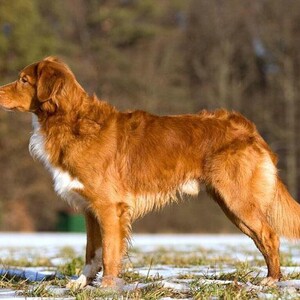
Nova Scotia Duck Tolling Retriever. · Cal119 / Wikimedia Commons, public domain. Cropped and resized.
The Nova Scotia Duck Tolling Retriever (Toller) is a medium-sized retriever, red or orange, with a water-repellent coat. It was developed in Nova Scotia at the beginning of the 19th century to lure ducks by playing on the shore and then retrieve them from the water. The standard describes it as highly intelligent, easy to train and full of stamina.
Quick facts
| Common name | Nova Scotia Duck Tolling Retriever (Toller) |
| Scientific name | Canis lupus familiaris |
| Country of origin | Canada (Nova Scotia) |
| Official recognition | FCI, definitively since 30 November 1981 (group 8, retrievers; standard no. 312); also recognised by the AKC |
| Lifespan | 12–14 years, according to the AKC |
| Size (males) | ideally 48–51 cm at the withers; 20–23 kg |
| Size (females) | ideally 45–48 cm at the withers; 17–20 kg |
| Coat type | Double, water-repellent, of medium length and softness |
| Common colours | Shades of red or orange, usually with white markings |
| Energy level | Very high |
| Suited to an apartment? | Only with a great deal of exercise |
| Temperament | Highly intelligent, easy to train, full of stamina |
| Tendency to aggression | Low |
| Good with children | Very good, according to the AKC |
| Good with other animals | Good, according to the AKC |
| Genetic predispositions | Hip dysplasia, progressive retinal atrophy, Addison's disease, cleft palate |
- Primary category:Dog breeds
- Explore this animal's categories:
History and origin
The FCI standard says the breed was developed in Nova Scotia at the beginning of the 19th century to lure (“toll”) and retrieve waterfowl. The dog runs, jumps and plays along the shoreline, in full view of a flock of ducks, occasionally disappearing and reappearing, helped by the hidden hunter, who throws it small sticks or a ball.
Its play arouses the curiosity of the ducks, which swim towards the shore, within gunshot range. Wikipedia says it is the smallest of the retrievers, that it is often mistaken for a small Golden Retriever and that it is the provincial dog of Nova Scotia.
How the breed developed
- Early 19th century – The breed appears in Nova Scotia.
- 30 November 1981 – The FCI recognises the breed.
- 24 June 1987 – The current FCI standard is published.
Breed rating
| Feature | Stars |
|---|---|
| Training and intelligence | ★★★★★ |
| Easy to train | ★★★★★ |
| Intelligence | ★★★★☆ |
| Independence | ★★★☆☆ |
| Stubbornness | ★★★★☆ |
| Behaviour and temperament | ★★★★★ |
| Affectionate with family | ★★★★★ |
| Friendly with children | ★★★★★ |
| Good with other dogs | ★★★★☆ |
| Good with cats and other animals | ★★★☆☆ |
| Loyalty | ★★★★★ |
| Tendency to be aggressive | ★☆☆☆☆ |
| Tendency to bark | ★★☆☆☆ |
| Needs and care | ★★★☆☆ |
| Shedding | ★★★☆☆ |
| Needs frequent grooming | ★★☆☆☆ |
| Activity and lifestyle | ★★★★★ |
| Energy level | ★★★★★ |
| Daily exercise needs | ★★★★☆ |
| Suited to apartment life | ★★★☆☆ |
| Health and longevity | ★★★★☆ |
| Life expectancy | ★★★★☆ |
| Predisposition to genetic diseases | ★★★☆☆ |
| Working abilities and uses | ★★★☆☆ |
| Good hunting dog | ★★★★★ |
| Good companion dog | ★★★★★ |
Indicative rating: 5 stars means the highest level. It is based on the ratings the American Kennel Club gives the breed and on the FCI standard.
Physical characteristics
The standard describes it as a medium-sized, powerful, compact, balanced and muscular dog, very agile, alert and determined. Many Tollers have a slightly sad expression until they start work, when they become focused and enthusiastic.
General appearance
It was bred to retrieve game from icy waters, so it has a double, water-repellent coat of medium length, with a soft, dense undercoat. It has soft feathering on the throat, behind the ears and on the backs of the thighs. Wikipedia says it also has webbing between its toes.
| Feature | Nova Scotia Duck Tolling Retriever |
|---|---|
| Size | Medium |
| Height at the withers | males: 48–51 cm; females: 45–48 cm |
| Weight | males: 20–23 kg; females: 17–20 kg |
| Coat | Double, water-repellent |
| Feet | Webbed |
| Tail | Bushy, always moving when it works |
The colour is red or orange, in various shades, with lighter feathering and underside of the tail. It usually has at least one white marking: the tip of the tail, the feet, the chest or a blaze on the face.
Training and socialisation
The standard describes it as highly intelligent, easy to train and full of stamina, a strong swimmer and a natural retriever, on land and in water.
The AKC says it often has a curious mix of stubbornness and softness, “with the mind of a Chesapeake and the heart of a spaniel”. It responds well to reward-based training and generally wants to please its owner.
Tips for effective training
- Use rewards. It responds well to them.
- Be patient. It can be stubborn.
- Give it a job. Retrieving and swimming are its favourites.
- Keep sessions varied. It has a great need for mental activity.
Activity needs and lifestyle
The AKC says most Tollers have medium to high energy and are not content without daily exercise. A brisk 30-minute walk and a few retrieving sessions a day are enough for many, but some need more.
| Activity | How often | Why it matters |
|---|---|---|
| Brisk walk | at least 30 minutes a day | High energy |
| Ball retrieving | several times a day | Retriever instinct |
| Swimming | whenever possible | A water dog |
Tips for a balanced life
- It suits active families.
- Dry its ears after swimming.
- Do not let it get bored.
Care and health
Coat and skin care
The AKC says the coat should be brushed weekly, and often daily during the shedding season. Pay attention to the hair near and under the ears, which is finer and tangles more easily. Tollers are shown as naturally as possible, with minimal trimming.
Common health problems
The AKC says it is a fairly healthy breed, with a life expectancy of 12–14 years. Breeders test their dogs for:
| Condition | Description | Common symptoms |
|---|---|---|
| Hip dysplasia | The hip joint forms incorrectly and, over time, arthritis develops | Limping, difficulty getting up or jumping, hip pain |
| Progressive retinal atrophy | The retina gradually degenerates | Has trouble seeing at night, then sees less and less well |
| Addison's disease | The adrenal glands do not produce enough hormones; it often appears in middle age | Weakness, vomiting, weight loss |
| Cleft palate and syndactyly | Inherited malformations detected by DNA test | Suckling problems in puppies, fused toes |
Other care
- Ask for the parents' DNA tests.
- Check the ears after swimming.
- Trim the nails regularly.
Diet and nutrition
The AKC says some dogs gain weight easily, so calories and weight should be watched.
Tips for a healthy diet
The table gives a starting estimate, calculated with the formula from the Merck Veterinary Manual. The first two calorie columns show the calories per day for a healthy adult dog. The last column shows what this means in dry food with 3,500–4,000 kcal per kilogram.
| Dog's weight | Calories per day (neutered) | Calories per day (not neutered) | Dry food per day (approximate) |
|---|---|---|---|
| 17 kg | 940 kcal | 1,050 kcal | 240–300 g |
| 20 kg | 1,060 kcal | 1,190 kcal | 260–340 g |
| 23 kg | 1,180 kcal | 1,320 kcal | 300–380 g |
- Split the food into two meals a day.
- Training treats count towards the daily portion.
- A dog is at the right weight when you can feel its ribs under the coat without pressing hard.
Foods to avoid
Some human foods are dangerous for dogs: chocolate, coffee, grapes and raisins, onions, garlic, xylitol (a sweetener used in chewing gum), macadamia nuts and alcohol.
Reproduction and development
Physical and emotional maturity
In dogs, sexual maturity usually comes between 6 and 12 months. Most breeds become adults at around 13–15 months.
Mating and pregnancy
Pregnancy lasts about 63 days, counted from ovulation. Mating a female on her first heat is not recommended. The FCI standard requires that only healthy dogs of typical breed appearance are used for breeding.
Caring for the puppies
In dogs, a litter has 5–6 puppies on average, and the number rises with the size of the breed. Socialisation starts in the first weeks: gentle handling, everyday noises and new people.
Interesting facts
- It lures ducks by playing. Its play on the shore arouses the ducks' curiosity.
- The smallest retriever. Wikipedia says it is the smallest of the retrievers.
- Webbed feet. It has webbing between its toes.
- A sad expression. It looks sad until it starts work.
- The provincial dog. It is the dog of the Canadian province of Nova Scotia.
Frequently asked questions
What does “tolling” mean?
Luring ducks within gunshot range by playing on the shore.
Is it a small Golden Retriever?
No. It is a separate breed, often mistaken for a small Golden.
How big does it get?
Males measure 48–51 cm and weigh 20–23 kg; females measure 45–48 cm and weigh 17–20 kg.
How long does it live?
The AKC gives 12–14 years.