Catahoula Leopard DogCharacteristics, history, training and care
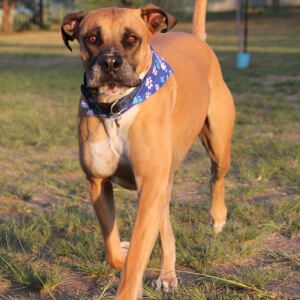
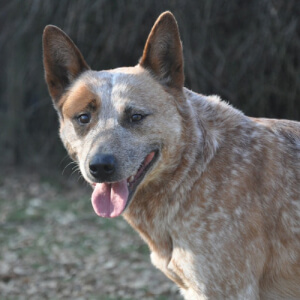
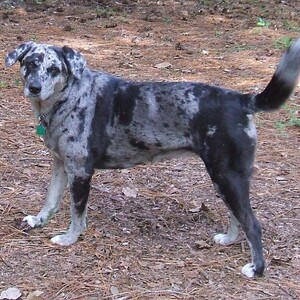
Catahoula Leopard Dog. · Noles1984 / Wikimedia Commons, public domain. Cropped and resized.
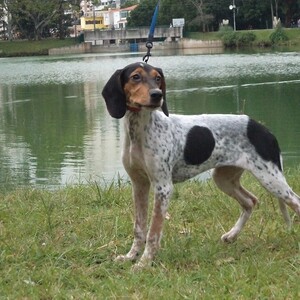
The Catahoula Leopard Dog is an American working dog from Louisiana, with a coat often spotted like a leopard (merle) and eyes that can be any colour, even a different colour in each eye. The AKC describes it as loyal, vigilant and independent, very energetic, with a constant need for a job. Since 1979 it has been the official state dog of Louisiana. It is not recognised by the FCI.
Quick facts
| Common name | Catahoula Leopard Dog (Catahoula) |
| Scientific name | Canis lupus familiaris |
| Country of origin | USA (Louisiana) |
| Official recognition | Not recognised by the FCI; UKC since 1995; the AKC has it in the Foundation Stock Service since 1996 |
| Lifespan | 10–14 years, according to the AKC |
| Size (males) | 56–61 cm at the withers; 23–43 kg according to the AKC |
| Size (females) | 56–61 cm at the withers; 23–43 kg according to the AKC |
| Coat type | Single, short and smooth or medium and coarse |
| Common colours | Blue merle, red merle, brindle, solid colours |
| Energy level | Very high |
| Suited to an apartment? | No, according to the AKC |
| Temperament | Loyal, vigilant, independent, territorial |
| Tendency to aggression | Moderate; territorial |
| Good with children | Moderate |
| Good with other animals | Moderate |
| Genetic predispositions | Hip dysplasia, deafness, eye diseases |
- Primary category:Dog breeds
- Explore this animal's categories:
History and origin
The AKC says that in 1539, when the Spanish explorer Hernando de Soto landed in Florida, his scribes noted that North America had only one domestic animal: the Indians' dog, which looked like a wolf but barked like a dog. These dogs were later crossed with dogs brought by the Spanish and, later still, with French hounds. Wikipedia says that in the mid-18th century French settlers crossed the local dogs with the Beauceron.
The first settlers around Catahoula Lake, in Louisiana, used these dogs to catch wild hogs and cattle. On 9 July 1979, Governor Edwin Edwards declared it the official state dog of Louisiana; the UKC recognised it in 1995, and the AKC admitted it to the Foundation Stock Service in 1996.
How the breed developed
- 1539 – Hernando de Soto notes the Indians' dogs.
- Mid-18th century – Crosses with French dogs.
- 9 July 1979 – Official state dog of Louisiana.
- 1995 – Recognised by the UKC.
- 1996 – Enters the Foundation Stock Service (AKC).
Breed rating
| Feature | Stars |
|---|---|
| Training and intelligence | ★★★☆☆ |
| Easy to train | ★★★★☆ |
| Intelligence | ★★★☆☆ |
| Independence | ★★★☆☆ |
| Stubbornness | ★★★★★ |
| Behaviour and temperament | ★★★☆☆ |
| Affectionate with family | ★★★☆☆ |
| Friendly with children | ★★★☆☆ |
| Good with other dogs | ★★★★☆ |
| Good with cats and other animals | ★☆☆☆☆ |
| Loyalty | ★★★★★ |
| Tendency to be aggressive | ★★☆☆☆ |
| Tendency to bark | ★★★★☆ |
| Needs and care | ★★★☆☆ |
| Shedding | ★★★★★ |
| Needs frequent grooming | ★★★☆☆ |
| Activity and lifestyle | ★★★☆☆ |
| Energy level | ★★★☆☆ |
| Daily exercise needs | ★★★★★ |
| Suited to apartment life | ★★★★☆ |
| Health and longevity | ★★★☆☆ |
| Life expectancy | ★★★★☆ |
| Predisposition to genetic diseases | ★★☆☆☆ |
| Working abilities and uses | ★★☆☆☆ |
| Good working dog | ★★★★★ |
| Good companion dog | ★★★★☆ |
Indicative rating: 5 stars means the highest level. It is based on the ratings the American Kennel Club gives the breed; the breed is not recognised by the FCI.
Physical characteristics
Wikipedia says it is usually muscular, with a rectangular body, a large head, drop ears, a strong muzzle, a thick neck and a long, curved tail. The eyes can be any colour or combination: blue, brown, green or amber.
General appearance
Wikipedia says it has a single coat, either short and smooth or medium-length and coarse.
| Feature | Catahoula Leopard Dog |
|---|---|
| Size | Large |
| Height at the withers | 56–61 cm (AKC) |
| Weight | 23–43 kg (AKC) |
| Coat | Short or medium |
| Eyes | Any colour |
| Type | Working dog |
Wikipedia says it comes in many colours: blue merle, red merle, brindle and solid colours. The “leopard” look comes from the merle gene. Darker colours are preferred, and a mostly white coat is not desirable.
Training and socialisation
The AKC describes it as loyal, vigilant and independent. Without training and mental stimulation, it can become destructive in the house. Being independent and territorial, socialisation is very important for it to be a gentle, affectionate companion.
The AKC says it works like an adult from as early as 10 months, but needs a firm, consistent owner.
Tips for effective training
- Always give it a job. Otherwise it becomes destructive.
- Socialise it early. It is territorial.
- Be firm and consistent. It is independent.
- Do not keep it in a flat. The AKC says it is not suitable.
Activity needs and lifestyle
The AKC says it needs space to burn off its very high energy and always needs a job. It is not suited to the city or a flat; without exercise and attention, it starts digging and chewing.
| Activity | How often | Why it matters |
|---|---|---|
| Running | daily | Energy |
| Working livestock or hunting | weekly | Instinct |
| Training | several times a week | A busy mind |
Tips for a balanced life
- Suits very active owners with a yard.
- Trim its nails often.
- Check the ears regularly.
Care and health
Coat and skin care
The AKC recommends weekly brushing and the occasional bath. The nails grow quickly and should be trimmed regularly, and the ears checked often.
Common health problems
The AKC says most are healthy, but occasionally the following occur:
| Condition | Description | Common symptoms |
|---|---|---|
| Hip dysplasia | The hip joint forms incorrectly and, over time, arthritis develops | Limping, difficulty getting up or jumping, hip pain |
| Deafness | A hereditary condition | Does not react to sounds |
| Eye diseases | Inherited conditions | Poor vision |
Other care
- Ask for the puppy's hearing test.
- Trim the nails regularly.
- Go for yearly check-ups.
Diet and nutrition
The AKC recommends good-quality food suited to the dog's age, and attention to its weight.
Tips for a healthy diet
The table gives a starting estimate, calculated with the formula from the Merck Veterinary Manual. The first two calorie columns show the calories per day for a healthy adult dog. The last column shows what this means in dry food with 3,500–4,000 kcal per kilogram.
| Dog's weight | Calories per day (neutered) | Calories per day (not neutered) | Dry food per day (approximate) |
|---|---|---|---|
| 23 kg | 1,180 kcal | 1,320 kcal | 300–380 g |
| 32 kg | 1,510 kcal | 1,700 kcal | 380–490 g |
| 43 kg | 1,880 kcal | 2,120 kcal | 470–610 g |
- Adjust the portion to its level of effort.
- Do not let it run right after a meal.
- A dog is at the right weight when you can feel its ribs without pressing hard.
Foods to avoid
Some human foods are dangerous for dogs: chocolate, coffee, grapes and raisins, onions, garlic, xylitol (a sweetener used in chewing gum), macadamia nuts and alcohol.
Reproduction and development
Physical and emotional maturity
In dogs, sexual maturity usually comes between 6 and 12 months, but in large breeds it can be delayed until about two years. The body also reaches its adult form later than in small breeds.
Mating and pregnancy
Pregnancy lasts about 63 days, counted from ovulation. Mating a female on her first heat is not recommended. Only healthy dogs of typical breed appearance should be used for breeding.
Caring for the puppies
In large breeds, a litter has around 7 puppies on average. Socialisation starts in the first weeks: gentle handling, everyday noises and new people.
Interesting facts
- Louisiana's dog. Since 1979.
- Eyes of any colour. Even different from each other.
- Spotted like a leopard. Thanks to the merle gene.
- Seen by Hernando de Soto. In 1539.
- A wild hog hunter. That is what it was used for.
Frequently asked questions
Is it recognised by the FCI?
No; it is recognised by the UKC.
What colour are its eyes?
Any colour, even a different colour in each eye.
Is it suitable for a flat?
No, according to the AKC.
How long does it live?
The AKC gives 10–14 years.