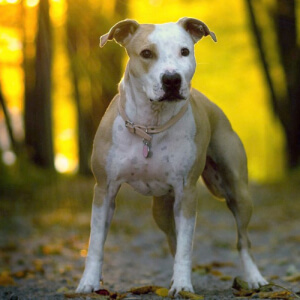
American Pit Bull TerrierCharacteristics, history, training and care
The American Pit Bull Terrier (APBT) is a medium-sized dog with a short coat and a muscular body, whose ancestors came from England. The American club UKC describes it in terms of strength and confidence: eager to please its owner and full of enthusiasm. In Romania it is classed as a dangerous dog and strict ownership rules apply.
Quick facts
| Common name | American Pit Bull Terrier (APBT) |
| Scientific name | Canis lupus familiaris |
| Country of origin | USA (ancestors from England and Ireland) |
| Official recognition | UKC (since 1898) and ADBA (since 1909); not recognised by the FCI or the AKC |
| Lifespan | 12–14 years (Wikipedia) |
| Size (males) | 45–53 cm at the withers; 15–27 kg |
| Size (females) | 43–50 cm at the withers; 13–22 kg |
| Coat type | Short, smooth, glossy, harsh to the touch |
| Common colours | Almost all colours, except merle |
| Energy level | High |
| Suited to an apartment? | Only with plenty of daily exercise |
| Temperament | Strong, confident, enthusiastic, eager to please |
| Tendency to aggression | Aggression towards people disqualifies a dog under the ADBA standard |
| Good with children | Only under close supervision |
| Good with other animals | Needs careful socialisation from an early age; many lines come from fighting dogs |
| Genetic predispositions | Hip dysplasia, degenerative myelopathy, patellar luxation, demodectic mange, skin allergies |
| In Romania | Dangerous dog (OUG 55/2002): neutering, muzzle, lead and insurance are compulsory |
- Primary category:Dog breeds
- Explore this animal's categories:
History and origin
Wikipedia says that, up to the middle of the 19th century, old English terriers were crossed with old English bulldogs in England. The result was the dog known as the “bull and terrier”, which had the courage of a terrier and the strength of a bulldog. These dogs reached the USA in the second half of the 19th century and are the direct ancestors of the breed.
In Britain they were used for bull-baiting and bear-baiting, which were banned in 1835. The fighting then moved to dog against dog, which was easier to hide. In the USA, in the early 20th century, pit bulls caught semi-wild cattle and pigs and were also family dogs.
The UKC recognised the breed on 10 February 1898, and the ADBA has registered it since 1909. In 1936, the AKC took about 50 dogs from the UKC registry under the name Staffordshire Terrier, a breed now called the American Staffordshire Terrier. Since 2015, the ADBA has treated them as two separate breeds.
How the breed developed
- Mid-19th century – The “bull and terrier” appears in England.
- 1835 – Britain bans bull-baiting and bear-baiting.
- 1889 – John P. Colby starts one of the best-known lines of the breed.
- 10 February 1898 – UKC recognition.
- 1909 – The ADBA starts registering the breed.
- 10 June 1936 – About 50 UKC dogs enter the AKC registry as Staffordshire Terriers.
- 2002 – In Romania, Emergency Ordinance OUG 55/2002 lists it among dangerous dogs.
Breed rating
| Feature | Stars |
|---|---|
| Training and intelligence | ★★★★☆ |
| Easy to train | ★★★★☆ |
| Intelligence | ★★★★☆ |
| Independence | ★★★☆☆ |
| Stubbornness | ★★★☆☆ |
| Behaviour and temperament | ★★★☆☆ |
| Affectionate with family | ★★★★★ |
| Friendly with children | ★★★☆☆ |
| Good with other dogs | ★☆☆☆☆ |
| Good with cats and other animals | ★★☆☆☆ |
| Loyalty | ★★★★★ |
| Tendency to be aggressive | ★★★☆☆ |
| Tendency to bark | ★★☆☆☆ |
| Needs and care | ★★☆☆☆ |
| Shedding | ★★☆☆☆ |
| Needs frequent grooming | ★☆☆☆☆ |
| Activity and lifestyle | ★★★★☆ |
| Energy level | ★★★★★ |
| Daily exercise needs | ★★★★★ |
| Suited to apartment life | ★★☆☆☆ |
| Health and longevity | ★★★★☆ |
| Life expectancy | ★★★★☆ |
| Predisposition to genetic diseases | ★★★☆☆ |
| Working abilities and uses | ★★★★☆ |
| Good dog for dog sports | ★★★★☆ |
| Good companion dog | ★★★★☆ |
Indicative rating: 5 stars means the highest level. The breed has no FCI standard and no AKC profile; the rating is based on the UKC description and on Wikipedia.
Physical characteristics
The ADBA standard describes it as a medium-sized dog with a short coat and smooth, well-defined muscles. The eyes are round or almond-shaped, and the ears are small or medium, half-pricked or “rose” (folded back). The tail is slightly thick and tapers to the tip.
General appearance
Wikipedia says it is larger than the Staffordshire Bull Terrier, by 15–20 cm in height and 11–16 kg in weight. Dogs at UKC shows are usually heavier and more massive than those in the ADBA registry.
| Feature | American Pit Bull Terrier |
|---|---|
| Size | Medium |
| Height at the withers | males: 45–53 cm; females: 43–50 cm |
| Weight | males: 15–27 kg; females: 13–22 kg |
| Coat | Short, smooth, glossy |
| Ears | Small or medium, half-pricked or “rose” |
| Tail | Slightly thick, tapering to the tip |
The ADBA accepts many colours and combinations. Merle (irregular patches on a lighter background) is not accepted by the ADBA or the UKC. The “Old Family Red Nose” line has a reddish nose, lips and nails.
Training and socialisation
The UKC says the breed does very well in competitions thanks to its intelligence and willingness to work. For such a powerful dog, obedience training is not optional: it must start in puppyhood and continue throughout its life, with rewards and clear rules.
The ADBA standard disqualifies aggression towards people. However, many lines come from dogs bred for fighting, so early socialisation with new people, dogs and places matters a great deal.
Tips for effective training
- Start in puppyhood. It is strong even when young.
- Use rewards. It wants to please its owner.
- Socialise it with other dogs. Many lines come from fighting dogs.
- Be consistent. The rules must be the same for the whole family.
Activity needs and lifestyle
It has lots of energy and stamina. Wikipedia says it excels at weight pulling, agility, flyball, lure coursing and obedience. The UKC warns that it is one of the best climbers among dogs, so the fence must be high and solid.
In Romania, OUG 55/2002 places it in category I of dangerous dogs, together with dogs that resemble the pit bull. The dog must be neutered and insured against damage caused to others. In the street it must wear a muzzle and be on a lead, and it is not allowed in public venues or on public transport.
| Activity | How often | Why it matters |
|---|---|---|
| Long walks on the lead | daily | Keeps it fit |
| Dog sports or tug-of-war | several times a week | Burns off energy |
| Obedience exercises | daily, a few minutes | Keeps it under control |
Tips for a balanced life
- For experienced owners.
- A high, solid fence.
- Follow the rules of OUG 55/2002.
Care and health
Coat and skin care
The short coat should be brushed once a week. Wikipedia says that, because of its short coat, the breed can have skin problems such as mange and allergies. Check the skin often, especially in puppies.
Common health problems
Wikipedia describes it as a hardy dog that lives 12–14 years, longer than many breeds of the same size. If unvaccinated, it catches parvovirus more easily than other breeds, especially as a puppy. Problems to watch for are:
| Condition | Description | Common symptoms |
|---|---|---|
| Hip dysplasia | The hip joint forms incorrectly and, over time, arthritis develops | Limping, difficulty getting up or jumping, hip pain |
| Patellar luxation | The kneecap slips out of place | Suddenly holds a hind leg up for a few steps, then uses it again |
| Degenerative myelopathy | A disease of the spinal cord that slowly worsens, in older dogs | Unsteady gait; the hind legs cross or drag |
| Demodectic mange | Mites that live in the hair follicles and multiply when immunity is weak | Hairless patches on the head and feet; in the severe form, all over the body, with crusts |
| Skin allergies | The skin reacts to food, pollen or dust | Itching, redness, frequent licking of the feet |
Other care
- Vaccinate the puppy against parvovirus on time.
- Ask for the parents' hip tests.
- Yearly check-ups, including the skin and thyroid.
Diet and nutrition
A muscular, active dog needs good-quality, protein-rich food, in portions suited to its activity. Excess weight puts strain on its joints.
Tips for a healthy diet
The table gives a starting estimate, calculated with the formula from the Merck Veterinary Manual. The first two calorie columns show the calories per day for a healthy adult dog. The last column shows what this means in dry food with 3,500–4,000 kcal per kilogram.
| Dog's weight | Calories per day (neutered) | Calories per day (not neutered) | Dry food per day (approximate) |
|---|---|---|---|
| 15 kg | 850 kcal | 960 kcal | 210–270 g |
| 20 kg | 1,060 kcal | 1,190 kcal | 260–340 g |
| 27 kg | 1,330 kcal | 1,490 kcal | 330–430 g |
- Split the food into two meals a day.
- If it has allergies, talk to the vet about a special diet.
- A dog is at the right weight when you can feel its ribs under the coat without pressing hard.
Foods to avoid
Some human foods are dangerous for dogs: chocolate, coffee, grapes and raisins, onions, garlic, xylitol (a sweetener used in chewing gum), macadamia nuts and alcohol.
Reproduction and development
Physical and emotional maturity
In dogs, sexual maturity usually comes between 6 and 12 months. Most breeds become adults at around 13–15 months.
Mating and pregnancy
Pregnancy lasts about 63 days, counted from ovulation. Mating a female on her first heat is not recommended. Only healthy dogs of typical breed appearance should be used for breeding.
Caring for the puppies
In dogs, a litter has 5–6 puppies on average, and the number rises with the size of the breed. Socialisation starts in the first weeks: gentle handling, everyday noises and new people.
Interesting facts
- A good climber. The UKC says it needs a very good fence.
- Related to the AmStaff. The American Staffordshire Terrier comes from APBT dogs registered in 1936.
- A working dog. In the USA it has been used for search and rescue, by the police and as a therapy dog.
- The “red nose” line. The Old Family Red Nose has a reddish nose and lips and reddish or amber eyes.
- Pincher. A male from the Colby line appears in the pedigree of most APBTs.
Frequently asked questions
Is it legal to own a pit bull in Romania?
Yes, but OUG 55/2002 bans importing, selling and breeding them, and the dog must be neutered and insured.
Does it have to wear a muzzle?
Yes; in the street it must wear a muzzle and be on a lead, and it is not allowed in public venues or on public transport.
Is it the same as the American Staffordshire Terrier?
They share the same origin, but the ADBA has treated them as separate breeds since 2015.
How long does it live?
Usually 12–14 years.