Portuguese PodengoCharacteristics, history, training and care
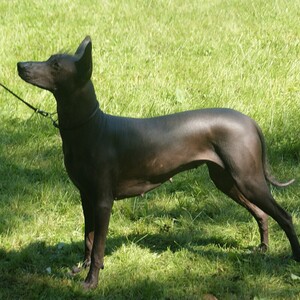
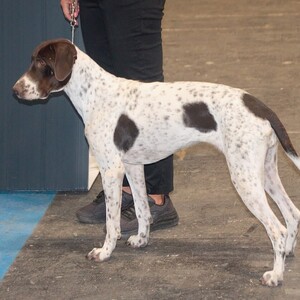
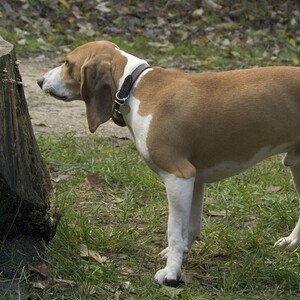
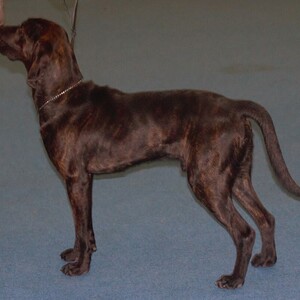
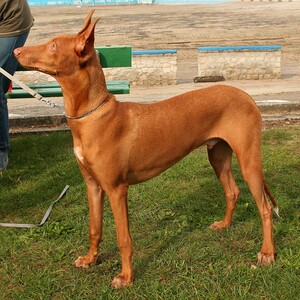
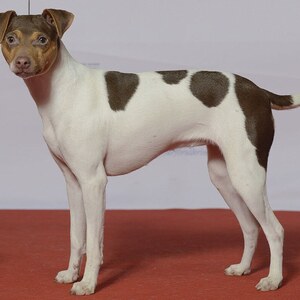
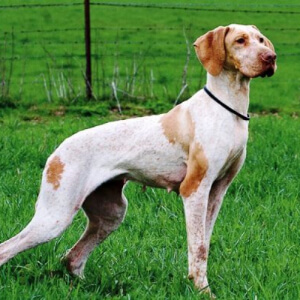
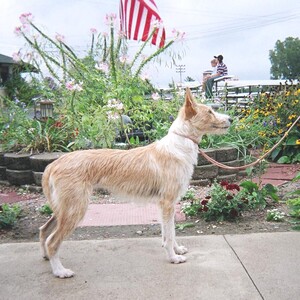
Portuguese Podengo. · Caronna / Wikimedia Commons, CC BY-SA 3.0. Cropped and resized.
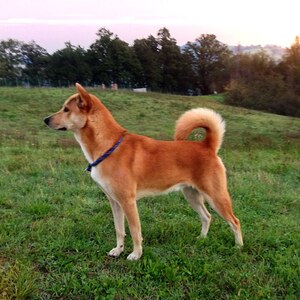
The Portuguese Podengo is a primitive-type hunting dog with a pyramid-shaped head, erect ears and a sickle tail. It comes in three sizes, small, medium and large, each with a short, smooth coat or a long, wire coat. The standard describes it as very lively and intelligent; it is used for hunting, as a guard dog and as a companion.
Quick facts
| Common name | Portuguese Podengo (Podengo Português) |
| Scientific name | Canis lupus familiaris |
| Country of origin | Portugal |
| Official recognition | FCI, definitively since 18 November 1954 (group 5, primitive type, hunting dogs; standard no. 94); the AKC recognises the small size |
| Lifespan | 12–15 years for the small size, according to the AKC |
| Size (males) | small: 20–30 cm; medium: 40–54 cm; large: 55–70 cm |
| Size (females) | the same three sizes |
| Weight | small: 4–6 kg; medium: 16–20 kg; large: 20–30 kg |
| Coat type | Short and smooth or long and wire, without undercoat |
| Common colours | Yellow and fawn, with or without white |
| Energy level | High |
| Suited to an apartment? | Yes, the small size, with exercise |
| Temperament | Lively, intelligent, independent, alert |
| Tendency to aggression | Low |
| Good with children | Very good, according to the AKC (small size) |
| Good with other animals | Very good with other dogs, according to the AKC; poor with small animals |
| Genetic predispositions | Hip dysplasia, eye diseases, patellar luxation |
- Primary category:Dog breeds
- Explore this animal's categories:
History and origin
The FCI standard says this primitive-type dog probably descends from dogs brought to the Iberian Peninsula by the Phoenicians and Romans in antiquity, and that it was later influenced by the dogs that accompanied the Moors in the 8th-century invasions.
It adapted to the terrain and climate of Portugal, and over the centuries its form changed according to its use. From the 15th century, the small size was selected as a ratter on the caravels of Portuguese navigators.
How the breed developed
- Antiquity – The Phoenicians and Romans bring dogs to the Iberian Peninsula.
- 8th century – The influence of the Moors' dogs.
- 15th century – The small size catches rats on caravels.
- 18 November 1954 – The FCI recognises the breed.
Breed rating
| Feature | Stars |
|---|---|
| Training and intelligence | ★★★☆☆ |
| Easy to train | ★★★☆☆ |
| Intelligence | ★★★★☆ |
| Independence | ★★★★☆ |
| Stubbornness | ★★★☆☆ |
| Behaviour and temperament | ★★★★☆ |
| Affectionate with family | ★★★★★ |
| Friendly with children | ★★★★★ |
| Good with other dogs | ★★★★★ |
| Good with cats and other animals | ★★☆☆☆ |
| Loyalty | ★★★★★ |
| Tendency to be aggressive | ★☆☆☆☆ |
| Tendency to bark | ★★★☆☆ |
| Needs and care | ★★★☆☆ |
| Shedding | ★★☆☆☆ |
| Needs frequent grooming | ★☆☆☆☆ |
| Activity and lifestyle | ★★★★☆ |
| Energy level | ★★★★☆ |
| Daily exercise needs | ★★★★☆ |
| Suited to apartment life | ★★★★☆ |
| Health and longevity | ★★★★☆ |
| Life expectancy | ★★★★☆ |
| Predisposition to genetic diseases | ★★☆☆☆ |
| Working abilities and uses | ★★★★☆ |
| Good hunting dog | ★★★★★ |
| Good companion dog | ★★★★☆ |
Indicative rating: 5 stars means the highest level. The rating is based on the American Kennel Club scores for the small size and on the FCI standard.
Physical characteristics
The standard describes it with a four-sided pyramid-shaped head, erect ears and a sickle tail, well proportioned, solid and muscular, very lively and intelligent.
General appearance
The coat comes in two varieties: short and smooth or long and wire, both without undercoat. In the wire variety, the muzzle has a “beard”.
| Feature | Portuguese Podengo |
|---|---|
| Sizes | small, medium and large |
| Height at the withers | 20–30 cm, 40–54 cm or 55–70 cm |
| Weight | 4–6 kg, 16–20 kg or 20–30 kg |
| Coat | Short or wire |
| Ears | Erect |
| Tail | Sickle-shaped |
The colours are yellow and fawn, in all shades, with or without white markings, or white with patches of these colours. In the small size, black and brown are also accepted, but not preferred.
Training and socialisation
The standard says the large size was used for big game, the medium for rabbits, alone or in packs, and the small for searching out rabbits in burrows and among stones. All are also used as guard dogs and companions.
The AKC says the small size is very lively and intelligent and learns quickly, but training should be fun and kept to short sessions.
Tips for effective training
- Keep sessions short and fun. This is the AKC's advice.
- Keep it on a lead. Its hunting instinct is strong.
- Use rewards. It learns quickly.
- Make sure the fence is secure. Only there can it be let loose.
Activity needs and lifestyle
The AKC says the small size needs brisk exercise every day: it has a well-deserved reputation as a tough, tireless dog. Play in a large fenced yard, a vigorous walk, agility, obedience or hunting give it the activity it needs.
| Activity | How often | Why it matters |
|---|---|---|
| Vigorous walk | daily | High energy |
| Play in a fenced yard | daily | Activity |
| Agility or obedience | weekly | Intelligence |
Tips for a balanced life
- Choose the size that suits your home.
- Only let it off the lead in safe places.
- In winter, a coat with no undercoat does not protect it from the cold.
Care and health
Coat and skin care
The AKC says it is easy to maintain: the wire coat is brushed and combed so it does not tangle, and the short coat is wiped down now and then with a damp cloth. A bath once a month is enough.
Common health problems
The AKC says the small size is generally healthy, and breeders screen their dogs for:
| Condition | Description | Common symptoms |
|---|---|---|
| Hip dysplasia | The hip joint forms incorrectly and, over time, arthritis develops | Limping, difficulty getting up or jumping, hip pain |
| Eye diseases | Inherited eye conditions | Watery eyes, poor vision |
| Patellar luxation | The kneecap slips out of place | Suddenly holds a hind leg up for a few steps, then uses it again |
Other care
- Check its paws after outings.
- Trim the nails regularly.
- Go for regular check-ups.
Diet and nutrition
The AKC says some dogs gain weight easily, so calories and weight should be watched. The amount depends greatly on size.
Tips for a healthy diet
The table gives a starting estimate, calculated with the formula from the Merck Veterinary Manual. The first two calorie columns show the calories per day for a healthy adult dog. The last column shows what this means in dry food with 3,500–4,000 kcal per kilogram.
| Dog's weight | Calories per day (neutered) | Calories per day (not neutered) | Dry food per day (approximate) |
|---|---|---|---|
| 5 kg | 370 kcal | 420 kcal | 92–120 g |
| 18 kg | 980 kcal | 1,100 kcal | 240–310 g |
| 25 kg | 1,250 kcal | 1,410 kcal | 310–400 g |
- Choose food suited to its size.
- Treats count towards the daily portion.
- A dog is at the right weight when you can feel its ribs without pressing hard.
Foods to avoid
Some human foods are dangerous for dogs: chocolate, coffee, grapes and raisins, onions, garlic, xylitol (a sweetener used in chewing gum), macadamia nuts and alcohol.
Reproduction and development
Physical and emotional maturity
In dogs, sexual maturity usually comes between 6 and 12 months. Most breeds become adults at around 13–15 months.
Mating and pregnancy
Pregnancy lasts about 63 days, counted from ovulation. Mating a female on her first heat is not recommended. The FCI standard requires that only healthy dogs of typical breed appearance are used for breeding.
Caring for the puppies
In dogs, a litter has 5–6 puppies on average, and the number rises with the size of the breed. Socialisation starts in the first weeks: gentle handling, everyday noises and new people.
Interesting facts
- A sailor. From the 15th century, the small size caught rats on caravels.
- Three sizes. Small, medium and large, which are not crossed with one another.
- A pyramid head. The standard describes its head as a four-sided pyramid.
- No undercoat. Neither the short nor the wire coat has an undercoat.
- “Wash and wear”. The AKC describes it as very easy to maintain.
Frequently asked questions
How many sizes does it come in?
Three: small, medium and large.
What does it hunt?
Mainly rabbits; the large size was used for big game.
Is it suited to an apartment?
The small size, yes, if it gets enough exercise.
How long does it live?
The AKC gives 12–15 years for the small size.