Staffordshire Bull TerrierCharacteristics, history, training and care
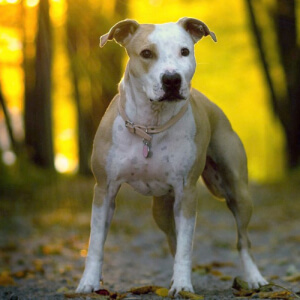
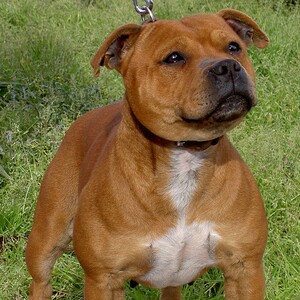
Staffordshire Bull Terrier. · Aixeneta / Wikimedia Commons, public domain. Cropped and resized.
The Staffordshire Bull Terrier (Staffy or Stafford) is a small to medium-sized English terrier with a short coat, very strong for its size, muscular, active and agile. The FCI standard describes it as having, by tradition, indomitable courage and tenacity, highly intelligent and affectionate, especially with children, bold, fearless and totally reliable. The AKC says it is “a gallon of dog poured into a quart-sized container”.
Quick facts
| Common name | Staffordshire Bull Terrier (Staffy) |
| Scientific name | Canis lupus familiaris |
| Country of origin | United Kingdom (England) |
| Official recognition | FCI, definitively since 21 October 1954 (group 3, bull-type terriers; standard no. 76); Kennel Club since 1935; also recognised by the AKC |
| Lifespan | 12–15 years, according to the AKC |
| Size (males) | 35.5–40.5 cm at the withers; 12.7–17 kg |
| Size (females) | 35.5–40.5 cm at the withers; 11–15.4 kg |
| Coat type | Smooth, short and close-lying |
| Common colours | White, red, fawn, black, blue, brindle, with or without white |
| Energy level | High |
| Suited to an apartment? | Yes, with plenty of exercise |
| Temperament | Brave, intelligent, affectionate, reliable |
| Tendency to aggression | Low towards people; can be quarrelsome with other dogs |
| Good with children | Very good, according to the standard and the AKC |
| Good with other animals | Moderate; strong prey drive |
| Genetic predispositions | Hereditary cataract, L-2-HGA, dysplasia, patellar luxation |
- Primary category:Dog breeds
- Explore this animal's categories:
History and origin
Wikipedia says the breed developed north of Birmingham and in Staffordshire, from the 19th-century bull terriers, which were produced by crossing bulldogs with various terriers. After the Cruelty to Animals Act of 1835 banned bull-baiting and bear-baiting, breeders added terrier blood for agility. The dogs had many names: “Patched Fighting Terrier”, “Staffordshire Pit-dog”, “Bull-and-Terrier”.
The AKC notes that these dogs were originally bred for fighting other dogs and that most have kept a strong prey drive. The Kennel Club recognised the breed in 1935. Wikipedia says British emigrants took dogs of this type to the United States, where, among others, they gave rise to the American Staffordshire Terrier.
How the breed developed
- 1835 – Bull-baiting is banned in England.
- 19th century – The “bull and terrier” develops in Staffordshire.
- 1935 – The Kennel Club recognises the breed.
- 21 October 1954 – The FCI recognises the breed.
Breed rating
| Feature | Stars |
|---|---|
| Training and intelligence | ★★★★★ |
| Easy to train | ★★★★★ |
| Intelligence | ★★★★★ |
| Independence | ★★★★☆ |
| Stubbornness | ★★★★★ |
| Behaviour and temperament | ★★★☆☆ |
| Affectionate with family | ★★★★★ |
| Friendly with children | ★★★★★ |
| Good with other dogs | ★★★☆☆ |
| Good with cats and other animals | ★★★★☆ |
| Loyalty | ★★★★★ |
| Tendency to be aggressive | ★★☆☆☆ |
| Tendency to bark | ★★★☆☆ |
| Needs and care | ★★★☆☆ |
| Shedding | ★★★★★ |
| Needs frequent grooming | ★★★☆☆ |
| Activity and lifestyle | ★★★★★ |
| Energy level | ★★★★★ |
| Daily exercise needs | ★★★★☆ |
| Suited to apartment life | ★★★☆☆ |
| Health and longevity | ★★★★☆ |
| Life expectancy | ★★★★☆ |
| Predisposition to genetic diseases | ★★☆☆☆ |
| Working abilities and uses | ★★★★☆ |
| Good companion dog | ★★★★★ |
| Good companion dog | ★★★★☆ |
Indicative rating: 5 stars means the highest level. It is based on the ratings the American Kennel Club gives the breed and on the FCI standard.
Physical characteristics
The standard describes it as a smooth-coated dog, well balanced, very strong for its size, muscular, active and agile. The AKC says that although it stands only 35–40 cm, it weighs 11–17 kg: it is a “rock-solid” terrier, with a short, broad head and pronounced cheek muscles.
General appearance
The coat is smooth, short and close to the body.
| Feature | Staffordshire Bull Terrier |
|---|---|
| Size | Medium |
| Height at the withers | 35.5–40.5 cm |
| Weight | males: 12.7–17 kg; females: 11–15.4 kg |
| Coat | Short, smooth |
| Head | Short and broad |
| Type | Bull-type terrier |
The standard accepts white, red, fawn, black or blue, solid or with white, and brindle in any shade, with or without white. Black and tan and liver are not accepted.
Training and socialisation
The standard describes it as very brave and tenacious, highly intelligent and affectionate, especially with children, bold, fearless and totally reliable. The AKC says it learns easily, responds quickly, is very eager to please and readily obeys its owner.
The AKC warns that, having originally been bred for fighting other dogs, most have a strong prey drive, so play with other dogs must be supervised so that it does not escalate.
Tips for effective training
- Supervise play with other dogs. It can escalate.
- Socialise it early. With people and dogs.
- Use rewards. It wants to please.
- Keep it on the lead. It has a strong prey drive.
Activity needs and lifestyle
The AKC says it needs regular exercise: chasing a ball in the garden, running alongside a bicycle or its owner, or a long hike through the woods. Running alongside a bicycle is recommended only after 18 months, when the bones have finished growing.
| Activity | How often | Why it matters |
|---|---|---|
| Long walks | daily | Fitness |
| Ball games | daily | Energy |
| Running (after 18 months) | several times a week | Stamina |
Tips for a balanced life
- It can also live in an apartment.
- Be careful when meeting other dogs.
- Very tough toys.
Care and health
Coat and skin care
The AKC says it is easy to look after: occasional baths and weekly brushing with a horsehair mitt to remove dead hair. The nails are trimmed at least monthly, as overly long nails hurt it.
Common health problems
The AKC says the breed is generally healthy, and responsible breeders screen their dogs for:
| Condition | Description | Common symptoms |
|---|---|---|
| Hereditary juvenile cataract | Clouding of the lens at a young age | Cloudy eyes, poor vision |
| L-2-HGA | Metabolic disease, detected by a DNA test | Tremors, seizures, unsteady gait |
| Hip dysplasia | The hip joint forms incorrectly and, over time, arthritis develops | Limping, difficulty getting up or jumping, hip pain |
| Patellar luxation | The kneecap slips out of place | Suddenly holds a hind leg up for a few steps, then uses it again |
Other care
- Ask for the parents' DNA tests.
- Trim the nails monthly.
- Have its eyes checked.
Diet and nutrition
The AKC recommends good-quality food suited to its age and keeping an eye on its weight, as some put on weight easily.
Tips for a healthy diet
The table gives a starting estimate, calculated with the formula from the Merck Veterinary Manual. The first two calorie columns show the calories per day for a healthy adult dog. The last column shows what this means in dry food with 3,500–4,000 kcal per kilogram.
| Dog's weight | Calories per day (neutered) | Calories per day (not neutered) | Dry food per day (approximate) |
|---|---|---|---|
| 11 kg | 680 kcal | 760 kcal | 170–220 g |
| 14 kg | 810 kcal | 910 kcal | 200–260 g |
| 17 kg | 940 kcal | 1,050 kcal | 240–300 g |
- Treats count towards the daily portion.
- Split the food into two meals a day.
- A dog is at the right weight when you can feel its ribs without pressing hard.
Foods to avoid
Some human foods are dangerous for dogs: chocolate, coffee, grapes and raisins, onions, garlic, xylitol (a sweetener used in chewing gum), macadamia nuts and alcohol.
Reproduction and development
Physical and emotional maturity
In dogs, sexual maturity usually comes between 6 and 12 months. Most breeds become adults at around 13–15 months.
Mating and pregnancy
Pregnancy lasts about 63 days, counted from ovulation. Mating a female on her first heat is not recommended. The FCI standard requires that only healthy dogs of typical breed appearance are used for breeding.
Caring for the puppies
In dogs, a litter has 5–6 puppies on average, and the number rises with the size of the breed. Socialisation starts in the first weeks: gentle handling, everyday noises and new people.
Interesting facts
- A lot of dog in a small body. The AKC says it is “a gallon of dog poured into a quart”.
- Good with children. The standard describes it as affectionate, especially with children.
- Many old names. Staffordshire Pit-dog, Bull-and-Terrier.
- Related to the Bull Terrier. They share the same ancestors, but look different.
- An American descendant. The American Staffordshire Terrier descends from it.
Frequently asked questions
Is it good with children?
Yes; the standard and the AKC describe it as very good with children.
Does it get along with other dogs?
Not always; play must be supervised.
How much does it weigh?
Males 12.7–17 kg, females 11–15.4 kg.
How long does it live?
The AKC gives 12–15 years.