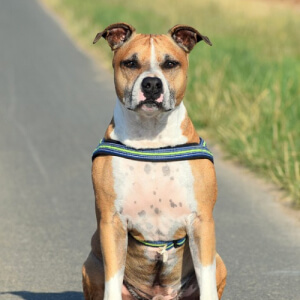
American Staffordshire TerrierCharacteristics, history, training and care
Quick facts
| Common name | American Staffordshire Terrier |
| Scientific name | Canis lupus familiaris |
| Country of origin | United States of America |
| Official Recognition | Recognised by the AKC; kennel organisations use different breed definitions |
| Typical lifespan | About 12-16 years |
| Dimensions (Male) | About 46-48 cm / 25-32 kg |
| Dimensions (Female) | About 43-46 cm / 18-27 kg |
| Coat type | Short, close, glossy |
| Common colours | Any colour, solid, parti-coloured or patched, including brindle, fawn, blue and black |
| Energy Level | High |
| Suitable for apartment? | Depends on exercise, training, health and the individual dog |
| Temperament | Friendly, brave, loyal |
| Behaviour towards unfamiliar people and dogs | Individual behaviour varies; socialisation, training and management matter |
| Compatibility with children | Depends on the individual; adult supervision and suitable handling are essential |
| Compatibility with other animals | Depends on socialisation, prey drive and the animals involved |
| Genetic predispositions | Hip dysplasia, cerebellar ataxia, heart disease, skin allergies |
- Primary category:Dog breeds
- Explore this animal's categories:
History and Origin
The American Staffordshire Terrier descends from 19th-century British bull-and-terrier dogs, which were bred from bulldogs and terriers for bull-baiting and dog fighting. After these cruel sports were banned, the breed was developed in America as a loyal, hard-working companion.
Development of the breed
- The 1800s - British breeders crossed bulldogs and terriers to create a strong, agile dog; immigrants later brought these dogs to the United States.
- The 20th century - In America, breeders selected larger, heavier dogs with a stable temperament, used as farm dogs, guardians and family companions.
- Official recognition - The AKC recognised the breed in 1936 as the "Staffordshire Terrier", separating it from the related American Pit Bull Terrier; the name was changed to American Staffordshire Terrier in 1972. It is a different breed from the English Bull Terrier.
Breed Evaluation
The American Staffordshire Terrier is a clever, strong and loyal dog, suitable for active families and experienced owners. These editorial ratings provide a general guide. Individual dogs vary with health, training and environment.
| Characteristic | Stars |
|---|---|
| Training and Intelligence | ★★★★☆ |
| Easy to train | ★★★★☆ |
| Intelligence | ★★★★☆ |
| Level of independence | ★★★☆☆ |
| Level of stubbornness | ★★★★☆ |
| Behavior and Temperament | ★★★★☆ |
| Affectionate with family | ★★★★★ |
| Friendly with children | ★★★★☆ |
| Compatible with other dogs | ★★☆☆☆ |
| Compatible with cats and other animals | ★★☆☆☆ |
| Degree of loyalty | ★★★★★ |
| Tendency to be aggressive | ★★★☆☆ |
| Tendency to bark | ★★☆☆☆ |
| Needs and Care | ★★☆☆☆ |
| Shedding level | ★★★☆☆ |
| Requires frequent care | ★★☆☆☆ |
| Activity and Lifestyle | ★★★★☆ |
| Energy level | ★★★★☆ |
| Daily exercise requirement | ★★★★☆ |
| Suitable for apartment living | ★★★☆☆ |
| Health and Longevity | ★★★★☆ |
| Life expectancy | ★★★★☆ |
| Predisposition to genetic diseases | ★★★☆☆ |
| Work and Utility Features | ★★★★☆ |
| Good guard dog | ★★★★☆ |
| Good companion dog | ★★★★★ |
Physical Characteristics
The American Staffordshire Terrier is a stocky, muscular and well-proportioned dog, with an alert expression and great strength for its size.
General appearance
- A strong, athletic body with a broad, deep chest and well-defined muscles.
- A short, close, glossy coat that needs little care.
- A broad head with a medium-length muzzle, pronounced cheek muscles and strong jaws.
- Ears set high, either natural (rose or half-prick) or cropped in countries where this is legal.
- A short tail that tapers to a point and is never docked.
| Characteristic | American Staffordshire Terrier |
|---|---|
| Size | Medium (about 43-48 cm at the shoulder) |
| Weight | About 18-32 kg |
| Coat | Short, close, glossy |
| Muzzle | Medium length, broad and strong |
| Shedding tendency | Moderate |
| Build | Stocky and muscular |
The American Staffordshire Terrier combines physical strength with agility and intelligence.
Training and Socialization
The American Staffordshire Terrier is intelligent, eager to please and very loyal, which makes it relatively easy to train. However, because it is strong and determined, it needs a calm, experienced and consistent owner.
Tips for effective training
- Early socialisation is essential - Puppies should meet many people, animals and new situations to grow into confident, friendly adults.
- Reward-based training - It responds best to positive methods such as food rewards, praise and play.
- Avoid harsh methods - It is a sensitive dog, and harsh training can cause fear and mistrust.
- Practise control commands - Commands such as "wait", "leave it" and "come" are important for keeping it under control in tense situations.
- Careful with other dogs - Some AmStaffs do not tolerate other dogs, so meetings should be supervised and introductions made slowly.
The American Staffordshire Terrier is a very loyal and affectionate dog, but it must be well trained and socialised to avoid behaviour problems.
Activity and Lifestyle Needs
The American Staffordshire Terrier is an energetic dog that needs daily exercise and mental stimulation; otherwise it may become destructive.
| Activity | Recommended duration |
|---|---|
| Daily walks | About 60 min |
| Interactive games | About 30 min |
| Strength activities (tug toys, flirt pole) | About 15-20 min |
| Obedience training | About 15-20 min/day |
Recommendations for a balanced lifestyle
- Good for active families - It needs plenty of exercise and interaction.
- Not for a quiet lifestyle - Without enough activity, it can become anxious or destructive.
- Protective of its family - Good socialisation helps prevent excessive suspicion of strangers.
- Can live in an apartment - It can adapt to a small home if it gets enough exercise every day.
The American Staffordshire Terrier should not be left alone for long periods; it needs company and mental stimulation.
Care and Health
Its short coat needs little care, but the breed is prone to some health problems, so regular veterinary checks are important.
Fur and skin care
- Weekly brushing - Removes dead hair and keeps the coat healthy and shiny.
- Baths only when needed - It has little doggy smell and does not need frequent washing.
- Skin checks - The breed can be prone to allergies, so watch the skin for irritation or redness.
Common health problems
| Condition | Description | Possible signs |
|---|---|---|
| Hip and elbow dysplasia | Abnormal development of the joints, affecting mobility | Lameness, joint pain |
| Cerebellar ataxia (NCL) | An inherited nerve disease typical of the breed; a DNA test is available | Loss of balance and coordination in young adult dogs |
| Heart disease | Some dogs inherit heart problems, such as valve defects | Tiredness, breathing difficulties |
| Skin allergies | Sensitivity to environmental or food factors | Itching, redness, excessive scratching |
Other aspects of care
- Regular veterinary checks - Help monitor the heart, joints and skin.
- Balanced diet - Preventing obesity is important, as extra weight strains the joints and heart.
- Nail trimming - Nails should be kept short to prevent discomfort when walking.
Diet and Nutrition
The American Staffordshire Terrier is an active, muscular dog that needs a balanced diet with enough good-quality protein.
Recommendations for a healthy diet
Choose a complete, balanced diet for the dog’s age, size and health. Plan home-prepared diets or supplements with a qualified veterinarian. Raw pet food can carry harmful bacteria. Good protein sources in complete dog foods include chicken, fish and turkey.
| Food type | Daily Amount (Adults) | Frequency |
|---|---|---|
| Premium dry food | Individual amount; follow a complete diet’s guidance and veterinary advice | 2 meals/day |
| Home cooked food | Individual amount; follow a complete diet’s guidance and veterinary advice | 2 meals/day |
| Raw food: bacterial contamination is a concern | Individual amount; follow complete-food guidance and veterinary advice | 2 meals/day |
Forbidden foods
Chocolate, grapes and raisins, onions and xylitol - toxic to dogs. / Cooked bones - can break teeth or cause intestinal blockage. / Salty and spicy food - not suitable for dogs. / Too much milk - many dogs cannot digest lactose well and may get diarrhoea.
The American Staffordshire Terrier should be fed properly to keep its muscles and energy, without becoming overweight.
Reproduction and Development
Breeding can involve health risks. Responsible breeders use appropriate health screening and veterinary advice rather than assuming that a breed is free of reproductive problems.
Physical and emotional maturity
- Physical maturity: It reaches adult size at about 12-18 months, but continues to build muscle until about 2 years.
- Emotional maturity: It stays playful all its life, but usually becomes calmer and less impulsive after 2-3 years.
Mating and Gestation
- Breeding decisions - A veterinarian should assess health, maturity and relevant screening. A fixed age alone does not establish that a dog should be bred.
- Duration of gestation: Approximately 58-68 days, usually about 63 days.
- Average number of puppies: Usually about 5-10 puppies per litter.
Puppy care
- The first 3 weeks: Puppies need a warm, safe place and feed only on their mother's milk.
- Between 4-8 weeks: They begin to eat solid food and should get used to gentle handling by people.
- Moving to a new home - Timing depends on health, development and local requirements. Continue careful socialisation and veterinary care.
Curiosities and Interesting Facts
- Very strong for its size - The AmStaff is powerful and muscular, and some dogs compete successfully in weight-pulling events.
- A loyal dog - Although the breed has a controversial reputation, a well-raised American Staffordshire Terrier is devoted and very affectionate with its family.
- A farm dog - In the past it was often kept as a farm dog and family guardian.
- Therapy dogs - Thanks to their affectionate nature, some AmStaffs work as therapy dogs.
- Dog sports - The AmStaff competes in obedience, agility, dock diving and weight pulling.
- Legal restrictions - In some countries and cities, the breed is subject to special laws, for example muzzle rules or ownership permits.
The Dog in Popular Culture
Pit bull–type dogs closely related to the American Staffordshire Terrier have appeared in films, advertising and posters, as symbols of loyalty and courage.
Importance in American culture
- A national symbol - In early 20th-century American posters and cartoons, a bull-and-terrier dog often represented the United States as brave and loyal.
- Pete the Pup - The dog with a ring around its eye in the "Our Gang" (The Little Rascals) films of the 1920s and 1930s was a pit bull–type dog, often linked with the AmStaff.