Dogue de BordeauxCharacteristics, history, training and care
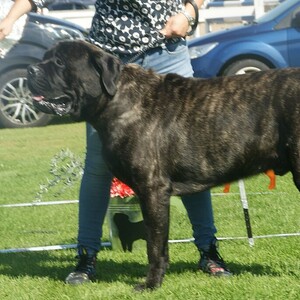
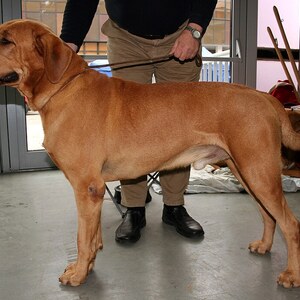
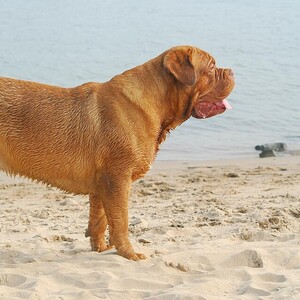
Dogue de Bordeaux. · DJT / Wikimedia Commons, CC BY-SA 2.5. Cropped and resized.
The Dogue de Bordeaux is one of the oldest French breeds: a very powerful, muscular molosser with a massive head and a fawn coat. It was used for hunting wild boar, for guarding and by butchers. Today it is a brave guardian, yet calm and balanced, very attached to its owner and affectionate.
Quick facts
| Common name | Dogue de Bordeaux (French Mastiff) |
| Scientific name | Canis lupus familiaris |
| Country of origin | France (Aquitaine) |
| Official recognition | FCI, definitively since 1954 (group 2, molossoid breeds, mastiff type; standard no. 116); also recognised by the AKC |
| Lifespan | The AKC gives 5–8 years; a 2024 British study found 11.1 years |
| Size (males) | 60–68 cm at the withers; at least 50 kg |
| Size (females) | 58–66 cm at the withers; at least 45 kg |
| Coat type | Fine, short, soft to the touch |
| Common colours | Solid fawn, from mahogany to isabelle, with a black or brown mask or no mask |
| Energy level | Moderate |
| Suited to an apartment? | Not really; it is very large |
| Temperament | Calm, balanced, brave, very attached to its owner |
| Tendency to aggression | Low; a vigilant guardian, without aggression |
| Good with children | Average; with supervision |
| Good with other animals | Average; males are dominant |
| Genetic predispositions | Bloat, heart disease, hip and elbow dysplasia, brachycephalic syndrome, cancer, epilepsy |
- Primary category:Dog breeds
- Explore this animal's categories:
History and origin
The FCI standard says the Dogue de Bordeaux probably descends from the dogs of the Alans, especially the “alan vautre”, of which Gaston Phoebus, Count of Foix, wrote in the 14th century that it “bites harder than three greyhounds”. The word “dogue” appeared at the end of the same century.
In the mid-19th century, these dogs were little known outside Aquitaine. They were used for hunting wild boar, for fighting, for guarding houses and cattle, and by butchers. The breed suffered greatly in the two world wars and came close to extinction, but it made a fresh start in the 1960s.
How the breed developed
- 14th century – Gaston Phoebus describes the “alan vautre”.
- 1863 – Dogues de Bordeaux appear under their present name at the first French dog show, in Paris.
- 1896 – Pierre Mégnin publishes the first standard.
- After 1945 – The breed is threatened with extinction.
- 1960s – The breed makes a fresh start.
- 1989 – The film “Turner & Hooch” makes the breed known in the United States.
- 4 November 2008 – the current FCI standard is published.
Breed rating
| Feature | Stars |
|---|---|
| Training and intelligence | ★★★★☆ |
| Easy to train | ★★★★☆ |
| Intelligence | ★★★★☆ |
| Independence | ★★★☆☆ |
| Stubbornness | ★★★★☆ |
| Behaviour and temperament | ★★★★☆ |
| Affectionate with family | ★★★★★ |
| Friendly with children | ★★★☆☆ |
| Good with other dogs | ★★★☆☆ |
| Good with cats and other animals | ★★★☆☆ |
| Loyalty | ★★★★★ |
| Tendency to be aggressive | ★★☆☆☆ |
| Tendency to bark | ★★★☆☆ |
| Needs and care | ★★★★☆ |
| Shedding | ★★★★☆ |
| Needs frequent grooming | ★★☆☆☆ |
| Activity and lifestyle | ★★★★☆ |
| Energy level | ★★★☆☆ |
| Daily exercise needs | ★★★☆☆ |
| Suited to apartment life | ★★☆☆☆ |
| Health and longevity | ★★★★☆ |
| Life expectancy | ★★☆☆☆ |
| Predisposition to genetic diseases | ★★★★☆ |
| Working abilities and uses | ★★★★★ |
| Good guard dog | ★★★★★ |
| Good companion dog | ★★★★☆ |
Indicative rating: 5 stars means the highest level. It is based on the ratings the American Kennel Club gives the breed and on the FCI standard.
Physical characteristics
The AKC describes it as a typical brachycephalic molosser, very powerful, with a very muscular yet harmonious body. It is built fairly close to the ground. The AKC says that, in proportion, it has the largest head of any dog.
General appearance
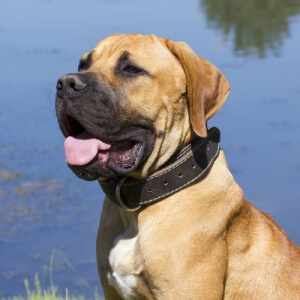
The head is voluminous, broad and angular, with wrinkles and a lower jaw longer than the upper, as in the bulldog. The oval, wide-set eyes have a frank expression. The relatively small ears, darker than the coat, hang down. The tail is very thick at the base.
| Feature | Dogue de Bordeaux |
|---|---|
| Size | Very large |
| Height at the withers | males: 60–68 cm; females: 58–66 cm |
| Weight | males: at least 50 kg; females: at least 45 kg |
| Coat | Fine, short, soft |
| Head | Massive, broad, wrinkled |
| Tail | Very thick at the base |
The coat is solid fawn, in all shades, from mahogany to isabelle. The mask may be black or brown, or absent. Small white markings on the chest and the tips of the feet are allowed.
Training and socialisation
The standard describes it as a former fighting dog, gifted for guarding, which it does with vigilance and great courage, but without aggression. It is a good companion, calm and balanced, and very attached to its owner. The male usually has a dominant character.
The AKC says it is a sensitive breed that needs trust. Discipline must be firm and consistent, but not harsh. Early socialisation and obedience classes are absolutely essential.
Tips for effective training
- Socialise it as a puppy. The AKC says this is absolutely essential.
- Be firm but gentle. Harshness damages its trust.
- Keep the puppy off the stairs. Only light exercise until 18 months.
- Make time for it. The AKC says it is not a breed for timid or very busy people.
Activity needs and lifestyle
The AKC recommends only light exercise until at least 18 months, with no stairs and no jumping from a height. Swimming is excellent exercise at any age. Adults can do more strenuous work, even cart pulling.
| Activity | How often | Why it matters |
|---|---|---|
| Quiet walks | daily | Exercise without overexertion |
| Swimming | weekly, in summer | Gentle exercise for the joints |
| Obedience exercises | a few minutes a day | Keeps control |
Tips for a balanced life
- In summer, protect it from the heat: it breathes with difficulty.
- Keep a cloth to hand: it drools a great deal.
- It suits a calm, experienced owner.
Care and health
Coat and skin care
The AKC says the breed is known for how much it drools. The facial wrinkles must be cleaned and dried at least weekly, sometimes daily. The ears are cleaned weekly, the nails trimmed monthly, and it is bathed about every four weeks.
Common health problems
The AKC says the breed is generally healthy, but a few problems are worth watching for:
| Condition | Description | Common symptoms |
|---|---|---|
| Gastric dilatation-volvulus (bloat) | The stomach fills with gas and may twist; this is a veterinary emergency | Swollen belly, trying to vomit without success, drooling, restlessness |
| Hip dysplasia | The hip joint forms incorrectly and, over time, arthritis develops | Limping, difficulty getting up or jumping, hip pain |
| Elbow dysplasia | The elbow joint develops incorrectly and arthritis appears | Limping on the front legs, especially after exercise |
| Brachycephalic syndrome | The airways are narrowed by the short muzzle | Noisy breathing, tires quickly, copes poorly with heat |
| Heart disease | Hereditary heart conditions | Tiredness, coughing, fainting |
| Cancer and epilepsy | Occur more often than in other breeds | Lumps, weight loss; repeated seizures |
Other care
- Clean and dry the wrinkles on its face.
- Clean the ears weekly.
- Trim the nails monthly.
Diet and nutrition
The AKC says some dogs put on weight easily. For such a heavy dog, extra kilos put a strain on the joints and heart.
Tips for a healthy diet
The table gives a starting estimate, calculated with the formula from the Merck Veterinary Manual. The first two calorie columns show the calories per day for a healthy adult dog. The last column shows what this means in dry food with 3,500–4,000 kcal per kilogram.
| Dog's weight | Calories per day (neutered) | Calories per day (not neutered) | Dry food per day (approximate) |
|---|---|---|---|
| 45 kg | 1,950 kcal | 2,190 kcal | 490–630 g |
| 52 kg | 2,170 kcal | 2,440 kcal | 540–700 g |
| 60 kg | 2,410 kcal | 2,720 kcal | 600–780 g |
- Split the food into two meals a day to reduce the risk of bloat.
- Do not give it cooked bones or fatty food.
- A dog is at the right weight when you can feel its ribs without pressing hard.
Foods to avoid
Some human foods are dangerous for dogs: chocolate, coffee, grapes and raisins, onions, garlic, xylitol (a sweetener used in chewing gum), macadamia nuts and alcohol.
Reproduction and development
Physical and emotional maturity
In dogs, sexual maturity usually comes between 6 and 12 months, but in large breeds it can be delayed until about two years. Very large breeds become adults only at around 2 years.
Mating and pregnancy
Pregnancy lasts about 63 days, counted from ovulation. Mating a female on her first heat is not recommended. The FCI standard requires that only healthy dogs of typical breed appearance are used for breeding.
Caring for the puppies
In large breeds, a litter has around 7 puppies on average. The puppies grow very fast, so they need growth food suited to large breeds. Socialisation starts in the first weeks.
Interesting facts
- The biggest head. The AKC says that, in proportion, it has the largest head of any dog.
- Bites like three greyhounds. That is what Gaston Phoebus wrote about its ancestors in the 14th century.
- Three old types. There were the Toulouse, Paris and Bordeaux types; the last one gave rise to today's breed.
- It drools a lot. The AKC gives it top marks for drooling.
- A film star. Hooch, from “Turner & Hooch”, was a Dogue de Bordeaux.
In popular culture
“Turner & Hooch” (1989)
The breed became known in the United States thanks to the 1989 film “Turner & Hooch”, about a police officer and his canine partner, a Dogue de Bordeaux. Since then, the breed's popularity has grown a great deal in the United States.
Frequently asked questions
How big does a Dogue de Bordeaux get?
Males measure 60–68 cm and weigh at least 50 kg; females measure 58–66 cm and weigh at least 45 kg.
Is it aggressive?
No. The standard says it guards with courage but without aggression; it is calm and affectionate with its family.
Does it drool?
Yes, a great deal.
How long does it live?
The AKC gives 5–8 years, while a 2024 British study found an average of 11.1 years.