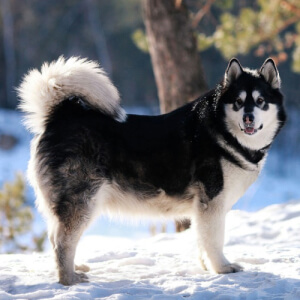
Alaskan MalamuteCharacteristics, history, training and care
The Alaskan Malamute is a powerful sled dog developed for hauling loads in Arctic conditions. It has a dense double coat and substantial exercise and care needs. Individual dogs vary in behaviour and health.
The Alaskan Malamute and Siberian Husky are different breeds. The Malamute was selected primarily for strength and endurance in hauling loads. Choosing one requires attention to time, climate, shedding and training needs.
Quick facts
| Common name | Alaskan Malamute |
| Scientific name | Canis lupus familiaris |
| Country of origin | USA - Alaska |
| Official Recognition | AKC: 1935; FCI: 1963, Group 5, Section 1, Standard No 243 |
| Typical lifespan | Approximately 10-14 years, indicative; varies individually |
| Dimensions (Male) | FCI guide: 63.5 cm at the withers and 38 kg; no absolute limits |
| Dimensions (Female) | FCI guide: 58.5 cm at the withers and 34 kg; no absolute limits |
| Coat type | Double, thick, with a coarse outer coat and dense undercoat |
| Common colours | Shades of grey, black, sable and red, usually with white; solid white is also allowed |
| Energy Level | High; daily exercise and activities, adapted to age and health |
| Suitable for an apartment? | Depends on exercise, training, health and the individual dog |
| Temperament | Generally affectionate, friendly and independent |
| Behaviour towards unfamiliar people and dogs | Individual behaviour varies; socialisation, training and management matter |
| Compatibility with children | Depends on the individual; adult supervision and suitable handling are essential |
| Compatibility with other animals | Depends on socialisation, prey drive and the animals involved |
| Health considerations | Hip dysplasia and eye disorders; relevant tests for polyneuropathy and other hereditary diseases |
- Primary category:Dog breeds
- Explore this animal's categories:
History and Origin
The Alaskan Malamute is an Arctic dog bred for pulling loads, with great strength and endurance. Its origin is linked to the Mahlemut (Malimiut) Inupiat people of northwestern Alaska and to the dogs that helped them haul sleds.
Evolution of the breed
- Origin in Alaska: the name comes from the Mahlemut people and their way of life.
- Hauling work: a strong body and stamina were needed to pull heavy loads over long distances.
- AKC recognition in 1935: the breed was registered in the Working Group.
- FCI recognition in 1963: today it belongs to Group 5, the section for Nordic sled dogs, with standard No. 243.
Its traditional role explains many of its needs today. A Malamute kept as a companion still needs activity, training and contact with people.
Breed Evaluation
It suits active people who can manage a large, independent dog. Being affectionate with the family does not remove the need for training and supervision. These are general editorial ratings, not measured scores; individual dogs vary.
Stars are indicative editorial assessments, not results of a scientific test. The scale goes from 1, low, to 5, high. For independence, shedding or stubbornness, more stars mean a stronger trait, not an advantage. Behaviour and health are assessed individually.
| Characteristic | Stars |
|---|---|
| Training and Intelligence | ★★★☆☆ |
| Easy to train | ★★☆☆☆ |
| Intelligence | ★★★★☆ |
| Level of independence | ★★★★★ |
| Level of stubbornness | ★★★★☆ |
| Behavior and Temperament | ★★★☆☆ |
| Affectionate with family | ★★★★★ |
| Friendly with children | ★★★☆☆ |
| Compatible with other dogs | ★★☆☆☆ |
| Compatible with cats and other animals | ★☆☆☆☆ |
| Degree of loyalty | ★★★★☆ |
| Tendency to be aggressive | ★★☆☆☆ |
| Tendency to bark and vocalise | ★★★★☆ |
| Needs and Care | ★★★★☆ |
| Shedding level | ★★★★★ |
| Requires frequent care | ★★★★☆ |
| Activity and Lifestyle | ★★★★★ |
| Energy level | ★★★★★ |
| Daily exercise requirement | ★★★★★ |
| Suitable for apartment living | ★★☆☆☆ |
| Health and Longevity | ★★★☆☆ |
| Life expectancy | ★★★☆☆ |
| Predisposition to genetic diseases | ★★★☆☆ |
| Work and Utility Features | ★★★★★ |
| Suitable for pulling (sled, cart) | ★★★★★ |
| Good companion dog | ★★★★☆ |
The intelligence score shows the ability to learn, not an IQ. The aggressiveness score does not estimate the risk of a bite, and the genetic diseases score does not give a probability of illness. Being friendly with people does not automatically mean being compatible with every dog, cat or small animal.
Physical Characteristics
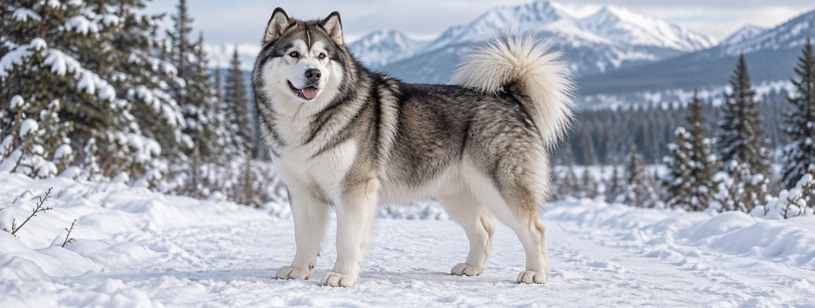
The Malamute has a powerful body, a deep chest and strong legs. It is built for long, steady effort and pulling. The FCI standard states that it was not developed as a racing dog.
General appearance
- A broad head and a strong, bulky muzzle, in proportion to its solid body.
- Triangular ears, small compared with the head.
- Brown eyes: blue eyes are a fault in the FCI breed standard.
- A double coat, with a coarse outer coat and a dense, woolly undercoat; colours include shades of grey, black, sable and red, usually with white.
- A bushy tail carried over the back like a waving plume, not tightly curled.
| Characteristic | Alaskan Malamute |
|---|---|
| Size | Large |
| Weight | FCI guide values: male 38 kg, female 34 kg |
| Coat | Double and thick; solid white is also allowed |
| Muzzle | Large and bulky, neither too narrow nor too short |
| Shedding tendency | High, especially seasonal |
| Bone structure | Heavy, in balance with the size and muscles |
The FCI guide heights are 63.5 cm for males and 58.5 cm for females, measured at the withers (the top of the shoulders). They are working guide values, not absolute limits. A heavier dog is not automatically healthier or more valuable.
Training and Socialization
The Malamute can learn well, but its independence requires consistency and patience. Short sessions, clear rules and rewards help it understand what is expected. AVSAB recommends reward-based training.
Tips for effective training
- Start early: introduce house rules and pleasant experiences with people and new situations step by step.
- Practise loose-lead walking: reward walking without pulling before the dog's adult strength becomes hard to manage.
- Practise recall in safe places: increase the difficulty gradually, as a small animal can easily distract the dog.
- Teach calm and handling: brushing, touching the paws and resting should be practised just like exercise.
- Find good help: for ongoing problems, look for a trainer who uses gentle, reward-based methods.
Socialisation should follow the puppy's reactions and its veterinary vaccination plan. It does not mean the puppy must accept every approach. Meetings with other animals should be supervised; early contact does not guarantee lifelong compatibility.
Activity and Lifestyle Needs
Daily exercise and activities are essential. The PDSA suggests at least two hours of exercise a day for the breed. The exact routine should be adapted to a healthy adult dog, its fitness and the weather; it does not apply automatically to puppies or sick dogs.
| Activity | Recommended duration / practical guide |
|---|---|
| Walks and exploring | Several outings spread through the day; the PDSA suggests at least 2 hours of exercise a day for the breed, adjusted to the individual |
| Training | Short, repeated sessions built into the daily routine; no single fixed duration |
| Pulling and hiking | Introduced gradually once the dog is fully grown and fit; effort depends on the route and the temperature |
| Interactive games | Daily, with breaks and adapted to the dog's interest; can complement walks |
Recommendations for a balanced lifestyle
- Balance exercise and rest: a good routine does not mean non-stop effort.
- Give mental activities: scent games and simple exercises can complement physical activity.
- Keep the dog close to the family: a garden does not replace walks, training or company.
- Make the space safe: check fences, access to the road and meetings with other animals; Malamutes can dig and escape.
- Adapt outings to the heat: reduce effort, choose cool hours and provide water and a cool resting place.
A bored Malamute may dig, chew things and howl. The solution is to understand its needs and give it a suitable routine, not just more intense exercise.
Care and Health
Care includes the coat, weight, mobility and general health. The thick coat can hide changes in the body, so a bulky look is not enough to judge weight.
Fur and skin care
- Regular brushing: removes loose hair and lets you check the skin; more brushing is needed during shedding.
- Baths when needed: use products made for dogs and dry the coat thoroughly.
- Skin checks: watch for irritation, bald patches or lasting changes, and see a vet if they appear.
Common health problems
Important problems to watch for in the breed include the following. The list is not ranked by frequency, and the possible signs do not make a diagnosis on their own.
| Condition | Description | Possible signs |
|---|---|---|
| Hip dysplasia | Abnormal development of the hip joint | Limping, stiffness or difficulty getting up; signs are sometimes subtle |
| Eye disorders, including cone degeneration | Eye or retinal problems that may affect vision | Difficulty finding the way; in cone degeneration, poor vision in bright light ("day blindness") |
| Inherited polyneuropathy | A disease that affects many nerves | Weakness, changes in gait and less tolerance of exercise |
Other aspects of care
- Recommended tests: the AMCA (Alaskan Malamute Club of America) recommends hip evaluation, eye examinations and a DNA test for polyneuropathy; other tests are chosen with the vet.
- Prevention and check-ups: set up a plan for vaccinations, parasite control and regular check-ups.
- Teeth, ears and claws: get the dog used to handling gradually and check these areas regularly.
- Healthy weight: monitor body condition and adjust food, especially when activity changes.
A good test result does not rule out every disease, and a dog that looks healthy has not automatically had all the relevant tests.
Diet and Nutrition
A complete diet suited to the dog's age and health is the basis of good feeding. Portions are adjusted to activity and body condition. A pet dog and a dog trained for hard work do not have the same energy needs.
Recommendations for a healthy diet
Complete food: choose a product for the dog's life stage, including food for large-breed puppies during growth. / Measured portions: start from the feeding guide on the package and adjust to body condition and activity. / Treats: WSAVA recommends that treats make up no more than 10% of daily calories, counted in the total food. / Home-made diets: should be formulated as a complete diet by a veterinary nutritionist. / Fresh water: must always be available.
The table shows how the portion is worked out, without giving one amount for the whole breed. Example calculation, not a feeding recommendation: if the individual plan allows 1,400 kcal from the main food, and the label shows 350 kcal per 100 g, the portion is 400 g. Each dog's real needs must be worked out separately.
| Food type | Daily amount for adults | Frequency |
|---|---|---|
| Complete dry food | Depends on the product's energy content and the dog's needs; in the example above: 400 g | Usually split into two meals, unless the individual plan says otherwise |
| Home-cooked food | Calculated from a complete recipe made with a specialist; no single standard amount | Split according to the feeding plan |
| Raw diet / BARF | Not a general recommendation; requires a check of nutritional balance and the risk of contamination | Only as part of an individual plan discussed with the veterinary team |
The FDA warns about the microbiological risks of raw pet food. "Raw" or "home-made" does not automatically mean complete and balanced.
Forbidden foods
Do not give chocolate, grapes or raisins. / Avoid onions, garlic, products with xylitol and alcohol. / Very hard bones and chews can break teeth or cause injuries; they are not a safe way to care for teeth. / If you suspect your dog has eaten something toxic, contact your vet immediately.
Water must be fresh and easy to reach. Changes in diet should be made gradually, watching how the dog tolerates them and its weight. For a therapeutic diet, discuss treats and any supplements with the vet.
Reproduction and Development
Responsible breeding takes into account health, suitable temperament and care planning. The relevant health tests are done before choosing a breeding pair; a healthy appearance does not replace them.
Physical and emotional maturity
- Physical development: a puppy's large size does not mean its joints and muscles are fully mature. Exercise should match its development.
- Behavioural development: training and socialisation continue through adolescence; calm behaviour and self-control are practised, with no single timetable for all dogs.
Mating and Gestation
- Preparing for breeding: the timing is decided after assessing development, health and test results, not just after the first heat.
- Gestation: in dogs it lasts about 63 days after ovulation; the mating date does not always show the exact day of birth.
- Number of puppies: varies from litter to litter. The vet monitors the pregnancy and can estimate the number with suitable tests; no fixed number can be promised for every female.
Puppy care
- The first weeks: milk, warmth, hygiene and monitoring growth are the priorities.
- As they grow: age-appropriate food and pleasant new experiences are introduced gradually.
- Prevention: a plan of check-ups, vaccinations and deworming is set up with the vet.
- Preparing for a new home: development, independence and paperwork are checked; the time to leave the litter is not decided by the puppy's size alone.
Raising a Malamute requires patience and a well-adjusted routine. A puppy should not be given the loads and effort of an adult trained for pulling.
Curiosities and Interesting Facts
- It is built for pulling heavy loads and for endurance, not for sled-racing speed.
- The name comes from the Mahlemut people of Alaska, with whom the breed's origin is linked.
- Brown eyes are typical; blue eyes are a fault in the FCI standard.
- The coat is double, and seasonal shedding can leave a lot of hair in the house.
- It can be very vocal, howling and making "talking" sounds rather than barking.
- Standard sizes are guide values; not every dog is expected to have the same weight.
- It has been the official state dog of Alaska since 2010.
The Dog in Popular Culture
Its northern looks and history as a working dog have made the breed easy to recognise. There are also documented links with film and with the symbols of its home state.
Alaskan malamute in modern media and culture
- Indiana, George Lucas's dog: the official Star Wars website explains that this Malamute helped inspire Chewbacca as Han Solo's travelling companion; the dog's name was also used for Indiana Jones.
- An inspiration, not a portrait: the character's look and voice came from several sources; Chewbacca is not a realistic picture of a Malamute.
- Alaska's official dog: a 2010 law made the breed a state symbol of Alaska.
Importance in modern culture
- Its link with Arctic transport recalls the role of working dogs in the lives of northern peoples.
- Organised dog sports, including weight pulling and sledding, keep alive part of the work the breed was bred for.
- Popularity requires responsibility: a photo or a film story does not replace an honest look at the time, conditions and care a family can provide.
Frequently asked questions
- Is the Alaskan Malamute the same as the Siberian Husky? No. They are separate breeds. The Malamute is usually bigger and heavier and was bred for pulling heavy loads and endurance. A similar appearance does not replace checking a dog's origin.
- How big does it get? The FCI standard gives 63.5 cm and 38 kg for males and 58.5 cm and 34 kg for females. There is variation; size alone does not determine quality or health.
- Is it suitable for children? It can be affectionate with the family, but contact with children should be supervised. Its size and strength can cause accidents, and behaviour also depends on the individual dog, training and experiences.
- Can it live in an apartment? What matters most is activity, contact with the family, a safe space and the temperature. It is a demanding breed; a garden does not replace outings and training.
- How much does it shed? The double coat can shed a lot of hair, especially seasonally. Regular brushing is needed, more often during these periods. It is not a good choice for someone who wants very little hair in the house.
- Is it hard to train? It can learn well, but its independence requires patience and consistency. Rewards and short exercises are recommended. Loose-lead walking, recall and accepting care are important skills.
- What health checks are important? The breed club stresses hip and eye evaluations and the DNA test for polyneuropathy. Other tests are chosen with the vet, and testing does not rule out all diseases.
- How long does an Alaskan Malamute live? Around 10–14 years is an approximate guide, with variation between individuals and sources. Health, weight and care affect longevity; this range is not a guarantee.