Common clownfishAmphiprion ocellaris — clown anemonefish
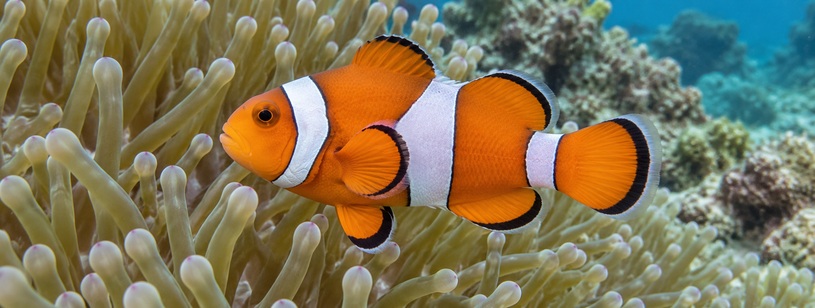
The common clownfish (Amphiprion ocellaris) is a small marine fish known for its orange body, three white bars and close association with sea anemones. It inhabits tropical waters of the eastern Indian Ocean and western Pacific, around reefs and sheltered lagoons.
The female is the largest member of the group, while the breeding male cares for the eggs. Clownfish is a common name for several related species; A. ocellaris is one of the best known.
Quick facts
| Common name | Common clownfish |
| Scientific name | Amphiprion ocellaris |
| Typical lifespan | Estimated at around 6–10 years in the wild by Florida Museum; not a guaranteed age. |
| Length | Up to around 11 cm including the tail fin |
| Diet type | Omnivorous |
| Conservation status | Least Concern (LC) globally |
| Geographical distribution | Southeast Asia, northwestern Australia and neighbouring regions, north to Japan’s Ryukyu Islands |
| Habitat | Tropical saltwater; reefs and sheltered lagoons |
| Other names | Common clownfish; clown anemonefish; false clown anemonefish |
| Depth | Usually shallow water; accounts report occurrence down to around 15 m |
| Typical appearance | Orange body, three white bars with thin black outlines, rounded tail |
| Food | Small crustaceans and other planktonic animals, algae and other food particles |
| Social life | Small groups with a dominant female and a breeding male |
| Activity | Mainly daytime |
| Reproduction | Adhesive eggs on a hard surface near an anemone; external fertilisation |
| Egg care | The male guards and fans the eggs |
| Hatching | Often around 6–8 days after laying; temperature affects timing |
- Primary category:Fish
- Explore this animal's categories:
Interesting facts
- A sea anemone is an animal. Its tentacles contain stinging cells used in feeding and defence.
- The fish and anemone can benefit each other. The fish gains shelter; the anemone may gain protection and food scraps.
- The female dominates the group. She is generally larger than the breeding male and younger fish.
- A male can become female. This may happen when the dominant female disappears.
- The father guards the eggs. Fanning helps bring oxygenated water to them.
- White bars can help fish recognise potential rivals. Experiments with A. ocellaris found different responses to models bearing different numbers of bars.
Characteristics
What does a common clownfish look like?
Its body is flattened from side to side, with a small mouth and rounded tail fin. The familiar orange form has three vertical white bars: one behind the eye, one across the middle of the body and one just before the tail. The middle bar bulges towards the head at its centre.
Black outlines around the bars are usually thin. Darker natural populations also occur, including black-and-white fish from northern Australia. Selective breeding has produced further colour and pattern varieties.
How big does it grow?
Maximum reported total length is around 11 cm. Many individuals are smaller. In an established group, the breeding female is largest and the breeding male ranks next in size.
How does it differ from Amphiprion percula?
| Species or criterion | Identification features |
|---|---|
| Amphiprion ocellaris | Usually thinner black outlines around the white bars; 10–11 dorsal-fin spines |
| Amphiprion percula | Often broader black areas; a separate, very similar-looking species |
| Reliable identification | Colour alone may be insufficient, especially in aquarium-bred varieties |
Dorsal-fin spines are rigid supports in the front portion of the fin on the fish’s back. Specialists may use them in identification; keepers do not need to handle a fish to count them at home.
Habits and behaviour
A clear social hierarchy
Common clownfish live in small groups associated with an anemone. The dominant female and breeding male are the pair that lays and fertilises eggs. Smaller group members do not breed while they remain lower in the hierarchy.
Dominant and submissive behaviour maintains these relationships. Fish may chase intruders and defend the area around their anemone. Living in groups does not mean that any two fish placed together will be compatible.
Why does the anemone not sting it?
Mucus covering the fish’s skin contributes to protection from its host anemone’s tentacles. The association involves biological adaptations and acclimation to the host. This protection does not make every anemone species safe for every clownfish.
The close association is called symbiosis. When both partners benefit, it is described as mutualism. The fish receives shelter, while the anemone may gain defence against some fishes that would eat its tentacles.
Can it recognise the number of bars?
In a study published in 2024, researchers observed common clownfish responses to other fish and to models with white bars. Models bearing three bars prompted stronger aggressive responses than some models with fewer bars.
The findings suggest that body patterns help these fish identify potential competitors. They do not establish that clownfish count in the same way that people do.
Habitat and geographical distribution
Where does it live in the wild?
Amphiprion ocellaris occurs in the eastern Indian Ocean and western Pacific. Its range includes parts of Southeast Asia and northwestern Australia, extending north to the Ryukyu Islands of southern Japan.
It favours shallow tropical water around reefs and sheltered lagoons. Adults stay close to their host anemone, which offers protection from many predators.
Which anemones provide shelter?
Documented natural hosts include Heteractis magnifica, Stichodactyla gigantea and Stichodactyla mertensii. Associations depend on the fish species and available hosts.
Sea anemones are invertebrate animals related to jellyfish. Despite their flower-like appearance, they are not plants.
Can it live in an aquarium?
Yes, the species is bred in captivity. It requires a stable marine aquarium, suitable filtration and water-quality monitoring. A small unequipped container cannot meet these needs.
Captive-bred clownfish can be kept without a living anemone. Anemones have their own lighting, water and space requirements, and an unsuitable host can injure a fish. Choosing one requires separate research and marine aquarium experience.
Diet and feeding
What do clownfish eat?
Common clownfish are omnivores. Their natural foods include small crustaceans, other planktonic animals, algae and food particles near their anemone. Plankton consists of organisms carried largely by water currents.
They can catch food in the water around their shelter. They do not live solely on anemone leftovers and should not be described as exclusive algae eaters.
Feeding in captivity
- Choose food suitable for omnivorous marine fish, in pieces appropriate to their mouths.
- Adjust portions to the fish and aquarium so leftovers do not accumulate.
- Watch every individual to check that subordinate fish can eat.
- Excess food harms water quality; filtration and maintenance remain essential.
Very young larvae have different needs from adults. Hatcheries use tiny live organisms such as rotifers, then introduce other foods as the fish develop.
Reproduction and life cycle
How does a breeding pair form?
The species can change from male to female, a process called protandry. If the dominant female disappears, the breeding male may become female, while a lower-ranking individual may become the breeding male.
Young fish are not all mature, breeding males. Social relationships influence sexual development, and captive studies show that immature fish can differentiate directly into a male–female pair.
Eggs and the male’s role
The pair uses a cleaned hard surface near the anemone. The female lays eggs that stick to the surface, and the male fertilises them externally. They do not give birth to live young.
The male guards the eggs and fans water around them. Hatching often occurs after around 6–8 days, although temperature and developmental conditions affect timing.
From egg to young fish
| Stage | Development and care |
|---|---|
| Egg | Attached to a surface and cared for by the male |
| Larva | After hatching, spends time in the water column before settling in a reef habitat |
| Juvenile | Body and fins develop; white bars appear progressively |
| Adult | Position within the group influences access to breeding |
Newly hatched larvae do not immediately look like miniature adults. Developmental research has followed the formation of their fins and three white bars, which emerge in stages.
How long does it live?
The Florida Museum gives an estimated wild lifespan of around 6–10 years. This is an approximate range, rather than a guaranteed age or species record. Health and husbandry influence lifespan in captivity.
Names and history
| Classification level | Name |
|---|---|
| Class | Actinopterygii — ray-finned fishes |
| Family | Pomacentridae |
Where do its names come from?
Anemonefish refers to the close association with sea anemones. Familiar English names for this species include common clownfish and clown anemonefish.
Its accepted scientific name is Amphiprion ocellaris, with the authority Cuvier, 1830. Pomacentridae includes other reef fishes as well as clownfish.
Captive breeding and research
Aquarium breeding can supply fish without collecting those individuals directly from reefs. The species is also used in research into juvenile development and social relationships.
Conservation and threats
Is the common clownfish endangered?
Amphiprion ocellaris is globally assessed as Least Concern (LC). This status applies to this species and does not mean that every local population is free from problems.
What threatens it?
- Excessive aquarium collection can affect local populations.
- Reef degradation and loss of host anemones reduce available shelter.
- Warming water can contribute to anemone bleaching and habitat damage.
Bleaching occurs when anemones lose much of the microscopic algae living in their tissues. Studies of anemones and associated fishes have documented effects on survival or reproduction; the extent varies among species, locations and warming events.
How can wild populations be protected?
Protecting reefs, limiting destructive collection and choosing captive-bred fish with a known origin can reduce pressure on natural populations. Aquarium fish should never be released into the sea.
In popular culture
Clownfish in Finding Nemo
Nemo and his father, Marlin, are clownfish in Pixar’s Finding Nemo. The story made these fish familiar to many children and adults.
The film is fiction. Its characters’ behaviour and journey are not a guide to real clownfish biology or aquarium care.
Frequently asked questions
Do clownfish live in fresh or salt water?
They are marine fish. Amphiprion ocellaris needs salt water and suitable marine aquarium conditions.
What do common clownfish eat?
They are omnivores, eating small crustaceans, other planktonic organisms, algae and food particles.
How large does the common clownfish grow?
It can reach around 11 cm in total length. Breeding females are generally larger than males.
Why does it live among anemone tentacles?
The anemone provides shelter from predators. Mucus on the fish’s skin contributes to protection from its host.
Can a clownfish change sex?
Yes. A male may become female when the dominant female disappears. Group relationships influence sexual development.
Which parent cares for the eggs?
The male guards and fans them until they hatch.
Does an aquarium clownfish require an anemone?
No. Captive-bred clownfish can be kept without a living anemone, but they need a well-maintained marine aquarium.
Is it endangered?
Amphiprion ocellaris is globally assessed as Least Concern, although collection and habitat damage can affect local populations.
Did you know? About common clownfish
- The common orange form has three white body bars.
- Small groups live close to a host anemone.
- A breeding male may become female if the dominant female disappears.
- The male cares for the eggs until hatching.