EurasierCharacteristics, history, training and care
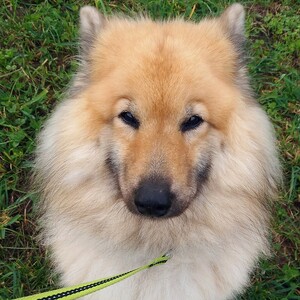
Eurasier. · Stiller Beobachter / Wikimedia Commons, CC BY 2.0. Cropped and resized.
The Eurasier is a spitz-type dog created in Germany in 1960 from the Chow Chow, the Wolfspitz and, later, the Samoyed. It was bred specifically as a family companion. It is self-confident, calm and well-balanced, watchful without being noisy, strongly attached to its family and reserved with strangers.
Quick facts
| Common name | Eurasier (Eurasian) |
| Scientific name | Canis lupus familiaris |
| Country of origin | Germany |
| Official recognition | FCI, definitively since 27 July 1973 (group 5, Asian spitz; standard no. 291); also recognised by the AKC |
| Lifespan | 12–16 years, according to the AKC |
| Size (males) | 52–60 cm at the withers; 23–32 kg |
| Size (females) | 48–56 cm at the withers; 18–26 kg |
| Coat type | Dense undercoat and medium-length, straight, loose-lying topcoat |
| Common colours | Fawn, red, wolf grey, black, black and tan; not pure white or patched |
| Energy level | Moderate |
| Suited to an apartment? | It can adapt, with daily walks |
| Temperament | Self-confident, calm, well-balanced, strongly attached to its family |
| Tendency to aggression | Very low |
| Good with children | Good |
| Good with other animals | Good, especially with dogs it knows |
| Genetic predispositions | Hip dysplasia, patellar luxation, hypothyroidism, eyelid and eyelash problems |
- Primary category:Dog breeds
- Explore this animal's categories:
History and origin
The FCI standard says the breed was created in 1960 by crossing a Chow Chow with a Wolfspitz. The dogs were first called “Wolf-Chow”, and after a cross with a Samoyed they were renamed “Eurasier” and recognised by the FCI. The founder of the breed was Julius Wipfel.
Wikipedia says Wipfel worked with Charlotte Baldamus and a small group of enthusiasts, aiming to combine the best qualities of the two breeds. Nobel laureate Konrad Lorenz was given a Eurasier puppy by Charlotte Baldamus, whom he named “Babett”, and he said she had the best character he had ever come across in a dog.
How the breed developed
- 1960 – Julius Wipfel crosses a Chow Chow with a Wolfspitz (“Wolf-Chow”).
- 1972 – After a cross with a Samoyed, the breed is renamed “Eurasier”.
- 27 July 1973 – The FCI recognises the breed.
- 1995 – The Canadian Kennel Club recognises the breed.
- 4 September 2019 – The current FCI standard is published.
Breed rating
| Feature | Stars |
|---|---|
| Training and intelligence | ★★★★☆ |
| Easy to train | ★★★★☆ |
| Intelligence | ★★★★☆ |
| Independence | ★★★★☆ |
| Stubbornness | ★★★☆☆ |
| Behaviour and temperament | ★★★★☆ |
| Affectionate with family | ★★★★☆ |
| Friendly with children | ★★★★☆ |
| Good with other dogs | ★★★☆☆ |
| Good with cats and other animals | ★★★☆☆ |
| Loyalty | ★★★★★ |
| Tendency to be aggressive | ★☆☆☆☆ |
| Tendency to bark | ★★☆☆☆ |
| Needs and care | ★★★★☆ |
| Shedding | ★★★☆☆ |
| Needs frequent grooming | ★★★☆☆ |
| Activity and lifestyle | ★★★★☆ |
| Energy level | ★★★☆☆ |
| Daily exercise needs | ★★★☆☆ |
| Suited to apartment life | ★★★☆☆ |
| Health and longevity | ★★★★☆ |
| Life expectancy | ★★★★★ |
| Predisposition to genetic diseases | ★★★☆☆ |
| Working abilities and uses | ★★★☆☆ |
| Good watchdog | ★★★☆☆ |
| Good companion dog | ★★★★★ |
Indicative rating: 5 stars means the highest level. It is based on the ratings the American Kennel Club gives the breed and on the FCI standard.
Physical characteristics
The standard describes it as a balanced, well-built, medium-sized spitz-type dog, with erect ears and a coat in various colours. The coat must not be so long that it hides the proportions of the body.
General appearance
The body is slightly longer than it is tall, and the muzzle and skull are almost the same length. The AKC says the tongue may be blue-black, pink or spotted, and the mask may be dark or light (“reverse”). The tail and the backs of the legs have longer hair.
| Feature | Eurasier |
|---|---|
| Size | Medium |
| Height at the withers | males: 52–60 cm; females: 48–56 cm |
| Weight | males: 23–32 kg; females: 18–26 kg |
| Coat | Medium-length, with a dense undercoat |
| Ears | Erect |
| Tongue | Blue-black, pink or spotted |
All colours and combinations are allowed, except pure white, irregular white patches and, according to the AKC, liver. Wikipedia mentions fawn, red, wolf grey, black and black and tan.
Training and socialisation
The standard describes it as self-confident, calm, well-balanced and very hard to provoke, watchful without being noisy, strongly attached to its family and relaxed with strangers. To develop these qualities, it needs close contact with its family and understanding but consistent training.
The AKC says it is loyal, eager to please and good at training, although it can also be independent. It is a sensitive dog that needs not harshness but affection and understanding.
Tips for effective training
- Keep it close to the family. The AKC says it is not suited to being kept in a kennel or tied up outside.
- Use only gentle methods. It is very sensitive to harsh words.
- Socialise it from an early age. It helps it be more open with strangers.
- Vary its food. The AKC says it is fussy and gets bored with the same food.
Activity needs and lifestyle
The AKC recommends good daily walks and active play with other dogs. Some Eurasiers love swimming, others agility or obedience, and some work as therapy dogs. Indoors they are calm; outdoors they become active and energetic.
| Activity | How often | Why it matters |
|---|---|---|
| Daily walks | daily | Exercise and socialisation |
| Play with other dogs | several times a week | It enjoys company |
| Agility or obedience | weekly | Mental activity |
Tips for a balanced life
- Do not leave it alone for many hours.
- In summer, protect it from the heat: its coat is thick.
- It suits a quiet family very well.
Care and health
Coat and skin care
The AKC says it needs a thorough combing once a week or every two weeks, with the body checked for burrs and parasites. It has very little odour and rarely needs a bath. It usually sheds its entire undercoat once or twice a year.
Common health problems
The AKC says Eurasiers were bred to be robust and are generally healthy. However, the following may occur:
| Condition | Description | Common symptoms |
|---|---|---|
| Hip dysplasia | The hip joint forms incorrectly and, over time, arthritis develops | Limping, difficulty getting up or jumping, hip pain |
| Patellar luxation | The kneecap slips out of place | Suddenly holds a hind leg up for a few steps, then uses it again |
| Hypothyroidism | The thyroid gland produces too little hormone | Weight gain, tiredness, dull coat |
| Distichiasis and eyelid problems | Misplaced eyelashes or rolled eyelids | Watery, irritated eyes |
| Gastric dilatation-volvulus (bloat) | The stomach fills with gas and may twist; this is a veterinary emergency | Swollen belly, trying to vomit without success, drooling, restlessness |
Other care
- Clean the eyes and ears regularly.
- Check the paw pads.
- Trim the nails, especially the dewclaws, when needed.
Diet and nutrition
The AKC says Eurasiers can be fussy and do not eat much. They like variety, and changing their food helps keep them from getting bored.
Tips for a healthy diet
The table gives a starting estimate, calculated with the formula from the Merck Veterinary Manual. The first two calorie columns show the calories per day for a healthy adult dog. The last column shows what this means in dry food with 3,500–4,000 kcal per kilogram.
| Dog's weight | Calories per day (neutered) | Calories per day (not neutered) | Dry food per day (approximate) |
|---|---|---|---|
| 18 kg | 980 kcal | 1,100 kcal | 240–310 g |
| 25 kg | 1,250 kcal | 1,410 kcal | 310–400 g |
| 32 kg | 1,510 kcal | 1,700 kcal | 380–490 g |
- Change food gradually, not suddenly.
- Give it its food in two meals a day.
- A dog is at the right weight when you can feel its ribs under the coat without pressing hard.
Foods to avoid
Some human foods are dangerous for dogs: chocolate, coffee, grapes and raisins, onions, garlic, xylitol (a sweetener used in chewing gum), macadamia nuts and alcohol.
Reproduction and development
Physical and emotional maturity
In dogs, sexual maturity usually comes between 6 and 12 months. Most breeds become adults at around 13–15 months.
Mating and pregnancy
Pregnancy lasts about 63 days, counted from ovulation. Mating a female on her first heat is not recommended. The FCI standard requires that only healthy dogs of typical breed appearance are used for breeding.
Caring for the puppies
In dogs, a litter has 5–6 puppies on average, and the number rises with the size of the breed. Socialisation starts in the first weeks: gentle handling, everyday noises and new people.
Interesting facts
- Three breeds in one. It was created from the Chow Chow, the Wolfspitz and the Samoyed.
- Konrad Lorenz's dog. The Nobel laureate had a Eurasier named Babett.
- A blue-black tongue. Some Eurasiers have a blue-black tongue, inherited from the Chow Chow.
- Made for the family. It was bred from the start as a companion.
- A fussy eater. The AKC says it likes variety.
In popular culture
Babett, Konrad Lorenz's dog
Konrad Lorenz, ethologist and Nobel Prize winner, was given a Eurasier puppy by Charlotte Baldamus. Wikipedia says he named her “Babett” and considered her character the best he had ever come across in a dog.
Frequently asked questions
Which breeds was the Eurasier developed from?
From the Chow Chow, the Wolfspitz and the Samoyed.
How big does it get?
Males measure 52–60 cm and weigh 23–32 kg; females measure 48–56 cm and weigh 18–26 kg.
Is it a family dog?
Yes, it was created specifically for family life and is very attached to its family.
How long does it live?
The AKC gives 12–16 years.