WeimaranerCharacteristics, history, training and care
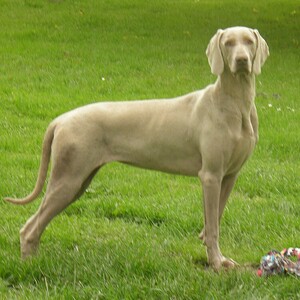
Weimaraner. · Ephyr / Wikimedia Commons, CC BY-SA 3.0. Cropped and resized.
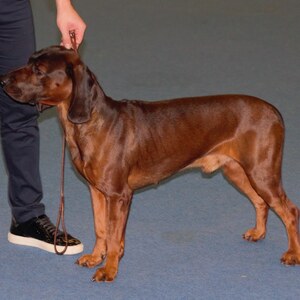
The Weimaraner is a large German pointing dog with a short silver-grey coat and light-coloured eyes, bred around the town of Weimar, in Thuringia. The FCI standard describes it as a versatile, easy-to-train, balanced and passionate hunting dog with a remarkable nose, a good watchdog, but without aggression. There is also a long-haired variety.
Quick facts
| Common name | Weimaraner |
| Scientific name | Canis lupus familiaris |
| Country of origin | Germany |
| Official recognition | FCI, definitively since 27 November 1954 (group 7, pointing dogs; standard no. 99); also recognised by the AKC |
| Lifespan | 10–13 years, according to the AKC |
| Size (males) | 59–70 cm at the withers; 30–40 kg |
| Size (females) | 57–65 cm at the withers; 25–35 kg |
| Coat type | Short, dense and smooth, almost no undercoat; or long and soft |
| Common colours | Silver grey, roe grey, mouse grey |
| Energy level | Very high |
| Suited to an apartment? | Only with a great deal of exercise |
| Temperament | Versatile, intelligent, affectionate, passionate, watchful |
| Tendency to aggression | Low |
| Good with children | Very good, according to the AKC |
| Good with other animals | Moderate; prey drive |
| Genetic predispositions | Bloat, hip dysplasia, vaccine reactions |
- Primary category:Dog breeds
- Explore this animal's categories:
History and origin
The FCI standard says there are many theories about the Weimaraner's origin. All that is certain is that, in the first third of the 19th century, dogs of this type, with plenty of bloodhound blood (“Leithund”), were kept at the court of Weimar. By the middle of the century, breeding was mainly in the hands of professional hunters and foresters around Weimar and in Thuringia.
When the bloodhounds fell out of use, the dogs were crossed with “Hühnerhund” (pointing dogs). From around 1890, the breed was bred to a plan, and it has remained pure ever since. Around 1900, the long-haired variety also appeared, rarely. Wikipedia says the breed was recognised in 1891.
How the breed developed
- First third of the 19th century – Kept at the court of Weimar.
- Around 1890 – Planned breeding begins.
- Around 1900 – The long-haired variety appears.
- 27 November 1954 – The FCI recognises the breed.
Breed rating
| Feature | Stars |
|---|---|
| Training and intelligence | ★★★★☆ |
| Easy to train | ★★★★★ |
| Intelligence | ★★★★★ |
| Independence | ★★★★☆ |
| Stubbornness | ★★★★★ |
| Behaviour and temperament | ★★★☆☆ |
| Affectionate with family | ★★★★★ |
| Friendly with children | ★★★★★ |
| Good with other dogs | ★★★★★ |
| Good with cats and other animals | ★★★☆☆ |
| Loyalty | ★★★★★ |
| Tendency to be aggressive | ★★☆☆☆ |
| Tendency to bark | ★★★★☆ |
| Needs and care | ★★★☆☆ |
| Shedding | ★★★★★ |
| Needs frequent grooming | ★★★☆☆ |
| Activity and lifestyle | ★★★★★ |
| Energy level | ★★★★★ |
| Daily exercise needs | ★★★★★ |
| Suited to apartment life | ★★★★★ |
| Health and longevity | ★★★★★ |
| Life expectancy | ★★★★☆ |
| Predisposition to genetic diseases | ★★☆☆☆ |
| Working abilities and uses | ★★★☆☆ |
| Good hunting dog | ★★★★★ |
| Good companion dog | ★★★★☆ |
Indicative rating: 5 stars means the highest level. It is based on the ratings the American Kennel Club gives the breed and on the FCI standard.
Physical characteristics
The AKC says it is instantly recognisable by its silver-grey coat, and its face, with amber or blue-grey eyes and long, velvety ears, has a friendly, intelligent expression. A well-bred Weimaraner has a uniform colour, with at most a small white spot on the chest.
General appearance
In the short-haired variety, the coat is short, but longer and thicker than in similar breeds, very dense and smooth, with little or no undercoat. The long-haired variety has a soft coat, 3–5 cm long on the flanks, straight or slightly wavy.
| Feature | Weimaraner |
|---|---|
| Size | Large |
| Height at the withers | males: 59–70 cm; females: 57–65 cm |
| Weight | males: 30–40 kg; females: 25–35 kg |
| Coat | Short or long |
| Colour | Silver grey |
| Type | Pointing dog |
The standard accepts silver grey, roe grey or mouse grey and their shades. The head and ears are usually slightly lighter. Only small white markings on the chest and toes are permitted.
Training and socialisation
The standard describes it as a versatile, easy-to-train, balanced and passionate hunting dog, persistent in searching, with a remarkable nose, a good watchdog, but without aggression.
A breeder quoted by the AKC says: “The good news is that Weimaraners are smart; the bad news is that Weimaraners are smart.” It learns quickly, both good things and bad, and works on the principle of “What's in it for me?”, so training must be creative and consistent.
Tips for effective training
- Go to classes. The AKC recommends them.
- Be creative. It asks itself “what's in it for me?”.
- Be consistent. It learns bad habits too.
- Keep it busy. The AKC gives 5 out of 5 for its need for mental stimulation.
Activity needs and lifestyle
The AKC says that, having been bred for hunting, it has great speed and stamina and thrives on plenty of activity: it makes the best running partner or teammate in dog sports.
| Activity | How often | Why it matters |
|---|---|---|
| Running | daily | Energy |
| Long walks | daily | Stamina |
| Hunting or dog sports | weekly | A busy mind |
Tips for a balanced life
- Suited to very active owners.
- Keep its nails short.
- Put away things it might swallow.
Care and health
Coat and skin care
The AKC says the biggest grooming job is keeping the nails short; if you hear them clicking on the floor, they are too long. The short coat should be brushed regularly.
Common health problems
The AKC says the breed is generally healthy, but the most serious problem is bloat. Watch for:
| Condition | Description | Common symptoms |
|---|---|---|
| Gastric dilatation-volvulus (bloat) | The stomach fills with gas and may twist; this is a veterinary emergency | Swollen belly, trying to vomit without success, drooling, restlessness |
| Hip dysplasia | The hip joint forms incorrectly and, over time, arthritis develops | Limping, difficulty getting up or jumping, hip pain |
| Vaccine reactions | A small percentage of puppies overreact | Fever, painful, swollen joints |
| Injuries and swallowed objects | Because it is very active and chews a lot | Cuts, sprains, digestive problems |
Other care
- Learn the signs of bloat.
- Do not let it run after a meal.
- Keep it away from small objects.
Diet and nutrition
The AKC says Weimaraners are hearty eaters (“they eat their dinner and then try to eat the bowl”) and recommends good food with a moderate amount of protein.
Tips for a healthy diet
The table gives a starting estimate, calculated with the formula from the Merck Veterinary Manual. The first two calorie columns show the calories per day for a healthy adult dog. The last column shows what this means in dry food with 3,500–4,000 kcal per kilogram.
| Dog's weight | Calories per day (neutered) | Calories per day (not neutered) | Dry food per day (approximate) |
|---|---|---|---|
| 25 kg | 1,250 kcal | 1,410 kcal | 310–400 g |
| 32 kg | 1,510 kcal | 1,700 kcal | 380–490 g |
| 40 kg | 1,780 kcal | 2,000 kcal | 440–570 g |
- Split the food into two meals a day.
- Do not let it run right after a meal.
- A dog is at the right weight when you can feel its ribs without pressing hard.
Foods to avoid
Some human foods are dangerous for dogs: chocolate, coffee, grapes and raisins, onions, garlic, xylitol (a sweetener used in chewing gum), macadamia nuts and alcohol.
Reproduction and development
Physical and emotional maturity
In dogs, sexual maturity usually comes between 6 and 12 months, but in large breeds it can be delayed until about two years. The body also reaches its adult form later than in small breeds.
Mating and pregnancy
Pregnancy lasts about 63 days, counted from ovulation. Mating a female on her first heat is not recommended. The FCI standard requires that only healthy dogs of typical breed appearance are used for breeding.
Caring for the puppies
In large breeds, a litter has around 7 puppies on average. Socialisation starts in the first weeks: gentle handling, everyday noises and new people.
Interesting facts
- The dog of the Weimar court. It was kept there as early as the 19th century.
- Clever, for better and worse. It learns anything quickly.
- It eats the bowl too. So the AKC jokes.
- Light eyes. Amber or blue-grey.
- Long-haired too. There is a rare long-haired variety.
Frequently asked questions
What colour is it?
Silver grey, roe grey or mouse grey.
Is it good with children?
Yes; the AKC gives it top marks.
Does it need a lot of exercise?
Yes, a great deal.
How long does it live?
The AKC gives 10–13 years.