Pyrenean Mountain DogCharacteristics, history, training and care
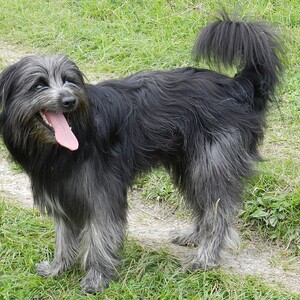
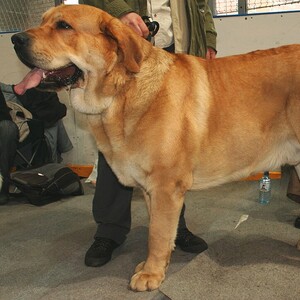
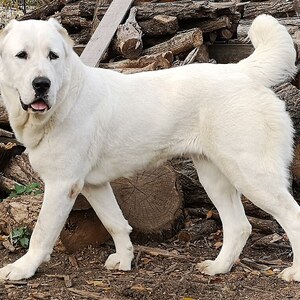
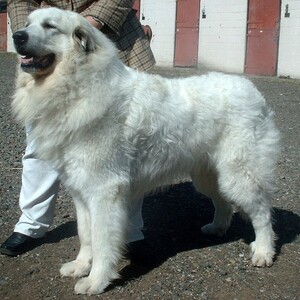
Pyrenean Mountain Dog. · Brunobarreto / Wikimedia Commons, CC BY-SA 3.0. Cropped and resized.
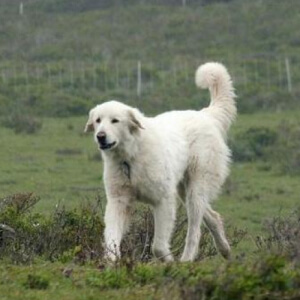
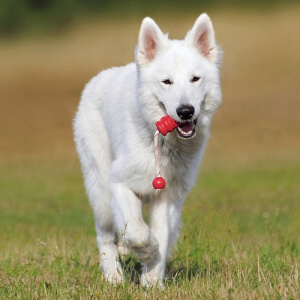
The Pyrenean Mountain Dog (Patou, Great Pyrenees) is a very large French dog, white or white with grey badger or yellowish markings, with an abundant coat. It guarded flocks against predators on its own in the mountains. The standard says its main qualities are strength and agility, together with gentleness and attachment to those it protects.
Quick facts
| Common name | Pyrenean Mountain Dog (Patou, Great Pyrenees) |
| Scientific name | Canis lupus familiaris |
| Country of origin | France |
| Official recognition | FCI, definitively since 25 January 1955 (group 2, molossoid breeds, mountain type; standard no. 137); also recognised by the AKC |
| Lifespan | 10–12 years, according to the AKC |
| Size (males) | 70–80 cm at the withers (+2 cm); over 45 kg according to the AKC |
| Size (females) | 65–75 cm at the withers (+2 cm); over 38 kg according to the AKC |
| Coat type | Abundant, flat, fairly long, with a thick undercoat |
| Common colours | White or white with grey badger, wolf grey, pale yellow or orange markings |
| Energy level | Moderate |
| Suited to an apartment? | No |
| Temperament | Strong, gentle, devoted, independent |
| Tendency to aggression | Low; a serious guard dog |
| Good with children | Average |
| Good with other animals | Good with the flock and family animals |
| Genetic predispositions | Hip and elbow dysplasia, patellar luxation, eye diseases, neurological and immune disorders |
- Primary category:Dog breeds
- Explore this animal's categories:
History and origin
The FCI standard says the breed has been present in the Pyrenees since time immemorial, was known in the Middle Ages as a castle guard and is mentioned by Gaston Phoebus in the 14th century. Already valued as a companion in the 17th century, it reached the height of its fame at the court of Louis XIV.
The first detailed description of the breed appears in 1897, in the book by Count de Bylandt. Ten years later the first clubs were founded, and in 1923, on the initiative of Bernard Sénac-Lagrange, the official standard was registered, very close to today's. Wikipedia says that in France it is usually called the “Patou”.
How the breed developed
- 14th century – It is mentioned by Gaston Phoebus.
- 17th century – It reaches the court of Louis XIV.
- 1897 – The first detailed description, by Count de Bylandt.
- 1923 – The official standard is registered.
- 25 January 1955 – The FCI recognises the breed.
Breed rating
| Feature | Stars |
|---|---|
| Training and intelligence | ★★★☆☆ |
| Easy to train | ★★★☆☆ |
| Intelligence | ★★★★☆ |
| Independence | ★★★★★ |
| Stubbornness | ★★★★★ |
| Behaviour and temperament | ★★★★☆ |
| Affectionate with family | ★★★★★ |
| Friendly with children | ★★★☆☆ |
| Good with other dogs | ★★★☆☆ |
| Good with cats and other animals | ★★★☆☆ |
| Loyalty | ★★★★★ |
| Tendency to be aggressive | ★★☆☆☆ |
| Tendency to bark | ★★★☆☆ |
| Needs and care | ★★★☆☆ |
| Shedding | ★★★☆☆ |
| Needs frequent grooming | ★★★☆☆ |
| Activity and lifestyle | ★★☆☆☆ |
| Energy level | ★★★☆☆ |
| Daily exercise needs | ★★★☆☆ |
| Suited to apartment life | ★☆☆☆☆ |
| Health and longevity | ★★★☆☆ |
| Life expectancy | ★★★☆☆ |
| Predisposition to genetic diseases | ★★★☆☆ |
| Working abilities and uses | ★★★★★ |
| Good guard dog | ★★★★★ |
| Good companion dog | ★★★★☆ |
Indicative rating: 5 stars means the highest level. It is based on the ratings the American Kennel Club gives the breed and on the FCI standard.
Physical characteristics
The AKC describes it as a large and immensely powerful mountain dog, up to 81 cm tall and often over 45 kg, usually with an almost Zen-like calm, but able to spring into action quickly, with grace and speed, to confront a threat.
General appearance
The coat is abundant, flat, fairly long and supple, harsher on the shoulders and back and longer on the tail and around the neck, where it may be slightly wavy. On the backs of the thighs the hair is finer and woollier, and the undercoat is thick.
| Feature | Pyrenean Mountain Dog |
|---|---|
| Size | Very large |
| Height at the withers | males: 70–80 cm; females: 65–75 cm |
| Weight | over 38–45 kg (AKC) |
| Coat | Abundant, with a thick undercoat |
| Colour | White, with or without markings |
| Temperament | Calm, ready for action |
The colour is white or white with grey markings (badger or wolf), pale yellow or orange (arrouye) on the head, ears, base of the tail and sometimes on the body. Grey badger markings are the most prized.
Training and socialisation
The standard says that, used on its own to protect flocks from predators, it was selected for its guarding and deterrent ability and for its attachment to the flock. It has a tendency towards independence and a spirit of initiative, which call for a certain authority on the owner's part.
The AKC says it was bred to think for itself, without guidance, so ordinary obedience training usually leaves it indifferent: it does not see the point of “sit” and “heel”.
Tips for effective training
- Be calm and firm. It needs an owner with authority.
- Be patient. The AKC says classic training bores it.
- Socialise it as a puppy. It is a serious guard dog.
- Make sure the fence is solid. It patrols its territory.
Activity needs and lifestyle
The AKC says it is not a very active breed. When working, it patrols its territory, but saves its energy for fending off threats. Moderate walks with its owner are enough for it.
| Activity | How often | Why it matters |
|---|---|---|
| Moderate walks | daily | Exercise |
| Time in a large yard | daily | It patrols its territory |
| Easy hikes | occasionally | A mountain dog |
Tips for a balanced life
- It needs a house with a large yard.
- In summer, keep it out of the heat.
- It suits experienced owners.
Care and health
Coat and skin care
The AKC says that, although it has a lot of coat, it does not need much grooming, as the coat sheds dirt and does not tangle easily. However, it sheds its undercoat heavily — “like a snowstorm”, as one owner puts it.
Common health problems
The AKC says it is generally healthy, and breeders test their dogs for:
| Condition | Description | Common symptoms |
|---|---|---|
| Hip dysplasia | The hip joint forms incorrectly and, over time, arthritis develops | Limping, difficulty getting up or jumping, hip pain |
| Elbow dysplasia | The elbow joint develops incorrectly and arthritis appears | Limping on the front legs, especially after exercise |
| Patellar luxation | The kneecap slips out of place | Suddenly holds a hind leg up for a few steps, then uses it again |
| Eye diseases | Inherited eye conditions | Watery eyes, poor vision |
| Gastric dilatation-volvulus (bloat) | The stomach fills with gas and may twist; this is a veterinary emergency | Swollen belly, trying to vomit without success, drooling, restlessness |
Other care
- Trim the double dewclaws on the hind legs.
- Check the ears regularly.
- Brush it often during shedding.
Diet and nutrition
The AKC says some eat surprisingly little for their size and recommends a good-quality, low-protein dry food formulated for large breeds.
Tips for a healthy diet
The table gives a starting estimate, calculated with the formula from the Merck Veterinary Manual. The first two calorie columns show the calories per day for a healthy adult dog. The last column shows what this means in dry food with 3,500–4,000 kcal per kilogram.
| Dog's weight | Calories per day (neutered) | Calories per day (not neutered) | Dry food per day (approximate) |
|---|---|---|---|
| 38 kg | 1,710 kcal | 1,930 kcal | 430–550 g |
| 50 kg | 2,110 kcal | 2,370 kcal | 530–680 g |
| 60 kg | 2,410 kcal | 2,720 kcal | 600–780 g |
- Split the food into two meals a day to reduce the risk of bloat.
- Do not let it run right after a meal.
- Puppies need growth food suited to very large breeds.
Foods to avoid
Some human foods are dangerous for dogs: chocolate, coffee, grapes and raisins, onions, garlic, xylitol (a sweetener used in chewing gum), macadamia nuts and alcohol.
Reproduction and development
Physical and emotional maturity
In dogs, sexual maturity usually comes between 6 and 12 months, but in large breeds it can be delayed until about two years. Very large breeds become adults only at around 2 years.
Mating and pregnancy
Pregnancy lasts about 63 days, counted from ovulation. Mating a female on her first heat is not recommended. The FCI standard requires that only healthy dogs of typical breed appearance are used for breeding.
Caring for the puppies
In large breeds, a litter has around 7 puppies on average. The puppies grow very fast, so they need growth food suited to large breeds. Socialisation starts in the first weeks.
Interesting facts
- At the Sun King's court. It reached the height of its fame at the court of Louis XIV.
- A castle guard. In the Middle Ages it guarded castles.
- Badger markings. Grey badger markings are the most prized.
- A snowstorm. The undercoat comes out in large amounts when it sheds.
- Indifferent to “sit”. The AKC says it does not see the point of classic commands.
Frequently asked questions
How does it differ from the Pyrenean Mastiff?
They are different breeds: the Patou is French, the Pyrenean Mastiff is Spanish.
How big does it get?
Males measure 70–80 cm and females 65–75 cm.
Is it easy to train?
Not very; it thinks independently.
How long does it live?
The AKC gives 10–12 years.