WildcatInteresting facts and information
The European wildcat (Felis silvestris) and Afro-Asiatic wildcat (Felis lybica) are distinct. Domestic cats descend mainly from African wildcat ancestors.
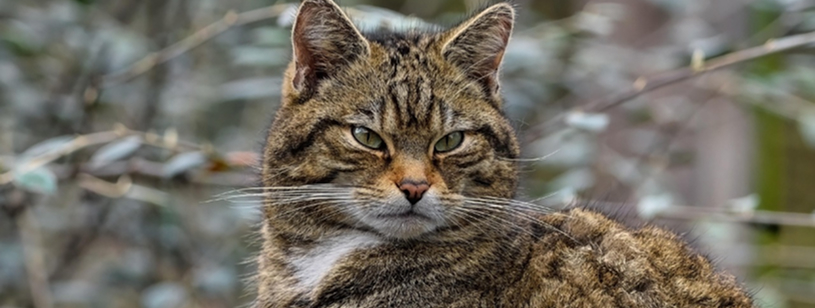
The European wildcat looks like a large tabby cat, but it has a sturdier body, thick fur and a bushy, blunt tail with distinct black rings. Although people rarely see it, the wildcat plays an important role in the ecosystem by hunting rodents and other small mammals.
Quick facts
| Common name | European wildcat |
| Scientific name | Felis silvestris |
| Typical lifespan | Up to about 10 years in the wild, 15 years or more in captivity |
| Maximum speed | Varies with species or individual, distance and conditions |
| Height at shoulder | About 35-40 cm |
| Length | About 45-65 cm (head and body), plus a 25-35 cm tail |
| Weight | About 3-5 kg (females), 5-8 kg (males) |
| Diet type | Carnivore (mainly rodents; also rabbits, birds, reptiles) |
| Main predators | Wolves, lynxes, golden eagles and foxes (for kittens); humans |
| Conservation status | Least Concern (IUCN); rare or threatened in some countries, such as Scotland |
| Distribution | Scattered populations across Europe, Turkey and the Caucasus |
| Living environment | Forests, forest edges, mountains, dense scrub |
- Primary category:Mammals
- Explore this animal's categories:
Interesting facts
- Territorial - Each wildcat has its own home range; males usually cover larger areas than females, often several square kilometres.
- Rodent hunters - Small rodents such as voles and mice make up most of the European wildcat's diet.
- Scent messages - Wildcats mark their territory with urine, droppings, scratches on trees and scent from glands on the face.
- Truly wild - Wildcats are very shy of people, and even kittens raised by humans usually stay wild.
- A tail with rings - The thick, blunt tail with a few clear black rings and a black tip is one of the best ways to tell a wildcat from a tabby house cat.
- Active at dusk and night - Wildcats hunt mainly at dawn, at dusk and at night, using their excellent night vision and hearing.
Records and remarkable features
- The European wildcat (Felis silvestris) is a wild cat associated with woodland and other habitats in Europe. It is distinct from the Afro-Asiatic wildcat (Felis lybica), the main ancestral wildcat of domestic cats.
Physical characteristics and adaptations
The European wildcat looks like a large, sturdy tabby cat, but it is more robust and better adapted to life in the wild than the domestic cat.
Essential physical adaptations
- A muscular, compact body - Gives strength and agility for hunting.
- Thick fur - Grey-brown with dark stripes, it protects against cold and wet weather and helps the cat blend into the forest.
- A thick, ringed tail - Bushy, with a blunt black tip and several clear black rings.
- Strong legs and retractable claws - Allow fast climbing and precise attacks on prey.
- Excellent night vision - Large eyes and pupils that open wide help it hunt in low light.
- Sharp hearing - It can hear the faint sounds of rodents moving in grass or under snow.
- Scent glands - Glands on the face and elsewhere are used to mark territory.
Differences from the domestic cat
| Characteristic | European wildcat (Felis silvestris) | Domestic cat (Felis catus) |
|---|---|---|
| Size | Usually larger and sturdier | Usually smaller and slimmer |
| Fur | Thick, grey-brown with dark stripes | Very varied in colour, pattern and length |
| Tail | Thick and blunt, with distinct black rings and a black tip | Usually thinner and more pointed |
| Behaviour | Shy, solitary and territorial | Often sociable and used to people |
| Food | Lives only by hunting | Often fed by people |
| Habitat | Forests, mountains and other wild areas | Towns, villages, farms and homes |
Habits and behaviour
The wildcat is a solitary, territorial predator that avoids people.
Life Mode
- It lives alone, and each animal has its own home range.
- Females have smaller ranges, which often overlap with those of males.
- It is most active at dusk, at night and at dawn.
- It marks its territory with urine, droppings, scratches and by rubbing its face on trees or stones.
Social interactions
- It avoids other wildcats, except in the mating season.
- The female raises her kittens alone.
- It is usually quiet, but when threatened it hisses, spits and growls loudly.
Defence techniques
- Camouflage - Its striped fur makes it hard to see in dense vegetation.
- Speed and agility - When in danger, it quickly escapes into trees, rocks or thick cover.
- Fierce defence - If cornered, it fights back with claws and teeth.
Habitat and geographic distribution
The European wildcat lives in scattered populations across Europe, from Portugal and Scotland to the Carpathians, the Balkans, Turkey and the Caucasus. Related wildcats live in Africa and Asia.
Species distribution
| Region | Presence species |
|---|---|
| Europe | Felis silvestris (European wildcat) |
| Central Asia and the Middle East | Felis lybica (Asiatic wildcat and African wildcat) |
| Africa | Felis lybica (African wildcat) |
Habitats
- Deciduous and mixed forests - Its main habitat, offering shelter and plenty of food.
- Mountains and hills - It likes areas with dense vegetation and rocks.
- Forest edges and meadows - It often hunts in grassland and clearings close to the forest.
Impact of environmental change
- Habitat loss - Deforestation and building reduce and split up the wildcat's habitat.
- Hybridisation with domestic cats - Mating with domestic cats threatens the wildcat's genetic identity.
- Fewer prey - Changes in farming and pesticides can reduce the number of rodents.
Diet and feeding
The wildcat is a carnivore that hunts mainly small mammals, especially rodents, and sometimes birds and other small animals.
What does the wildcat eat?
| Food type | Specific examples |
|---|---|
| Rodents | Voles, wood mice, rats, dormice |
| Rabbits and hares | Rabbits and young hares, where they are common |
| Birds and eggs | Small birds, pigeons and ground-nesting birds |
| Amphibians and reptiles | Lizards, frogs, small snakes |
| Insects | Grasshoppers and beetles |
Hunting methods
- It moves slowly and silently, creeping to within a few metres of its prey.
- It is very patient and can wait without moving for a long time near a rodent burrow.
- It catches prey with a quick pounce and kills it with a bite to the neck.
- It hunts across its home range, often along forest edges and in meadows.
Reproduction and life cycle
Wildcats breed once a year, and the female raises the kittens alone.
Breeding season
- Mating usually takes place between January and March.
- Males travel more widely, call loudly and sometimes fight over females.
- After mating, the male leaves, and the female raises the kittens alone.
Pregnancy and childbirth
| Characteristic | Details |
|---|---|
| Duration of pregnancy | About 63-68 days |
| Number of kittens per birth | Usually 2-4, sometimes more |
| Weight at birth | About 100 g |
| Nursing period | About 3-4 months |
Breeding of kittens
- Kittens are born blind and helpless, in a den in a hollow tree, rock crevice or old burrow.
- At about 4-5 weeks old they start to come out of the den.
- From about 3 months, they start hunting with their mother.
- At about 5-6 months they become independent and leave to find their own territory.
- Wildcats can breed when they are about a year old.
Survival rate
- Many kittens die in their first year, from predators, disease or lack of food.
- In the wild, wildcats usually live up to about 10 years; in captivity they can live 15 years or more.
Name and history
Origin of name
- The English name "wildcat" simply means a cat that lives in the wild.
- The scientific name Felis silvestris comes from Latin: felis means "cat" and silvestris means "of the forest".
Taxonomic Classification
| Classification | Name |
|---|---|
| Kingdom | Animalia |
| Phylum | Chordata |
| Class | Mammalia |
| Order | Carnivora |
| Family | Felidae |
| Genus | Felis |
| Species | Felis silvestris |
Evolution and fossils
- Wildcats belong to the genus Felis, a group of small cats that also includes the jungle cat and the sand cat.
- The European wildcat (Felis silvestris) and Afro-Asiatic wildcat (Felis lybica) are distinct. Domestic cats descend mainly from African wildcat ancestors.
- Cats probably began living alongside people in the Near East around 10,000 years ago, when early farmers stored grain that attracted mice.
- A cat buried with a person in Cyprus about 9,500 years ago is one of the earliest signs of this close relationship.
Cultural significance and mythology
Wildcats and their domestic descendants have appeared in myths and symbols for thousands of years.
Wild cat in myths and legends
- Ancient Egypt - Cats descended from the African wildcat (Felis lybica) were linked with the goddess Bastet, and many were mummified as offerings.
- Scottish Highlands - The wildcat appears on the crests of the clans of the Clan Chattan confederation, with the motto "Touch not the cat bot a glove" (do not touch the cat without a glove).
- Scottish folklore - The Cat Sìth, a large black fairy cat of Celtic legend, may have been inspired by wildcats or wildcat hybrids.
- Norse mythology - The goddess Freyja rode in a chariot pulled by two cats.
Wild cat in symbolism
- Freedom and independence - Because it cannot be tamed, the wildcat is a symbol of wildness and independence.
- The "Highland tiger" - The Scottish wildcat has become a symbol of the wild nature of Scotland.
- Conservation - The wildcat is a symbol of efforts to protect Europe's forests and small predators.
Conservation status and threats
The European wildcat is listed as Least Concern by the IUCN, but in many countries it is rare, and some populations, such as the one in Scotland, are seriously threatened.
Conservation status
| Species | IUCN status | Population Estimate |
|---|---|---|
| European wildcat (Felis silvestris) | Least Concern | Increasing in some areas, declining or very rare in others |
| African wildcat (Felis lybica) | Least Concern | Widespread, but threatened by hybridisation in places |
| Scottish wildcat population | Not assessed separately | Very few pure wildcats left in the wild; reintroductions started in 2023 |
Main threats
- Hybridisation with domestic cats - The greatest threat in many areas, because it gradually erases the wildcat's genetic identity.
- Habitat loss - Deforestation and the spread of towns and roads reduce wildcat territories.
- Persecution - In the past, wildcats were widely hunted and trapped as pests.
- Diseases - Domestic cats can pass diseases to wildcats.
- Road accidents - Many wildcats are killed on roads.
Protection measures
- Legal protection - The wildcat is protected by law in most European countries.
- Neutering domestic cats - In wildcat areas, neutering feral and pet cats reduces hybridisation.
- Reintroduction - Wildcats bred in captivity have been released in the Cairngorms in Scotland since 2023.
- Monitoring - Camera traps and genetic tests help biologists follow wildcat populations.
In popular culture
The wildcat appears in heraldry, sport and nature films as a symbol of wildness and strength.
Film and documentation
- Nature documentaries - Wildcats in Scotland and the forests of central Europe appear in many wildlife films.
- The Scottish wildcat, often called the "Highland tiger", has been the subject of conservation campaigns.
Books and literature
- "Warriors" (Erin Hunter) - A series of children's fantasy novels about clans of wild-living cats.
- Scottish clan histories - The wildcat is a central symbol in the heraldry of Clan Chattan.
Mascots and symbols
- Heraldry - Wildcats appear on the crests of several Scottish clans, such as Mackintosh and Macpherson.
- Sports teams - Many teams, especially in North America, are called "Wildcats".
- Place names - The Scottish county of Caithness is thought to take its name from an ancient people known as the "cat people".