Alpine DachsbrackeCharacteristics, history, training and care
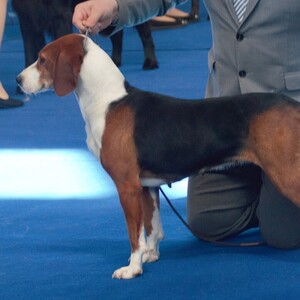
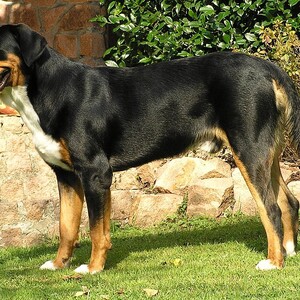
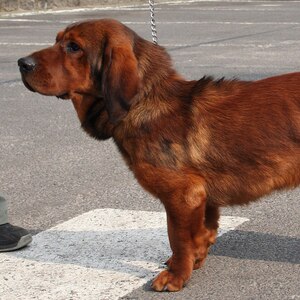
Alpine Dachsbracke. · Pleple2000 / Wikimedia Commons, CC BY-SA 3.0. Cropped and resized.
The Alpine Dachsbracke is an Austrian hunting dog: short-legged, sturdy and very resistant to bad weather. Mountain hunters use it mainly to track wounded roe deer and red deer. It is friendly, intelligent and fearless, but has a strong hunting instinct.
Quick facts
| Common name | Alpine Dachsbracke (in German: Alpenländische Dachsbracke) |
| Scientific name | Canis lupus familiaris |
| Country of origin | Austria |
| Official recognition | FCI, definitively since 1 June 1975 (Group 6, leash hounds, with a working trial; standard no. 254) |
| Lifespan | No published data for the breed; medium-sized breeds usually live 10–13 years |
| Size (males) | 34–42 cm at the withers; ideally 37–38 cm |
| Size (females) | 34–42 cm at the withers; ideally 36–37 cm |
| Weight | about 15–18 kg |
| Coat type | Double: very dense topcoat and thick undercoat, lying close to the body |
| Common colours | Dark stag red, with or without black hairs; black with red-brown markings |
| Energy level | High |
| Suited to an apartment? | Only with plenty of daily exercise; happier in a house |
| Temperament | Friendly, intelligent, fearless |
| Tendency to aggression | Low |
| Good with children | Good |
| Good with other animals | Good with other dogs; its hunting instinct may make it chase small animals |
| Genetic predispositions | No breed-specific diseases are known |
- Primary category:Dog breeds
- Explore this animal's categories:
History and origin
Hunting dogs very similar to the Alpine Dachsbracke have lived in the Alps since ancient times. The modern breed took shape in Austria, for hunting in the mountains.
The FCI standard notes that Crown Prince Rudolf of Habsburg asked his foresters to bring dogs of this kind on his hunting expeditions to Turkey and Egypt.
How the breed developed
- 1881 and 1885 – The dogs accompany Crown Prince Rudolf of Habsburg on hunts in Turkey and Egypt.
- 1932 – Austria's canine organisations recognise the breed, under the name “Alpine-Erzgebirgs-Dachsbracke”, as the third Austrian scent hound breed.
- 1975 – The name becomes “Alpenländische Dachsbracke”, and the FCI confirms Austria as the country of origin.
- 1991 – The breed is moved to the leash (scent) hound section of FCI Group 6.
- 10 October 1995 – The current standard is published.
Breed rating
| Feature | Stars |
|---|---|
| Training and intelligence | ★★★★☆ |
| Easy to train | ★★★★☆ |
| Intelligence | ★★★★☆ |
| Independence | ★★★☆☆ |
| Stubbornness | ★★★☆☆ |
| Behaviour and temperament | ★★★★☆ |
| Affectionate with family | ★★★★☆ |
| Friendly with children | ★★★★☆ |
| Good with other dogs | ★★★★☆ |
| Good with cats and other animals | ★★☆☆☆ |
| Loyalty | ★★★★☆ |
| Tendency to be aggressive | ★☆☆☆☆ |
| Tendency to bark | ★★★☆☆ |
| Needs and care | ★★★☆☆ |
| Shedding | ★★★☆☆ |
| Needs frequent grooming | ★★☆☆☆ |
| Activity and lifestyle | ★★★★☆ |
| Energy level | ★★★★☆ |
| Daily exercise needs | ★★★★☆ |
| Suited to apartment life | ★★☆☆☆ |
| Health and longevity | ★★★★☆ |
| Life expectancy | ★★★★☆ |
| Predisposition to genetic diseases | ★★☆☆☆ |
| Working abilities and uses | ★★★★★ |
| Good hunting dog (tracking) | ★★★★★ |
| Good companion dog | ★★★★☆ |
Indicative rating: 5 stars means the highest level. The breed has no AKC profile; the rating is based on the FCI standard (“intelligent, friendly, fearless”) and on the breed's role as a hunting dog.
Physical characteristics
It is a short-legged, sturdy, strong-boned dog. The body is long: height and length are in a ratio of 2 to 3. The legs are short for the body, but straight and strong.
General appearance
It looks a little like a Dachshund, but has longer legs and a more massive body. The broad ears hang down almost to the canine teeth. The tail is thick at the base, with longer hair on the underside, and reaches almost to the ground.
| Feature | Alpine Dachsbracke |
|---|---|
| Size | Medium, with short legs |
| Height at the withers | 34–42 cm |
| Weight | about 15–18 kg |
| Coat | Very dense, with a thick undercoat, lying close to the body |
| Eyes | Dark brown |
| Ears | Set high, broad, smooth, rounded at the tip |
| Tail | Thick at the base, carried slightly down |
The ideal colour is dark stag red, with or without black hairs among the red ones. Black with red-brown markings on the head, chest, legs and under the tail is also accepted. A white star on the chest is allowed.
Training and socialisation
The Alpine Dachsbracke is intelligent and learns quickly, especially anything to do with hunting. It is bred to follow a trail even after a long time, so its nose can lead it a long way.
It responds well to calm, consistent training with rewards.
Tips for effective training
- Let it work with its nose. Search and tracking games keep it content.
- Practise the recall. The “come” command should be practised often, in safe places.
- Socialise it early. If it will live with cats and small animals, get it used to them from puppyhood.
- Use rewards. Food and praise work well with this friendly dog.
Activity needs and lifestyle
It is a working dog for rough ground and high altitude. It needs sustained daily exercise and chances to use its nose.
| Activity | How often | Why it matters |
|---|---|---|
| Long walks on the lead | daily | Exercise and new smells |
| Tracking and search games | several times a week | Uses the instinct it was bred for |
| Outings in nature | weekly | Varied terrain, like in the mountains |
Tips for a balanced life
- Outside the garden, keep it on the lead: if it picks up a scent, it may go after it.
- Check the fence, especially along the bottom.
- It suits hunters or very active families best.
Care and health
Coat and skin care
The short, dense coat is easy to look after. Brushing once a week is enough, and more often when it is moulting.
Common health problems
There are no published health studies for this breed and no known hereditary diseases specific to it. Annual vet check-ups, vaccinations and parasite control remain important, especially for a dog that spends a lot of time in the woods.
Other care
- Check the long ears after every outing for dirt and burrs.
- Look for ticks after walks in the woods.
- Trim the nails when they start to touch the floor.
Diet and nutrition
How much food it needs depends on how hard the dog works. During the hunting season it needs more calories than in the rest of the year.
Tips for a healthy diet
The table gives a starting estimate, calculated with the formula from the Merck Veterinary Manual. The first two calorie columns show the calories per day for a healthy adult dog. The last column shows what this means in dry food with 3,500–4,000 kcal per kilogram.
| Dog's weight | Calories per day (neutered) | Calories per day (not neutered) | Dry food per day (approximate) |
|---|---|---|---|
| 15 kg | 850 kcal | 960 kcal | 210–270 g |
| 18 kg | 980 kcal | 1,100 kcal | 240–310 g |
- Give it its food in two meals a day.
- Increase the portion slightly on days of heavy effort, then go back to normal.
- A dog is at the right weight when you can feel its ribs without pressing hard.
Foods to avoid
Some human foods are dangerous for dogs: chocolate, coffee, grapes and raisins, onions, garlic, xylitol (a sweetener used in chewing gum), macadamia nuts and alcohol.
Reproduction and development
Physical and emotional maturity
In dogs, sexual maturity usually comes between 6 and 12 months. Most breeds become adults at around 13–15 months.
Mating and pregnancy
Pregnancy lasts about 63 days, counted from ovulation. Mating a female on her first heat is not recommended. The FCI standard requires that only healthy dogs of typical breed appearance are used for breeding.
Caring for the puppies
In dogs, a litter has 5–6 puppies on average, and the number rises with the size of the breed. Socialisation starts in the first weeks: gentle handling, everyday noises and new people.
Interesting facts
- It hunted with a prince. Crown Prince Rudolf of Habsburg took dogs of this kind on hunting expeditions to Turkey and Egypt.
- It has “four eyes”. On black dogs, the reddish markings above the eyes are called “Vieräugl” in German, meaning “four eyes”.
- A cold trail is no problem. It is used to find wounded game even after the trail has gone “cold”.
- It has a working trial. For some FCI titles, the dog must also pass a hunting test, not just a show.
- It copes with any weather. The standard describes it as a robust, weatherproof dog, made for the mountains.
Frequently asked questions
What is an Alpine Dachsbracke?
It is a short-legged Austrian hound, used to find wounded game and to hunt hares and foxes.
How big does it get?
It stands 34–42 cm at the withers and weighs about 15–18 kg.
Is it a good family dog?
It is friendly and gets on well with children, but needs plenty of exercise and scent work.
Does it look like a Dachshund?
Yes, it has short legs and a long body, but it is taller and more massive than a Dachshund.