Flat-Coated RetrieverCharacteristics, history, training and care
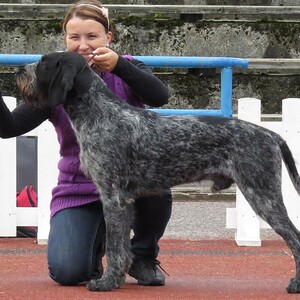
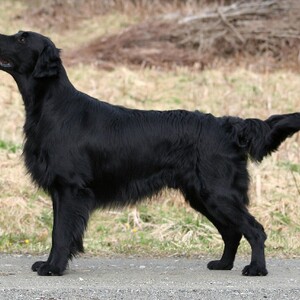
Flat-Coated Retriever. · Gunnandreassen / Wikimedia Commons, CC BY-SA 3.0. Cropped and resized.
The Flat-Coated Retriever is an English gundog with a flat, glossy coat, black or liver, bred to retrieve game on land and from water. It is optimistic, friendly and very eager to please. One author called it the “Peter Pan” of retrievers, because it never seems to grow up.
Quick facts
| Common name | Flat-Coated Retriever (Flat-Coat) |
| Scientific name | Canis lupus familiaris |
| Country of origin | United Kingdom (England) |
| Official recognition | FCI, definitively since 23 December 1954 (group 8, retrievers, with a working trial; standard no. 121); AKC, since 1915 |
| Lifespan | 8–10 years, according to the AKC |
| Size (males) | preferably 59–61.5 cm at the withers; 27–36 kg |
| Size (females) | preferably 56.5–59 cm at the withers; 25–32 kg |
| Coat type | Dense, fine to medium texture, as flat as possible, with feathering on the legs and tail |
| Common colours | Black or liver |
| Energy level | Very high |
| Suited to an apartment? | Can adapt, with plenty of exercise |
| Temperament | Optimistic, friendly, confident, kindly |
| Tendency to aggression | Very low |
| Good with children | Very good |
| Good with other animals | Very good |
| Genetic predispositions | Hip dysplasia, eye diseases |
- Primary category:Dog breeds
- Explore this animal's categories:
History and origin
Wikipedia says the Flat-Coated Retriever appeared in England in the mid-19th century and became popular as the gamekeeper's dog. Its ancestors are thought to include Newfoundland dogs brought over by Canadian sailors, collie-type dogs, for ease of training, and setters, for scenting ability. The first dogs appeared around 1860, and the final type was established 20 years later.
It was very popular until the Golden Retriever, bred partly from it, took its place. By the end of the Second World War so few dogs remained that the breed's survival was uncertain. From the 1960s, careful breeding rebuilt the population.
How the breed developed
- Around 1860 – The first Flat-Coated Retrievers appear.
- Around 1880 – The final type is established.
- 1915 – The AKC officially recognises the breed.
- 1945 – The breed is close to extinction.
- 23 December 1954 – The FCI recognises the breed.
- 1960s – Careful breeding rebuilds the population.
- 2022 – A liver Flat-Coat from Oslo wins Best in Show at Crufts.
Breed rating
| Feature | Stars |
|---|---|
| Training and intelligence | ★★★★★ |
| Easy to train | ★★★★★ |
| Intelligence | ★★★★★ |
| Independence | ★★★☆☆ |
| Stubbornness | ★★★☆☆ |
| Behaviour and temperament | ★★★★☆ |
| Affectionate with family | ★★★★★ |
| Friendly with children | ★★★★★ |
| Good with other dogs | ★★★★★ |
| Good with cats and other animals | ★★★★☆ |
| Loyalty | ★★★★★ |
| Tendency to be aggressive | ★☆☆☆☆ |
| Tendency to bark | ★★★☆☆ |
| Needs and care | ★★★★☆ |
| Shedding | ★★★☆☆ |
| Needs frequent grooming | ★★☆☆☆ |
| Activity and lifestyle | ★★★★☆ |
| Energy level | ★★★★★ |
| Daily exercise needs | ★★★★★ |
| Suited to apartment life | ★★★★☆ |
| Health and longevity | ★★★★☆ |
| Life expectancy | ★★☆☆☆ |
| Predisposition to genetic diseases | ★★★☆☆ |
| Working abilities and uses | ★★★★☆ |
| Good hunting dog | ★★★★★ |
| Good companion dog | ★★★★★ |
Indicative rating: 5 stars means the highest level. It is based on the ratings the American Kennel Club gives the breed and on the FCI standard.
Physical characteristics
The AKC says the Flat-Coat is about as tall as a Labrador, but has a sleeker, more elegant silhouette. The long head, unique among retrievers, is described as being “of one piece”, with a very slight stop.
General appearance
The almond-shaped, dark brown eyes have an intelligent, friendly expression. The small ears hang close to the head. The feathered tail is carried straight. The standard says its joy of life shows in the enthusiastic action of its tail.
| Feature | Flat-Coated Retriever |
|---|---|
| Size | Large |
| Height at the withers | males: 59–61.5 cm; females: 56.5–59 cm |
| Weight | males: 27–36 kg; females: 25–32 kg |
| Coat | Flat, glossy, feathered |
| Head | Long, “of one piece” |
| Eyes | Almond-shaped, dark brown |
The standard accepts only black or liver. Wikipedia says yellow dogs also occur, but this colour is a disqualification at shows.
Training and socialisation
The standard describes it as generously endowed with natural gundog ability, optimistic and friendly, confident and kindly. The AKC gives it the top score for trainability: it is very intelligent, responsive and eager to please.
It has a sensitive nature and does not respond well to harsh corrections. It wants to be with its family, and if it is often left alone for long periods it may get into mischief. Early socialisation and puppy classes are recommended.
Tips for effective training
- Use gentle methods. The AKC says it is sensitive to harshness.
- Do not leave it alone for long. It always wants to be with the family.
- Give it the chance to swim. It loves water.
- Try dog sports. Obedience, tracking, agility, rally.
Activity needs and lifestyle
The AKC says it is an active sporting breed that needs plenty of exercise every day: long walks, play and dog sports such as obedience, tracking, agility or rally.
| Activity | How often | Why it matters |
|---|---|---|
| Long walks | daily | Very high energy |
| Swimming and retrieving from water | weekly | It loves water |
| Dog sport | several times a week | Mental activity |
Tips for a balanced life
- It suits a very active family.
- Check the ears after swimming.
- Keep it close to the family.
Care and health
Coat and skin care
The AKC says the medium-length coat should be groomed weekly with a brush and a metal comb. The ears should be checked and cleaned regularly, and the nails trimmed often.
Common health problems
The AKC says the Flat-Coat is generally healthy, and responsible breeders test their dogs for:
| Condition | Description | Common symptoms |
|---|---|---|
| Hip dysplasia | The hip joint forms incorrectly and, over time, arthritis develops | Limping, difficulty getting up or jumping, hip pain |
| Eye diseases | Inherited eye conditions | Poor vision, cloudy eyes |
| Gastric dilatation-volvulus (bloat) | The stomach fills with gas and may twist; this is a veterinary emergency | Swollen belly, trying to vomit without success, drooling, restlessness |
Other care
- Check the ears regularly.
- Trim the nails often.
- Brush its teeth regularly.
Diet and nutrition
The AKC recommends good-quality food suited to the dog's age and activity level, and fresh water always available.
Tips for a healthy diet
The table gives a starting estimate, calculated with the formula from the Merck Veterinary Manual. The first two calorie columns show the calories per day for a healthy adult dog. The last column shows what this means in dry food with 3,500–4,000 kcal per kilogram.
| Dog's weight | Calories per day (neutered) | Calories per day (not neutered) | Dry food per day (approximate) |
|---|---|---|---|
| 25 kg | 1,250 kcal | 1,410 kcal | 310–400 g |
| 30 kg | 1,440 kcal | 1,620 kcal | 360–460 g |
| 36 kg | 1,650 kcal | 1,850 kcal | 410–530 g |
- Split the food into two meals a day to reduce the risk of bloat.
- Training treats count towards the daily portion.
- A dog is at the right weight when you can feel its ribs without pressing hard.
Foods to avoid
Some human foods are dangerous for dogs: chocolate, coffee, grapes and raisins, onions, garlic, xylitol (a sweetener used in chewing gum), macadamia nuts and alcohol.
Reproduction and development
Physical and emotional maturity
In dogs, sexual maturity usually comes between 6 and 12 months, but in large breeds it can be delayed until about two years. The body also reaches its adult form later than in small breeds.
Mating and pregnancy
Pregnancy lasts about 63 days, counted from ovulation. Mating a female on her first heat is not recommended. The FCI standard requires that only healthy dogs of typical breed appearance are used for breeding.
Caring for the puppies
In large breeds, a litter has around 7 puppies on average. Socialisation starts in the first weeks: gentle handling, everyday noises and new people.
Interesting facts
- The “Peter Pan” of retrievers. This is what author Paddy Petch calls it in the book “The Complete Flat-Coated Retriever”, because it never seems to grow up.
- It helped create the Golden Retriever. The Golden Retriever was bred partly from the Flat-Coat.
- Guide dog. It is used in the United Kingdom in the guide dog programme for blind people.
- Detection dog. Its good nose makes it suitable for drug detection.
- Crufts champion. In 2022, a liver Flat-Coat from Oslo won Best in Show at Crufts.
Frequently asked questions
Why is it called “Peter Pan”?
Because it stays playful and childlike all its life.
How big does it get?
Males measure 59–61.5 cm and weigh 27–36 kg; females measure 56.5–59 cm and weigh 25–32 kg.
Is it good with children?
Yes, the AKC gives it the top score for being good with children.
How long does it live?
The AKC gives 8–10 years.