XoloitzcuintleCharacteristics, history, training and care
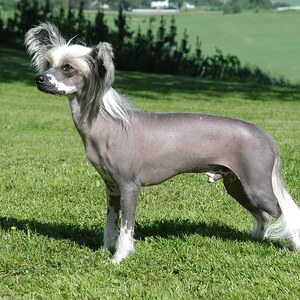
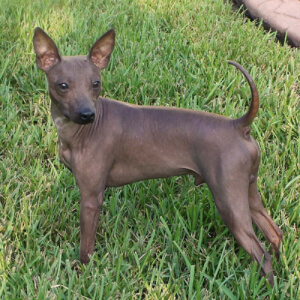
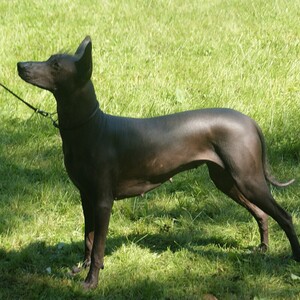
Xoloitzcuintle. · Canarian / Wikimedia Commons, CC BY-SA 4.0. Cropped and resized.
The Xoloitzcuintle (Xolo) is a primitive dog from Mexico, best known in its hairless form, although there is also a coated variety. It comes in three sizes: standard, intermediate and miniature. The FCI standard describes it as quiet and calm, cheerful, alert and intelligent, sometimes suspicious of strangers, a good guard dog and an excellent companion, never aggressive.
Quick facts
| Common name | Xoloitzcuintle (Xolo) |
| Scientific name | Canis lupus familiaris |
| Country of origin | Mexico |
| Official recognition | FCI, definitively since 6 November 1961 (group 5, primitive type; standard no. 234); also recognised by the AKC |
| Lifespan | 13–18 years, according to the AKC |
| Size (males) | standard 46–60 cm; intermediate 36–45 cm; miniature 25–35 cm |
| Size (females) | the same three sizes; 4.5–25 kg depending on size (AKC) |
| Coat type | Hairless (with a few hairs on the head, feet and tail) or with a short coat |
| Common colours | Black, dark grey, slate grey, reddish, liver, bronze, blond |
| Energy level | Medium to high |
| Suited to an apartment? | Yes |
| Temperament | Quiet, calm, cheerful, alert, intelligent |
| Tendency to aggression | Very low; never aggressive |
| Good with children | Moderate |
| Good with other animals | Moderate |
| Genetic predispositions | Missing teeth in the hairless variety, sensitive skin, hip dysplasia, luxating patella |
- Primary category:Dog breeds
- Explore this animal's categories:
History and origin
The FCI standard says the breed is of very ancient origin. In pre-Hispanic Mexico, Xoloitzcuintle meat was eaten by the indigenous peoples at special ceremonies, and the dog was regarded as the representative of the god Xolotl, from whom it takes its name. Its role was to guide the souls of the dead to the underworld. Because of this, it became rare and almost died out.
The Mexican Kennel Federation saved the breed and has used it on its logo since 1940. The hairless variety is also called “perro pelón mexicano”, while the indigenous peoples called the coated one “itzcuintle”. Wikipedia says that in 2016 the mayor of Mexico City declared it a “cultural heritage and symbol” of the city.
How the breed developed
- Pre-Hispanic Mexico – The dog of the god Xolotl.
- 1940 – It appears on the logo of the Mexican kennel club.
- 6 November 1961 – The FCI recognises the breed.
- 2016 – Declared a symbol of Mexico City.
Breed rating
| Feature | Stars |
|---|---|
| Training and intelligence | ★★★★☆ |
| Easy to train | ★★★★★ |
| Intelligence | ★★★☆☆ |
| Independence | ★★★☆☆ |
| Stubbornness | ★★★★☆ |
| Behaviour and temperament | ★★★★☆ |
| Affectionate with family | ★★★★☆ |
| Friendly with children | ★★★★☆ |
| Good with other dogs | ★★★☆☆ |
| Good with cats and other animals | ★☆☆☆☆ |
| Loyalty | ★★★★☆ |
| Tendency to be aggressive | ★☆☆☆☆ |
| Tendency to bark | ★★★☆☆ |
| Needs and care | ★★★☆☆ |
| Shedding | ★★★★☆ |
| Needs frequent grooming | ★★★☆☆ |
| Activity and lifestyle | ★★★★☆ |
| Energy level | ★★★★☆ |
| Daily exercise needs | ★★★★☆ |
| Suited to apartment life | ★★★☆☆ |
| Health and longevity | ★★★★☆ |
| Life expectancy | ★★★☆☆ |
| Predisposition to genetic diseases | ★☆☆☆☆ |
| Working abilities and uses | ★☆☆☆☆ |
| Good companion dog | ★★★★☆ |
| Good companion dog | ★★★☆☆ |
Indicative rating: 5 stars means the highest level. It is based on the ratings the American Kennel Club gives the breed and on the FCI standard.
Physical characteristics
The standard describes it as a natural primitive dog, shaped by evolution, slender and elegant, moderate in every respect, expressing speed, harmony and strength. The AKC says its forehead wrinkles when it is alert.
General appearance
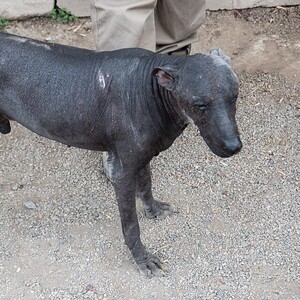
In the hairless variety, the hallmark of the breed is the total absence of hair on the body; on the forehead and nape there may be a few short, coarse hairs, no longer than 2.5 cm, and coarse hair on the feet and the tip of the tail. The AKC says the skin is tough and protective. The coated variety has short, smooth, close-lying hair.
| Feature | Xoloitzcuintle |
|---|---|
| Size | Small, medium or large |
| Height at the withers | 25–60 cm, in three sizes |
| Weight | 4.5–25 kg (AKC) |
| Coat | Hairless or short |
| Colour | Dark, solid |
| Type | Primitive dog |
The standard prefers dark, solid-coloured skin: black, greyish black, slate grey, dark grey, reddish, liver, bronze or blond. There may be patches of any colour, including white. The coated variety comes in the same colours.
Training and socialisation
The standard describes it as quiet and calm, cheerful, alert and intelligent, sometimes suspicious of strangers, a good guard dog and an excellent companion, never aggressive.
The AKC gives it 4 out of 5 for ease of training. It responds well to rewards and to a consistent owner; early socialisation helps it with strangers.
Tips for effective training
- Socialise it early. It can be suspicious of strangers.
- Use rewards. It learns easily.
- Protect its skin. Sun and cold affect it.
- Keep its mind busy. The AKC gives 4 out of 5 for its need for stimulation.
Activity needs and lifestyle
It needs daily walks and play. The hairless variety must be protected from strong sun and from cold when it goes out.
| Activity | How often | Why it matters |
|---|---|---|
| Walks | daily | Fitness |
| Play | daily | Energy |
| Light training | several times a week | A busy mind |
Tips for a balanced life
- It suits an apartment.
- Sun cream and a winter coat for the hairless dog.
- Brush its teeth often.
Care and health
Coat and skin care
The hairless variety does not shed, but its skin needs care: occasional baths and protection from sun and cold. The coated variety should be brushed from time to time. The AKC recommends checking the ears and brushing the teeth often.
Common health problems
The AKC says the Xolo is generally healthy, and responsible breeders check their dogs for:
| Condition | Description | Common symptoms |
|---|---|---|
| Hip dysplasia | The hip joint forms incorrectly and, over time, arthritis develops | Limping, difficulty getting up or jumping, hip pain |
| Patellar luxation | The kneecap slips out of place | Suddenly holds a hind leg up for a few steps, then uses it again |
| Eye diseases | Inherited conditions | Poor vision |
| Missing teeth | Wikipedia says the hairless variety often has dental anomalies | Some teeth are missing |
Other care
- Brush its teeth often.
- Protect the skin from the sun.
- Check the ears regularly.
Diet and nutrition
The AKC recommends good-quality food suited to the dog's age, and attention to its weight.
Tips for a healthy diet
The table gives a starting estimate, calculated with the formula from the Merck Veterinary Manual. The first two calorie columns show the calories per day for a healthy adult dog. The last column shows what this means in dry food with 3,500–4,000 kcal per kilogram.
| Dog's weight | Calories per day (neutered) | Calories per day (not neutered) | Dry food per day (approximate) |
|---|---|---|---|
| 4.5 kg | 350 kcal | 390 kcal | 88–111 g |
| 12 kg | 720 kcal | 810 kcal | 180–230 g |
| 25 kg | 1,250 kcal | 1,410 kcal | 310–400 g |
- The portion depends a lot on size.
- Treats count towards the daily portion.
- A dog is at the right weight when you can feel its ribs without pressing hard.
Foods to avoid
Some human foods are dangerous for dogs: chocolate, coffee, grapes and raisins, onions, garlic, xylitol (a sweetener used in chewing gum), macadamia nuts and alcohol.
Reproduction and development
Physical and emotional maturity
In dogs, sexual maturity usually comes between 6 and 12 months. Most breeds become adults at around 13–15 months.
Mating and pregnancy
Pregnancy lasts about 63 days, counted from ovulation. Mating a female on her first heat is not recommended. The FCI standard requires that only healthy dogs of typical breed appearance are used for breeding.
Caring for the puppies
In dogs, a litter has 5–6 puppies on average, and the number rises with the size of the breed. Socialisation starts in the first weeks: gentle handling, everyday noises and new people.
Interesting facts
- The dog of the god Xolotl. It guided the souls of the dead.
- Three sizes. Standard, intermediate and miniature.
- Different siblings. Hairless and coated puppies can be born in the same litter.
- On the Mexican club's logo. Since 1940.
- A symbol of the capital. Mexico City declared it a symbol in 2016.
In popular culture
Coco (2017)
Wikipedia says Dante, the dog in the Disney/Pixar animated film “Coco”, is a Xoloitzcuintle.
Frida Kahlo
Wikipedia says the Xolo appears in Frida Kahlo's paintings, including “The Love Embrace of the Universe, the Earth (Mexico), Myself, Diego and Señor Xolotl”, reproduced on the 500-peso banknote of 2007.
Frequently asked questions
Does it have hair?
There are both coated and hairless dogs.
How big does it get?
In three sizes, from 25 to 60 cm.
What breed is the dog in “Coco”?
A Xoloitzcuintle called Dante.
How long does it live?
The AKC gives 13–18 years.