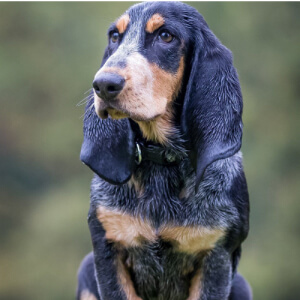
Basset Bleu de GascogneCharacteristics, history, training and care
Quick facts
| Common name | Basset Bleu de Gascogne |
| Scientific name | Canis lupus familiaris |
| Country of origin | France |
| Official Recognition | Recognized by FCI |
| Typical lifespan | About 10-14 years |
| Dimensions (Male) | About 34-42 cm / 17-20 kg |
| Dimensions (Female) | About 34-42 cm / 16-19 kg |
| Coat type | Short, dense, weather-resistant |
| Common colours | White mottled with black (looks blue), with black patches and tan markings |
| Energy Level | Moderate to high |
| Suitable for an apartment? | Depends on exercise, training, health and the individual dog |
| Temperament | Friendly, loyal, determined |
| Behaviour towards unfamiliar people and dogs | Individual behaviour varies; socialisation, training and management matter |
| Compatibility with children | Depends on the individual; adult supervision and suitable handling are essential |
| Compatibility with other animals | Depends on socialisation, prey drive and the animals involved |
| Health considerations | Hip dysplasia, ear infections, obesity, back problems |
- Primary category:Dog breeds
- Explore this animal's categories:
History and Origin
The Basset Bleu de Gascogne comes from Gascony in south-western France. It is a short-legged version of the large Grand Bleu de Gascogne, developed for hunting hares, rabbits and other small game on foot.
Evolution of the breed
- Old French hounds - Its ancestors are the blue-mottled hounds of Gascony, especially the Grand Bleu de Gascogne.
- Hunting on foot - Its short legs make it slower than tall hounds, so hunters on foot can follow it as it tracks game by scent through thick cover.
- Saved in the 20th century - The breed became very rare in the early 1900s, but French breeders revived it.
- The Basset Bleu de Gascogne has an FCI breed standard.
Breed Evaluation
The Basset Bleu de Gascogne is an excellent hunting dog and also an affectionate, loyal companion, suitable for families who enjoy walks. These are general editorial ratings, not measured scores; individual dogs vary.
| Characteristic | Stars |
|---|---|
| Training and Intelligence | ★★★☆☆ |
| Easy to train | ★★★☆☆ |
| Intelligence | ★★★★☆ |
| Level of independence | ★★★★☆ |
| Level of stubbornness | ★★★★☆ |
| Behavior and Temperament | ★★★★★ |
| Affectionate with family | ★★★★★ |
| Friendly with children | ★★★★★ |
| Compatible with other dogs | ★★★★☆ |
| Compatible with cats and other animals | ★★★☆☆ |
| Degree of loyalty | ★★★★★ |
| Tendency to be aggressive | ★☆☆☆☆ |
| Tendency to bark | ★★★★☆ |
| Needs and Care | ★★★☆☆ |
| Shedding level | ★★★☆☆ |
| Requires frequent care | ★★☆☆☆ |
| Activity and Lifestyle | ★★★★☆ |
| Energy level | ★★★★☆ |
| Daily exercise requirement | ★★★★☆ |
| Suitable for apartment living | ★★★☆☆ |
| Health and Longevity | ★★★★☆ |
| Life expectancy | ★★★★☆ |
| Predisposition to genetic diseases | ★★★☆☆ |
| Work and Utility Features | ★★★★★ |
| Good hunting dog | ★★★★★ |
| Good companion dog | ★★★★★ |
Physical Characteristics
The Basset Bleu de Gascogne is a sturdy but elegant short-legged hound.
General appearance
- A long body with short, strong legs, typical of basset breeds.
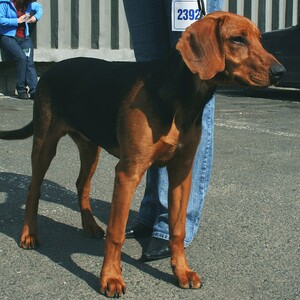
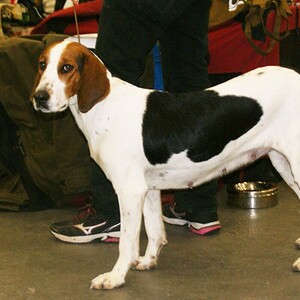
- A short, dense coat, white with black mottling that gives a bluish look, plus black patches and tan markings, including two tan spots above the eyes.
- Long, thin, folded ears, typical of French hounds.
- A large black nose with an excellent sense of smell.
- Dark brown eyes with a gentle, slightly sad expression.
| Characteristic | Basset Bleu de Gascogne |
|---|---|
| Size | Small to medium, low to the ground (about 34-42 cm at the shoulder) |
| Weight | About 16-20 kg |
| Coat | Short, dense, weather-resistant |
| Muzzle | Long, straight |
| Shedding tendency | Moderate |
| Build | Strong, long-bodied |
The Basset Bleu de Gascogne is well built for long days of hunting on rough ground.
Training and Socialization
The Basset Bleu de Gascogne is clever and friendly, but its strong hunting instinct can make it independent and stubborn. Consistent training and early socialisation help it become an obedient, balanced companion.
Tips for effective training
- Early socialisation - As a pack hound, it usually gets on well with other dogs, but it should also meet people and other animals from an early age.
- Reward-based training - It is very food-motivated and responds well to treats and praise.
- Short, varied training - It gets bored with repetition, so training should be lively and varied.
- Managing the nose - Strong scents easily distract it, so it should learn "come" and "wait", and be walked on a lead in open areas.
- No harsh punishments - It is sensitive and affectionate; a gentle but firm tone works much better.
The Basset Bleu de Gascogne is not the most obedient dog, but with patience and steady training it becomes a loyal, well-mannered companion.
Activity and Lifestyle Needs
The Basset Bleu de Gascogne is active but not hyperactive and needs regular exercise to stay healthy and happy.
| Activity | Recommended duration |
|---|---|
| Daily walks | About 60 min |
| Free play in a fenced garden | About 30 min |
| Scent games | About 20 min |
| Obedience training | About 10-15 min/day |
Recommendations for a balanced lifestyle
- Good in a house with a garden - It does not need a lot of space, but a fenced garden is a big advantage.
- Can live in an apartment - if it gets enough exercise every day, though its loud voice may bother neighbours.
- Loves to explore - Long walks and sniffing are essential for its happiness.
- Can become lazy - Without enough activity, it may become inactive and overweight.
The Basset Bleu de Gascogne does not need extreme exercise, but it must stay active to avoid weight problems and boredom.
Care and Health
The Basset Bleu de Gascogne is easy to groom, but it has some sensitivities typical of long-eared, long-bodied dogs.
Fur and skin care
- Weekly brushing - The short, dense coat needs little care, but brushing removes dead hair and keeps it shiny.
- Baths only when needed - It does not need frequent washing.
- Ear checks - The long ears should be cleaned regularly, as they can trap moisture and dirt and lead to infections.
Common health problems
| Condition | Description | Common symptoms |
|---|---|---|
| Hip dysplasia | Abnormal development of the hip joint | Limping, stiff joints |
| Ear infections (otitis) | Long ears can trap moisture | Scratching, discharge from the ear |
| Obesity and back problems | Extra weight strains its long back and short legs | Weight gain, reluctance to jump or climb stairs |
Other aspects of care
- Regular veterinary checks - Important for monitoring the joints, back and ears.
- Healthy weight - Food should match its activity to prevent obesity.
- Dental care - Regular tooth brushing helps prevent tartar.
The Basset Bleu de Gascogne is a generally healthy breed, but its ears, joints and weight need regular attention.
Diet and Nutrition
The Basset Bleu de Gascogne gains weight easily, so its food should be managed carefully.
Recommendations for a healthy diet
Choose a complete, balanced diet suited to age, size and health. Plan home-prepared diets and supplements with a qualified veterinarian; raw pet food can carry harmful bacteria.
| Food type | Daily Amount (Adults) | Frequency |
|---|---|---|
| Premium dry food | Individual amount; follow a complete diet’s guidance and veterinary advice | 2 meals/day |
| Home cooked food | Individual amount; follow a complete diet’s guidance and veterinary advice | 2 meals/day |
| Raw food: bacterial contamination is a concern | Individual amount; follow a complete diet’s guidance and veterinary advice | 2 meals/day |
Forbidden foods
Chocolate, grapes and raisins, onions and xylitol - toxic to dogs. / Cooked bones - can splinter and cause intestinal blockage. / Fatty and processed food - can cause digestive problems. / Overfeeding - can lead to obesity and joint problems.
The Basset Bleu de Gascogne should be fed carefully to keep a healthy weight and healthy joints.
Reproduction and Development
Breeding requires veterinary planning, suitable health screening and care for the mother and puppies. Pregnancy and birth can involve complications.
Physical and emotional maturity
- Physical maturity: It reaches adult size at about 12-18 months, but continues to fill out until about 2 years.
- Emotional maturity: It usually becomes calmer after 2 years, but stays playful and lively all its life.
Mating and Gestation
- Breeding decisions require veterinary assessment of maturity, health and suitable screening; reaching a fixed age does not establish that breeding is appropriate.
- Duration of gestation: Approximately 58-68 days, usually about 63 days.
- Average number of puppies: Usually about 4-8.
Puppy care
- The first 3 weeks: Puppies stay close to their mother for milk and protection.
- Between 4-8 weeks: They begin to eat solid food and develop social skills.
- Moving to a new home: When puppies go to their new homes, socialisation and training should continue to prevent behaviour problems.
Basset puppies need careful raising, without too much jumping or stair-climbing, to develop strong bones and joints.
Curiosities and Interesting Facts
- A "blue" dog - Its white coat is so densely flecked with black that it looks blue-grey.
- A great nose - Its sense of smell lets it follow a trail for long distances, even when the scent is old.
- Friendly - Although it is a hunting dog, it adapts well to family life and is very affectionate.
- A musical voice - It does not bark constantly, but when it follows a trail it gives a loud, ringing bay.
- Likes to dig - Its hunting instinct may lead it to dig in the garden.
- Rare abroad - It is valued by French hunters but little known in other countries.
The Dog in Popular Culture
The Basset Bleu de Gascogne is not famous worldwide, but it is part of the hunting tradition of south-western France.
The importance in French culture
- A hunters' companion - French hunters have used it for generations to hunt hares and rabbits.
- A family of blue hounds - It belongs to the family of Gascon blue hounds, together with the Grand Bleu de Gascogne and the Petit Bleu de Gascogne.
Basset Bleu de Gascogne in the media and canine sports
- Scent-hound events - It takes part in French hunting trials and tracking events that test its nose.