Cesky TerrierCharacteristics, history, training and care
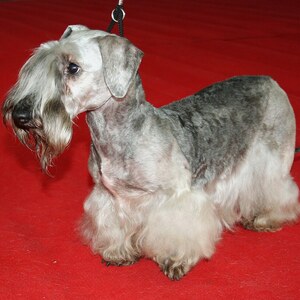
Cesky Terrier. · Pleple2000 / Wikimedia Commons, CC BY-SA 4.0. Cropped and resized.
The Cesky Terrier is a short-legged Czech terrier with a long, silky grey coat, a beard and eyebrows. It was created in 1949 for hunting foxes and badgers in the forests of Bohemia, but today it is mainly a companion dog. It is calmer and easier to train than many other terriers.
Quick facts
| Common name | Cesky Terrier (Czech Terrier) |
| Scientific name | Canis lupus familiaris |
| Country of origin | Czech Republic |
| Official recognition | FCI, definitively since 24 May 1963 (group 3, small-sized terriers; standard no. 246); also recognised by the AKC |
| Lifespan | 12–15 years |
| Size (males) | about 25–33 cm at the withers |
| Size (females) | about 25–33 cm at the withers |
| Weight | about 6–11 kg |
| Coat type | Long, fine but firm, slightly wavy, silky; clipped with scissors |
| Common colours | Grey-blue (puppies are born black) or light coffee brown (puppies are born chocolate) |
| Energy level | Moderate |
| Suited to an apartment? | Yes |
| Temperament | Self-confident, lively, calmer than other terriers, protective |
| Tendency to aggression | Low |
| Good with children | Very good |
| Good with other animals | Average; strong hunting instinct |
| Genetic predispositions | Patellar luxation, heart and eye diseases, “Scotty Cramp” |
- Primary category:Dog breeds
- Explore this animal's categories:
History and origin
The Cesky Terrier is the result of a cross between a Sealyham Terrier and a Scottish Terrier. The aim was a light hunting terrier with short legs, good pigmentation and practical drop ears, easy to groom and to train.
The breed was created by the Czech breeder František Horák, who worked as a research assistant at the Czechoslovak Academy of Sciences. Wikipedia tells how, when his dogs became known around the world, the letters he received from abroad drew the attention of the communist secret police.
How the breed developed
- 1949 – František Horák begins crossing the Sealyham Terrier with the Scottish Terrier.
- 24 May 1963 – The FCI recognises the breed.
- 11 March 1997 – The current FCI standard is published.
- 1997 – František Horák, the creator of the breed, dies.
Breed rating
| Feature | Stars |
|---|---|
| Training and intelligence | ★★★☆☆ |
| Easy to train | ★★★☆☆ |
| Intelligence | ★★★★☆ |
| Independence | ★★★☆☆ |
| Stubbornness | ★★★☆☆ |
| Behaviour and temperament | ★★★★☆ |
| Affectionate with family | ★★★★☆ |
| Friendly with children | ★★★★★ |
| Good with other dogs | ★★★☆☆ |
| Good with cats and other animals | ★★☆☆☆ |
| Loyalty | ★★★★☆ |
| Tendency to be aggressive | ★☆☆☆☆ |
| Tendency to bark | ★★★☆☆ |
| Needs and care | ★★☆☆☆ |
| Shedding | ★★☆☆☆ |
| Needs frequent grooming | ★★★☆☆ |
| Activity and lifestyle | ★★★☆☆ |
| Energy level | ★★★☆☆ |
| Daily exercise needs | ★★★☆☆ |
| Suited to apartment life | ★★★★☆ |
| Health and longevity | ★★★★☆ |
| Life expectancy | ★★★★☆ |
| Predisposition to genetic diseases | ★★★☆☆ |
| Working abilities and uses | ★★★★☆ |
| Good hunting dog (earth work) | ★★★★☆ |
| Good companion dog | ★★★★★ |
Indicative rating: 5 stars means the highest level. It is based on the ratings the American Kennel Club gives the breed and on the FCI standard.
Physical characteristics
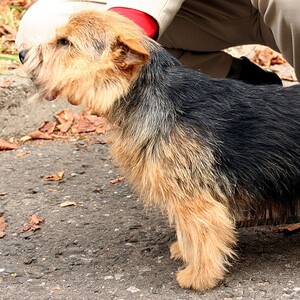
It is a muscular, short-legged terrier, longer than it is tall. The back rises slightly towards the rump. It has drop ears and a natural tail.
General appearance
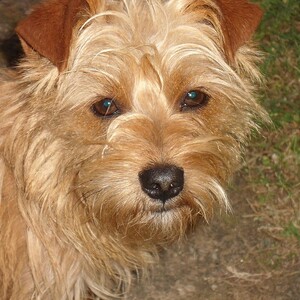
The medium-sized eyes have a friendly expression and are covered by long eyebrows. The triangular ears hang against the cheeks. The tail, ideally 18–20 cm long, hangs down at rest and is raised like a sabre when the dog is alert.
| Feature | Cesky Terrier |
|---|---|
| Size | Small, short-legged |
| Height at the withers | about 25–33 cm |
| Weight | about 6–11 kg |
| Coat | Long, silky, slightly wavy |
| Ears | Triangular, drop |
| Tail | Natural, ideally 18–20 cm |
There are two colours: grey-blue, in all shades from charcoal to platinum (puppies are born black), and light coffee brown (puppies are born chocolate brown). Yellow, grey or white markings are allowed on the head, neck, chest, belly and legs.
Training and socialisation
The AKC says it is a little less stubborn than other terriers and therefore easier to train. Even so, it needs “an iron hand in a velvet glove”.
It shuts down if treated harshly, so training must be purely positive, with rewards. Its hunting instinct must be kept under control from the start.
Tips for effective training
- Use only positive methods. Harshness makes it shut down.
- Socialise it early. It is reserved with strangers and protective of its family.
- Always keep it on a lead. If it sees or smells prey, it may run after it.
- Try dog sports. It is intelligent and eager to please.
Activity needs and lifestyle
It enjoys daily walks and play with its owner. It is small enough to live almost anywhere, as long as it gets exercise every day.
| Activity | How often | Why it matters |
|---|---|---|
| Lead walks | daily | Exercise and new smells |
| Play with its owner | daily | Keeps it happy |
| Digging in a permitted spot | occasionally | It loves to dig |
Tips for a balanced life
- The yard must be well fenced.
- It is a good watchdog, but does not bark excessively.
- Keep it away from small pets.
Care and health
Coat and skin care
Unlike other terriers, its coat is not stripped but clipped with scissors on the body, leaving the beard, eyebrows and the hair on the legs and belly longer. As the coat does not repel dirt, it needs regular baths. Hair in the ears must be removed to prevent infections.
Common health problems
The AKC says the breed is generally healthy, but breeders test their dogs for a few problems:
| Condition | Description | Common symptoms |
|---|---|---|
| Patellar luxation | The kneecap slips out of place | Suddenly holds a hind leg up for a few steps, then uses it again |
| “Scotty Cramp” | An inherited neurological disorder, not life-threatening | Muscle spasms that disrupt its gait, especially during exertion or excitement |
| Eye diseases | Progressive retinal atrophy and cataracts | Sees less and less well, cloudy eyes |
Other care
- Clean the ears regularly and pluck the hair from them.
- Trim the nails regularly.
- Brush its teeth often.
Diet and nutrition
Choose a good-quality food for small breeds. Watch its weight so it does not get fat.
Tips for a healthy diet
The table gives a starting estimate, calculated with the formula from the Merck Veterinary Manual. The first two calorie columns show the calories per day for a healthy adult dog. The last column shows what this means in dry food with 3,500–4,000 kcal per kilogram.
| Dog's weight | Calories per day (neutered) | Calories per day (not neutered) | Dry food per day (approximate) |
|---|---|---|---|
| 6 kg | 430 kcal | 480 kcal | 110–140 g |
| 8 kg | 530 kcal | 600 kcal | 130–170 g |
| 11 kg | 680 kcal | 760 kcal | 170–220 g |
- Give it its food in two meals a day.
- Training treats count towards the daily portion.
- A dog is at the right weight when you can feel its ribs without pressing hard.
Foods to avoid
Some human foods are dangerous for dogs: chocolate, coffee, grapes and raisins, onions, garlic, xylitol (a sweetener used in chewing gum), macadamia nuts and alcohol.
Reproduction and development
Physical and emotional maturity
In dogs, sexual maturity usually comes between 6 and 12 months. Small breeds become adults faster than large ones, usually at around one year.
Mating and pregnancy
Pregnancy lasts about 63 days, counted from ovulation. Mating a female on her first heat is not recommended. The FCI standard requires that only healthy dogs of typical breed appearance are used for breeding.
Caring for the puppies
In small breeds, a litter has 3–4 puppies on average. The puppies are very small and fragile in the first weeks, so they must be kept warm and handled with care. Socialisation starts early: gentle handling, everyday noises and new people.
Interesting facts
- Created by a researcher. František Horák worked at the Czechoslovak Academy of Sciences.
- Watched by the secret police. His correspondence with people abroad about his dogs drew the attention of the communist police.
- Born black. Grey-blue puppies are born black, and brown ones are born chocolate.
- Clipped, not stripped. It differs from most harsh-coated terriers.
- Rare worldwide. The AKC says there are so few of them that many dog groomers have never even heard of the breed.
Frequently asked questions
How big does a Cesky Terrier get?
It measures about 25–33 cm at the withers and weighs 6–11 kg.
Is it easy to train?
Easier than other terriers, if training is positive.
How do you care for the coat?
It is clipped with scissors, not stripped, and needs regular baths.
Is it good with children?
Yes. The AKC gives it the top score for compatibility with children.
How long does it live?
Its life expectancy is 12–15 years.