Canadian Eskimo DogCharacteristics, history, training and care
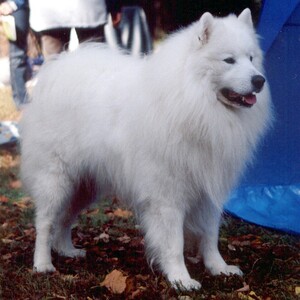
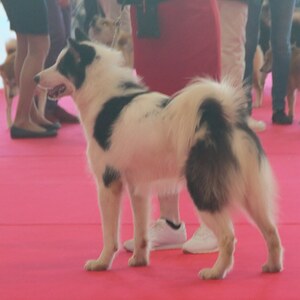
Canadian Eskimo Dog. · Canarian / Wikimedia Commons, CC BY-SA 4.0. Cropped and resized.
The Canadian Eskimo Dog is a powerful sled dog from the Canadian Arctic that has lived alongside the Inuit for more than 1,000 years. It pulled heavy sleds, found seals' breathing holes and kept polar bears at bay. It is a primitive working dog, not a dog for a flat.
Quick facts
| Common name | Canadian Eskimo Dog |
| Scientific name | Canis lupus familiaris |
| Country of origin | Canada (Arctic) |
| Official recognition | FCI, definitively since 25 June 1959 (group 5, Nordic sledge dogs; standard no. 211); also recognised by the AKC |
| Lifespan | 10–15 years |
| Size (males) | 58–70 cm at the withers; 30–40 kg |
| Size (females) | 50–60 cm at the withers; 18–30 kg |
| Coat type | Thick and dense; hard topcoat 7–15 cm long, very dense undercoat |
| Common colours | Many variations: solid white, white with patches on the head, white with patches on the body, solid colours |
| Energy level | Very high |
| Suited to an apartment? | No |
| Temperament | Loyal, sociable, playful, mischievous |
| Tendency to aggression | Low towards people |
| Good with children | Average |
| Good with other animals | Average; needs canine company |
| Genetic predispositions | No breed-specific diseases are known |
- Primary category:Dog breeds
- Explore this animal's categories:
History and origin
The breed has a history of 1,100–2,000 years linked to the Thule culture, the ancestors of today's Inuit, who settled the coast and islands of the Canadian Arctic. The AKC says the Thule people were the first to use dogs for pulling, hunting and guarding against polar bears.
The breed came close to extinction. Today's line comes mainly from dogs bred by the Eskimo Dog Research Foundation in the Northwest Territories. For six years, with money from the governments of Canada and the Territories, the foundation bought dogs from the Inuit of the Boothia Peninsula, the Melville Peninsula and Baffin Island.
How the breed developed
- 1,000–1,250 years ago – The Thule people begin using these dogs for pulling.
- 800–1,000 years ago – The Thule people spread with their dogs from Alaska to the Canadian Arctic and Greenland.
- 25 June 1959 – The FCI recognises the breed.
- 20th century – The Eskimo Dog Research Foundation saves the breed from the last Inuit populations.
- 28 February 2018 – The current FCI standard is published.
Breed rating
| Feature | Stars |
|---|---|
| Training and intelligence | ★★★☆☆ |
| Easy to train | ★★★☆☆ |
| Intelligence | ★★★★☆ |
| Independence | ★★★★★ |
| Stubbornness | ★★★★☆ |
| Behaviour and temperament | ★★★★☆ |
| Affectionate with family | ★★★☆☆ |
| Friendly with children | ★★★☆☆ |
| Good with other dogs | ★★★☆☆ |
| Good with cats and other animals | ★★☆☆☆ |
| Loyalty | ★★★★☆ |
| Tendency to be aggressive | ★★☆☆☆ |
| Tendency to bark | ★★☆☆☆ |
| Needs and care | ★★★★★ |
| Shedding | ★★★★★ |
| Needs frequent grooming | ★★★★☆ |
| Activity and lifestyle | ★★★★★ |
| Energy level | ★★★★★ |
| Daily exercise needs | ★★★★★ |
| Suited to apartment life | ★☆☆☆☆ |
| Health and longevity | ★★★☆☆ |
| Life expectancy | ★★★★☆ |
| Predisposition to genetic diseases | ★★☆☆☆ |
| Working abilities and uses | ★★★★★ |
| Good sled dog | ★★★★★ |
| Good companion dog | ★★★☆☆ |
Indicative rating: 5 stars means the highest level. It is based on the ratings the American Kennel Club gives the breed and on the FCI standard.
Physical characteristics
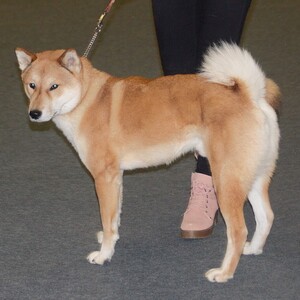
It is a powerful, muscular sled dog, built for hard work in the harshest winter conditions. The height at the hips is almost equal to the height at the withers.
General appearance
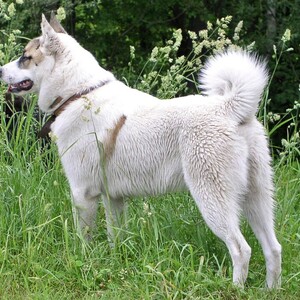
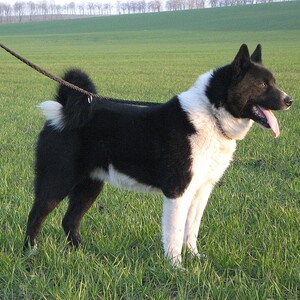
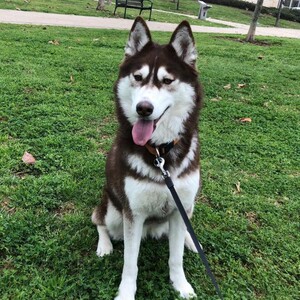
The small, slanting, usually dark eyes give it a wild expression. The short, thick ears stand erect, tilted forward. The large, bushy tail is carried high or curled over the back. Males have a mane on the neck and shoulders that makes them look bigger.
| Feature | Canadian Eskimo Dog |
|---|---|
| Size | Large |
| Height at the withers | males: 58–70 cm; females: 50–60 cm |
| Weight | males: 30–40 kg; females: 18–30 kg |
| Coat | Hard hair 7–15 cm long, very dense undercoat |
| Ears | Short, thick, erect |
| Tail | Bushy, curled over the back |
The standard says that no colour should dominate the breed. There are solid white dogs, white dogs with a little red, beige, grey or black around the eyes and ears, white dogs with patches on the head or body, and solid-coloured dogs.
Training and socialisation
The AKC is clear: it is a primitive working dog, not a pet. It is not suitable for first-time dog owners.
It is intelligent and playful, but independent. Training calls for experience with Arctic breeds, patience and plenty of activity.
Tips for effective training
- Give it a job. Pulling, sledding and backpacking hikes keep it happy.
- Keep it in canine company. The AKC says it needs other dogs.
- Be consistent. It is independent and tests limits.
- Do your research first. The AKC recommends reading a lot about the breed before getting a puppy.
Activity needs and lifestyle
In the past, a single dog pulled 45–80 kg and covered between 24 and 113 km a day. In summer it carried up to 15 kg on its back. It needs very intense exercise and mental stimulation.
| Activity | How often | Why it matters |
|---|---|---|
| Pulling (sled, bike, canicross) | several times a week | It is the job it was created for |
| Running or long hikes | daily | Very high energy |
| Play with other dogs | daily | It needs canine company |
Tips for a balanced life
- It needs a fenced yard.
- It is not suited to a warm climate.
- It is not suited to a flat or to inexperienced owners.
Care and health
Coat and skin care
The thick coat sheds once a year, usually in August or September. The undercoat then comes out in clumps over a few days, and the dog must be brushed daily. The standard forbids clipping or altering the coat with scissors.
Common health problems
There are no known hereditary diseases specific to the breed. The greatest risk for it is heat: it is not made for a warm climate.
Other care
- Protect it from heat and from exertion on hot days.
- Trim the nails regularly.
- Check its paws after runs on hard ground.
Diet and nutrition
As a primitive breed, the standard says it is first and foremost a carnivore: its natural food was seal, walrus, fish and caribou. The AKC recommends food high in fat and protein, with few starches.
Tips for a healthy diet
The table gives a starting estimate, calculated with the formula from the Merck Veterinary Manual. The first two calorie columns show the calories per day for a healthy adult dog. The last column shows what this means in dry food with 3,500–4,000 kcal per kilogram.
| Dog's weight | Calories per day (neutered) | Calories per day (not neutered) | Dry food per day (approximate) |
|---|---|---|---|
| 20 kg | 1,060 kcal | 1,190 kcal | 260–340 g |
| 30 kg | 1,440 kcal | 1,620 kcal | 360–460 g |
| 40 kg | 1,780 kcal | 2,000 kcal | 440–570 g |
- Discuss with your vet a diet suited to a very active dog.
- Increase the portion during periods of hard work and reduce it in summer.
- A dog is at the right weight when you can feel its ribs without pressing hard.
Foods to avoid
Some human foods are dangerous for dogs: chocolate, coffee, grapes and raisins, onions, garlic, xylitol (a sweetener used in chewing gum), macadamia nuts and alcohol.
Reproduction and development
Physical and emotional maturity
In dogs, sexual maturity usually comes between 6 and 12 months, but in large breeds it can be delayed until about two years. The body also reaches its adult form later than in small breeds.
Mating and pregnancy
Pregnancy lasts about 63 days, counted from ovulation. Mating a female on her first heat is not recommended. The FCI standard requires that only healthy dogs of typical breed appearance are used for breeding.
Caring for the puppies
In large breeds, a litter has around 7 puppies on average. Socialisation starts in the first weeks: gentle handling, everyday noises and new people.
Interesting facts
- It found seals. It helped Inuit hunters find the holes through which seals breathed.
- It kept polar bears at bay. When hunting, it could hold a musk ox or a polar bear until the hunters arrived.
- It pulled up to 80 kg. A single dog could pull 45–80 kg, dozens of kilometres a day.
- A relative of the Greenland Dog. The AKC says the two breeds are very closely related.
- Males look bigger. The mane on the neck and shoulders makes them look taller than they are.
In popular culture
The dog of the Inuit
For more than a thousand years, the Canadian Eskimo Dog has been part of Inuit life in the Arctic. Without it, sled transport, seal hunting and guarding camps against polar bears would have been much harder.
Frequently asked questions
Is it suited to being a pet?
The AKC says it is a primitive working dog, not an ordinary pet.
How big does it get?
Males measure 58–70 cm and weigh 30–40 kg; females measure 50–60 cm and weigh 18–30 kg.
Does it cope with heat?
No. It is not suited to a warm climate.
How long does it live?
Its life expectancy is 10–15 years.