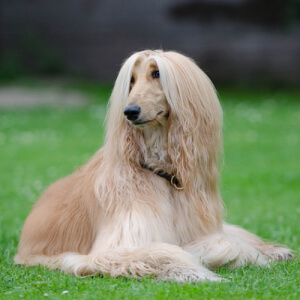
Afghan HoundCharacteristics, history, training and care
The Afghan Hound is a tall, elegant sighthound with a long, silky coat, from the mountains and deserts of Afghanistan. The FCI standard describes it as dignified and aloof, with a certain fierceness when hunting. It is independent and loving with its family, and needs plenty of running and frequent brushing.
Quick facts
| Common name | Afghan Hound |
| Scientific name | Canis lupus familiaris |
| Country of origin | Afghanistan |
| Official recognition | FCI, definitively since 12 December 1961 (group 10, sighthounds; standard no. 228) |
| Lifespan | 11.1 years on average, according to a UK study; the AKC gives 12–18 years |
| Size (males) | 68–74 cm at the withers; 23–27 kg (AKC) |
| Size (females) | 63–69 cm at the withers; somewhat lighter |
| Coat type | Long and very fine, silky; short on the back (the saddle) and on the face |
| Common colours | All colours are accepted except merle |
| Energy level | High |
| Suited to an apartment? | Only with daily running in an enclosed area |
| Temperament | Dignified, aloof, independent, loving with its family |
| Tendency to aggression | Low towards people; strong hunting instinct |
| Good with children | Good with older, gentle children |
| Good with other animals | Good with other dogs; may chase cats and small animals |
| Genetic predispositions | Chylothorax, sensitivity to anaesthesia, allergies, hip dysplasia |
- Primary category:Dog breeds
- Explore this animal's categories:
History and origin
Long-haired sighthounds had lived in Afghanistan for a long time, hunting hares, gazelles and other fast animals. Wikipedia says the first famous Afghan in Europe was Zardin, brought from India in 1907 by Captain John Barff. Zardin served as the model for the first breed standard, written in 1912.
Today's breed comes from two groups of dogs brought to Great Britain. In 1920, Major Bell-Murray brought desert dogs with a thinner coat from Baluchistan. In 1925, Mary Amps brought mountain dogs with a rich coat from Kabul, known as the Ghazni line.
Their beauty quickly made them show dogs. Wikipedia says that Sirdar, of the Ghazni line, won Best in Show at Crufts in 1928 and 1930. The FCI recognised the breed definitively on 12 December 1961.
How the breed developed
- 1907 – Zardin arrives in Great Britain.
- 1912 – The first breed standard is written.
- 1920 and 1925 – The Bell-Murray and Ghazni lines arrive.
- 12 December 1961 – Definitive FCI recognition.
- 3 August 2005 – Snuppy, an Afghan Hound, becomes the first cloned dog.
Breed rating
| Feature | Stars |
|---|---|
| Training and intelligence | ★★★★☆ |
| Easy to train | ★☆☆☆☆ |
| Intelligence | ★★★☆☆ |
| Independence | ★★★★★ |
| Stubbornness | ★★★★★ |
| Behaviour and temperament | ★★★☆☆ |
| Affectionate with family | ★★★☆☆ |
| Friendly with children | ★★★☆☆ |
| Good with other dogs | ★★★☆☆ |
| Good with cats and other animals | ★★☆☆☆ |
| Loyalty | ★★★☆☆ |
| Tendency to be aggressive | ★★☆☆☆ |
| Tendency to bark | ★★★☆☆ |
| Needs and care | ★★★★☆ |
| Shedding | ★★☆☆☆ |
| Needs frequent grooming | ★★★★★ |
| Activity and lifestyle | ★★★☆☆ |
| Energy level | ★★★★☆ |
| Daily exercise needs | ★★★★☆ |
| Suited to apartment life | ★★☆☆☆ |
| Health and longevity | ★★★☆☆ |
| Life expectancy | ★★★☆☆ |
| Predisposition to genetic diseases | ★★★☆☆ |
| Working abilities and uses | ★★★★☆ |
| Good sight-hunting dog | ★★★☆☆ |
| Good companion dog | ★★★★☆ |
Indicative rating: 5 stars means the highest level. The rating is based on the breed's AKC profile (trainability 1 out of 5, grooming 4 out of 5, energy 4 out of 5) and on the FCI standard.
Physical characteristics
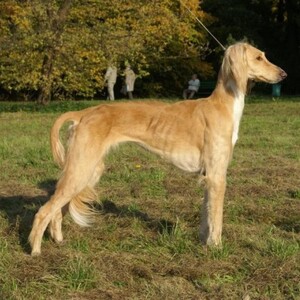
The FCI standard describes it as a sighthound that gives an impression of strength and dignity, combining speed with power. The head is carried high, with a proud air. The back is level and strong, and the tail ends in a ring.
General appearance
The coat is long and very fine on the body, but short and glossy along the back in adults, and on the face. On the head it has a long, silky topknot. The forefeet are large and covered with thick hair, which protects them on stony ground.
| Feature | Afghan Hound |
|---|---|
| Size | Large |
| Height at the withers | males: 68–74 cm; females: 63–69 cm (FCI) |
| Weight | 23–27 kg (AKC) |
| Coat | Long, fine and silky |
| Colour | All, except merle |
| Tail | With a ring at the tip |
The FCI standard accepts all colours except merle (a coat with irregular, “marbled” patches).
Training and socialisation
The Afghan Hound is an intelligent but very independent dog. Stanley Coren ranked it last of 138 breeds for obeying commands. Of the 199 trainers he surveyed, 121 placed it among the bottom 10 breeds.
Sighthounds were bred to hunt on their own, far from people, so they often make their own decisions. They respond better to short lessons with rewards than to harshness. The recall is hard to teach: a sighthound that sees an animal running will set off after it.
Tips for effective training
- Keep lessons short. It gets bored quickly.
- Use rewards. Harshness makes it shut down.
- Let it off the lead only in an enclosed area. Its hunting instinct is very strong.
- Get it used to brushing early. The coat needs a lot of care.
Activity needs and lifestyle
It is a runner bred for hunting, so it needs long walks every day and, from time to time, a free run in a well-fenced place. The AKC profile gives it 4 stars out of 5 for energy. At home it can be calm if it has had enough exercise.
| Activity | How often | Why it matters |
|---|---|---|
| Long walks | daily | Fitness |
| Running in a fenced area | several times a week | Satisfies its sighthound instinct |
| Lure coursing (chasing a lure) | occasionally | Keeps its mind busy |
Tips for a balanced life
- Suits patient owners.
- A yard with a high fence.
- Time for brushing and bathing.
Care and health
Coat and skin care
The long coat should be brushed several times a week, right down to the skin, so that it does not tangle. The AKC profile gives it 4 stars out of 5 for grooming. Regular baths keep the hair clean and easy to comb. The breed sheds little.
Common health problems
A UK study found a life expectancy of 11.1 years, compared with an average of 12.7 years for purebred dogs. Wikipedia names allergies, cancer and hip dysplasia as the main problems. As with other sighthounds, its low body fat makes it sensitive to anaesthesia.
| Condition | Description | Common symptoms |
|---|---|---|
| Chylothorax | Lymphatic fluid (chyle) builds up in the chest; the breed is among the most predisposed | Laboured, rapid breathing, coughing, tiredness |
| Hip dysplasia | The hip joint forms incorrectly and, over time, arthritis develops | Limping, difficulty getting up or jumping, hip pain |
| Allergies | The skin reacts to pollen, dust or food | Itching, red skin, frequent licking |
Other care
- Tell the vet it is a sighthound before any anaesthetic.
- Check its long ears.
- Go for yearly check-ups.
Diet and nutrition
A lean, active sighthound needs good-quality food with enough protein, suited to its age and activity.
Tips for a healthy diet
The table gives a starting estimate, calculated with the formula from the Merck Veterinary Manual. The first two calorie columns show the calories per day for a healthy adult dog. The last column shows what this means in dry food with 3,500–4,000 kcal per kilogram.
| Dog's weight | Calories per day (neutered) | Calories per day (not neutered) | Dry food per day (approximate) |
|---|---|---|---|
| 23 kg | 1,180 kcal | 1,320 kcal | 300–380 g |
| 25 kg | 1,250 kcal | 1,410 kcal | 310–400 g |
| 27 kg | 1,330 kcal | 1,490 kcal | 330–430 g |
- Split the food into two meals a day.
- Healthy sighthounds have a lithe body: the last ribs and the hip bones are easy to see.
- Do not let it run right after a meal.
Foods to avoid
Some human foods are dangerous for dogs: chocolate, coffee, grapes and raisins, onions, garlic, xylitol (a sweetener used in chewing gum), macadamia nuts and alcohol.
Reproduction and development
Physical and emotional maturity
In dogs, sexual maturity usually comes between 6 and 12 months, but in large breeds it can be delayed until about two years. The body also reaches its adult form later than in small breeds.
Mating and pregnancy
Pregnancy lasts about 63 days, counted from ovulation. Mating a female on her first heat is not recommended. The FCI standard requires that only healthy dogs of typical breed appearance are used for breeding.
Caring for the puppies
In large breeds, a litter has around 7 puppies on average. Socialisation starts in the first weeks: gentle handling, everyday noises and new people.
Interesting facts
- The first cloned dog. Snuppy, an Afghan Hound, was cloned in South Korea in 2005.
- Mountaineer's feet. Its large, hairy feet help it on mountain ground.
- Last for obedience. Stanley Coren ranked it 138th out of 138.
- On the cover of Life magazine. On 26 November 1945.
- A ringed tail. The tip of the tail curls into a circle.
In popular culture
Picasso's sculpture in Chicago
Wikipedia says Pablo Picasso stated that his 1967 sculpture in Chicago's Daley Plaza represents the head of an Afghan Hound named Kabul.
In films and cartoons
Afghan Hounds appear in “Balto” (Sylvie), in “Bluey” (Indy) and in the “101 Dalmatians” films.
Frequently asked questions
Why is it hard to train?
It is very independent and decides for itself whether to obey; it needs patience and rewards.
Does it shed a lot?
Little, but the long coat must be brushed several times a week.
How big does it get?
Males measure 68–74 cm at the withers and females 63–69 cm.
Does it get on with cats?
Only if it has grown up with them; otherwise it may chase them as prey.