Pontic shadAlosa immaculata — habitat, diet and reproduction
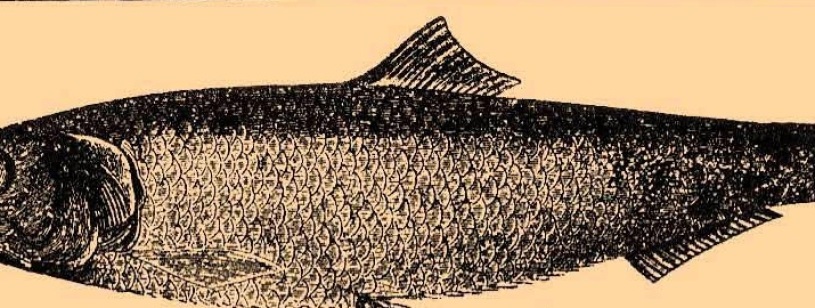
Pontic shad (Clupea pontica, now Alosa immaculata), illustration from the Brockhaus and Efron Encyclopedic Dictionary. · painter from Brockhaus and Efron Encyclopedic Dictionary / Public domain ().
The Pontic shad is a fish of the herring family that lives in the Black Sea and swims up the Danube in spring to spawn. Its migration in large schools was once eagerly awaited by fishers in the Delta and along the river. It lives only in the Black Sea and Sea of Azov basin.
Quick facts
| Common name | Pontic shad, Black Sea shad |
| Scientific name | Alosa immaculata (old synonym: Alosa pontica) |
| Lifespan | A few years; up to about 7 years |
| Length | About 30–45 cm |
| Weight | Usually 300–600 g; up to about 1 kg |
| Diet | Carnivore: small fish, crustaceans |
| Predators | Dolphins, large predatory fish, cormorants |
| Conservation status | Least Concern (LC), with populations affected by dams |
| Distribution | Black Sea, Sea of Azov and the rivers flowing into them |
| Habitat | Open sea; large rivers such as the Danube in spring |
| Family | Clupeidae (herring family) |
| Migration | From sea to river to breed |
- Primary category:Fish
- Explore this animal's categories:
Interesting facts
- In the past, shad swam up the Danube as far as Mohács in Hungary, more than a thousand kilometres from the sea.
- The shad’s belly forms a sharp keel covered with cutting scales.
- In spring, shad enter the Danube in large schools, usually in late April and early May.
- The Pontic shad lives only in the Black Sea and Sea of Azov basin.
Characteristics
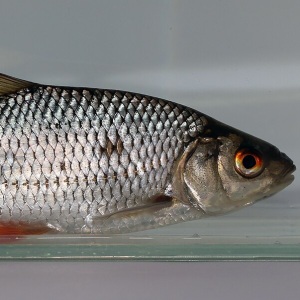
The Pontic shad has an elongated, flattened body with large scales that fall off easily. The belly forms a sharp, blade-like keel covered with cutting scales.
The back is bluish-green and the sides silvery with a metallic sheen. A small black spot sits high on the gill cover. The mouth is large with small teeth, and the eyes have thick fatty eyelids.
Behaviour
Shad live in schools in the open Black Sea, where they feed and grow. In spring, adults head for river mouths.
In the Danube, schools swim upstream, seeking the fastest-flowing stretches, where they spawn near the surface. After spawning, many fish return to the sea.
Habitat and distribution
The species lives in the Black Sea and Sea of Azov and migrates to spawn in the Danube, Dniester, Dnieper, Southern Bug, Don and Kuban.
In Romania, shad enter the Danube branches through the Delta and swim upriver. Today, the Iron Gates dams block their way further upstream.
Diet and feeding
The Pontic shad is a predator, eating small fish such as anchovy, sprat and gobies, plus crustaceans.
During the river migration, adults eat little or nothing. In turn, shad are prey for dolphins, large predatory fish and birds.
Reproduction and life cycle
Spawning takes place in the Danube in spring and early summer. Eggs are released near the surface in fast currents and drift as they develop.
The young then drift down the river to the sea, where they grow for a few years before returning to the Danube themselves.
Name and history
The scientific name Alosa immaculata means “spotless shad”. The species was long called Alosa pontica and earlier Clupea pontica, the name shown in the illustration on this page.
In villages along the Danube, smoked or grilled shad is a traditional spring dish.
Conservation and threats
The species is assessed as Least Concern, but populations are smaller than in the past. Dams have blocked access to upstream spawning grounds, and pollution and heavy fishing have reduced numbers.
Shad fishing is regulated by closed seasons and minimum sizes. Keeping the Danube free below the Iron Gates matters for shad and sturgeon.
Frequently asked questions
When do shad swim up the Danube?
In spring, usually from late April and early May, as the water warms.
How big is the Pontic shad?
Usually 30–45 cm and 300–600 g; the largest reach about 1 kg.
What does it eat?
Small fish such as anchovy, sprat and gobies, plus crustaceans.
Is the Pontic shad the same as mackerel?
No. Mackerel, sometimes also called “scrumbie” in Romanian, is a marine fish of another family. The Pontic shad is related to herring.