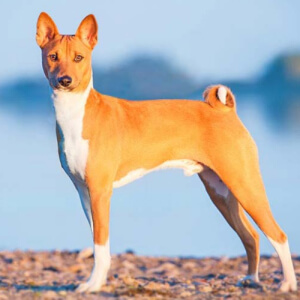
BasenjiCharacteristics, history, training and care
Quick facts
| Common name | Basenji |
| Scientific name | Canis lupus familiaris |
| Country of origin | Democratic Republic of Congo |
| Official Recognition | Recognized by FCI and AKC |
| Typical lifespan | About 12-16 years |
| Dimensions (Male) | About 41-43 cm / 10-12 kg |
| Dimensions (Female) | About 38-41 cm / 9-10 kg |
| Coat type | Short, fine, smooth |
| Common colours | Red, black, black and tan, or brindle, all with white markings |
| Energy Level | High |
| Suitable for apartment? | Suitability depends on exercise, training, safe management and the individual dog |
| Temperament | Independent, playful, curious |
| Behaviour towards unfamiliar people and dogs | Individual behaviour varies; appropriate socialisation, training and management matter |
| Compatibility with children | Depends on the individual; adult supervision and suitable handling are essential |
| Compatibility with other animals | Depends on socialisation, prey drive and the animals involved |
| Genetic predispositions | Fanconi syndrome, hip dysplasia, eye problems |
- Primary category:Dog breeds
- Explore this animal's categories:
History and Origin
The Basenji is one of the oldest dog breeds: genetic studies show that it separated very early from most modern breeds. It has long been used by the peoples of the Congo Basin in Central Africa for hunting.
Evolution of the breed
- Central African hunters - In the forests of the Congo, Basenjis helped hunters find game and drive it into nets; because they rarely bark, hunters often hung wooden bells on them.
- Ancient art - Some people link the Basenji with dogs with pricked ears and curled tails shown in ancient Egyptian art, but a direct connection is not proven.
- Arrival in Europe and America - Basenjis were brought to Britain in the 1930s and then to the United States; the AKC recognised the breed in 1943.
Breed Evaluation
The Basenji is a clever but independent dog that needs regular exercise and mental stimulation. These are general editorial ratings, not measured scores; individual dogs vary.
| Characteristic | Stars |
|---|---|
| Training and Intelligence | ★★★☆☆ |
| Easy to train | ★★☆☆☆ |
| Intelligence | ★★★★★ |
| Level of independence | ★★★★★ |
| Level of stubbornness | ★★★★★ |
| Behavior and Temperament | ★★★★☆ |
| Affectionate with family | ★★★★☆ |
| Friendly with children | ★★★☆☆ |
| Compatible with other dogs | ★★★☆☆ |
| Compatible with cats and other animals | ★★☆☆☆ |
| Degree of loyalty | ★★★★☆ |
| Tendency to be aggressive | ★★☆☆☆ |
| Tendency to bark | ★☆☆☆☆ |
| Needs and Care | ★★★★☆ |
| Shedding level | ★☆☆☆☆ |
| Requires frequent care | ★☆☆☆☆ |
| Activity and Lifestyle | ★★★★★ |
| Energy level | ★★★★★ |
| Daily exercise requirement | ★★★★★ |
| Suitable for apartment living | ★★★★☆ |
| Health and Longevity | ★★★★☆ |
| Life expectancy | ★★★★★ |
| Predisposition to genetic diseases | ★★★☆☆ |
| Work and Utility Features | ★★★★★ |
| Good hunting dog | ★★★★★ |
| Good companion dog | ★★★★☆ |
Physical Characteristics
The Basenji is a small, lean, agile dog, built for speed and stamina.
General appearance
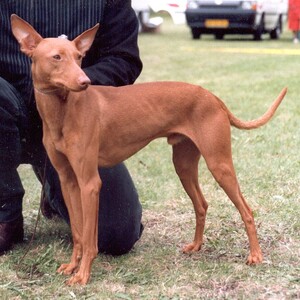
- A light, elegant body with well-defined muscles and long legs.
- A short, fine coat that needs very little care.
- A wrinkled forehead, especially when the dog is alert, and large, upright ears.
- A tail tightly curled over the back, a typical feature of the breed.
- Dark, almond-shaped eyes with a clever, slightly mysterious expression.
| Characteristic | Basenji |
|---|---|
| Size | Small (about 40-43 cm at the shoulder) |
| Weight | About 9-11 kg |
| Coat | Short, fine, smooth |
| Muzzle | Fine, tapering |
| Shedding tendency | Very low |
| Build | Light but strong |
The Basenji is a graceful, agile dog with a body made for hunting and fast running.
Training and Socialization
The Basenji is very intelligent but independent, which can make training hard for inexperienced owners. It is much less eager to obey than most working breeds and likes to make its own decisions.
Tips for effective training
- Early socialisation - The Basenji can be reserved with strangers and other animals, so it should be socialised from an early age.
- Reward-based training - It does not respond to harsh methods; rewards, praise and games work best.
- Short, varied training - It gets bored quickly, so training should be varied and interesting.
- Key commands - Commands such as "wait", "come" and "leave it" are important, as the Basenji may chase small animals.
- No punishment - Harsh treatment makes it stubborn and withdrawn, so it should be trained with patience.
The Basenji is not a dog for traditional obedience training; it is a partner that must be persuaded to cooperate, not forced.
Activity and Lifestyle Needs
The Basenji is an active, curious breed that needs daily exercise and mental stimulation to prevent destructive behaviour.
| Activity | Recommended duration |
|---|---|
| Daily walks | About 60 min |
| Free running in a secure area | 2-3 times a week |
| Interactive games | About 30 min |
| Training | About 10-15 min/day |
Recommendations for a balanced lifestyle
- Can live in an apartment, with plenty of exercise - As a small dog it adapts to smaller homes, but it needs daily activity.
- Good for active people - It suits people who enjoy running, hiking and being outdoors.
- Strong hunting instinct - It should not be let off the lead in open areas, as it may chase small animals and not come back.
- Needs mental stimulation - Puzzle toys and training are essential to prevent boredom.
The Basenji is happiest in an active home where it can use its energy and explore safely.
Care and Health
The Basenji is easy to groom thanks to its short coat and its habit of cleaning itself, like a cat. However, some inherited health problems need monitoring.
Fur and skin care
- Minimal brushing (once a week) - The short coat needs little care, but brushing removes dead hair.
- Baths only when needed - The Basenji has very little doggy smell and does not need frequent washing.
- Ear and claw care - Ears should be checked regularly and claws trimmed.
Common health problems
| Condition | Description | Common symptoms |
|---|---|---|
| Fanconi syndrome | An inherited kidney disease that occurs in the breed; a DNA test is available | Excessive thirst, frequent urination |
| Hip dysplasia | Abnormal development of the hip joint | Lameness, difficulty getting up |
| Eye problems | Such as progressive retinal atrophy and persistent pupillary membranes | Gradual loss of vision |
Other aspects of care
- Regular veterinary checks - Essential for monitoring the kidneys, eyes and joints.
- Healthy weight - The Basenji is active, but can gain weight if overfed.
- Protection from cold - Its short coat gives little protection in cold weather, so it may need a dog coat in winter.
The Basenji is easy to care for, but it needs monitoring for some inherited problems.
Diet and Nutrition
The Basenji needs a balanced diet with good-quality protein, matched to its activity level.
Recommendations for a healthy diet
Choose a complete, balanced diet for the dog’s age, size and health. Plan home-prepared diets and supplements with a qualified veterinarian.
| Food type | Daily Amount (Adults) | Frequency |
|---|---|---|
| Premium dry food | Individual amount; follow a complete diet’s guidance and veterinary advice | 2 meals/day |
| Home cooked food | Individual amount; follow a complete diet’s guidance and veterinary advice | 2 meals/day |
| Raw food: bacterial contamination is a concern | Individual amount; follow a complete diet’s guidance and veterinary advice | 2 meals/day |
Forbidden foods
Chocolate, grapes and raisins, onions and xylitol - toxic to dogs. ; Cooked bones - can splinter and cause intestinal blockage. ; Fatty and processed foods - can upset digestion. ; Overfeeding - can lead to weight gain.
The Basenji should be fed according to its energy needs, avoiding overfeeding and obesity.
Reproduction and Development
The Basenji has an unusual breeding cycle: unlike most dogs, which come into heat about twice a year, Basenji females usually come into heat only once a year, like wolves. Breeding requires veterinary planning and suitable health screening.
Physical and emotional maturity
- Physical maturity: The Basenji reaches adult size at about 10-12 months, but continues to mature until about 2 years.
- Emotional maturity: It usually becomes calmer and more predictable at about 2-3 years.
Mating and Gestation
- Breeding decisions - A veterinarian should assess health, maturity and relevant screening. A fixed age alone does not establish that a dog should be bred.
- Heat cycle: Usually once a year, often in autumn.
- Duration of gestation: Approximately 58-68 days, usually about 63 days.
- Average number of puppies: Usually about 4-6 puppies.
Puppy care
- The first 3 weeks: Puppies depend completely on their mother for warmth and milk.
- Between 4-8 weeks: They begin to eat solid food and learn social behaviour through play with littermates and people.
- Moving to a new home - Timing depends on health, development and local requirements. Continue careful socialisation and veterinary care.
Because Basenjis breed only once a year, litters are rarer, and careful selection is important for health and temperament.
Curiosities and Interesting Facts
- The "barkless dog" - The Basenji rarely barks; instead it makes a yodelling sound called a "baroo", linked to the shape of its larynx.
- An ancient breed - Genetic studies place the Basenji among the oldest dog breeds.
- Cleans itself like a cat - It is a very clean dog that often grooms itself.
- A fast runner - The Basenji is quick and agile and takes part in lure coursing like sighthounds.
- An escape artist - It is known for climbing or jumping fences and digging to get out of the garden.
- Once-a-year heat - Basenji females usually come into heat only once a year.
- Silent hunters - In the Congo, hunters hung wooden bells on their Basenjis so they could hear where the dogs were.
The Dog in Popular Culture
The Basenji became better known in the West thanks to a popular novel and film.
The importance in African culture
- A hunters' dog in the Congo - Local hunters used Basenjis to find and drive small antelopes and other game into nets.
Basenji in modern media and literature
- The novel "Goodbye, My Lady" (1954) - James Street's story of a boy in the Mississippi swamps and the Basenji he finds and raises.
- The film "Good-bye, My Lady" (1956) - The film based on the novel brought the Basenji to a wider audience.
- Books about ancient breeds - The Basenji is often described in books and studies about the oldest dog breeds.