Slovakian Wirehaired PointerCharacteristics, history, training and care
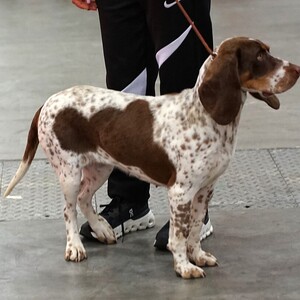
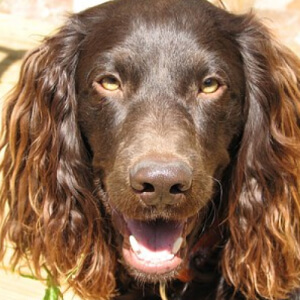
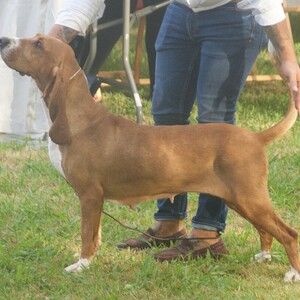
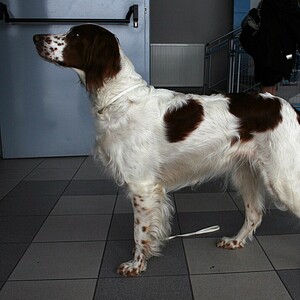
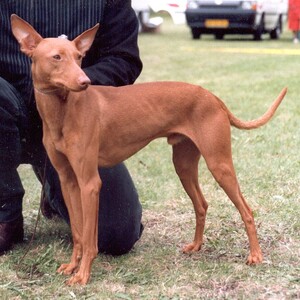
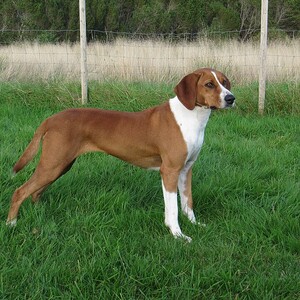
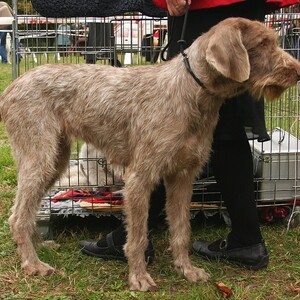
Slovakian Wirehaired Pointer. · Pleple2000 / Wikimedia Commons, CC BY-SA 4.0. Cropped and resized.
The Slovakian Wirehaired Pointer (Slovenský hrubosrstý stavač) is a versatile pointing dog, created in Slovakia after the Second World War. The FCI standard says it must work in the field, in the forest and in water, especially after the shot, searching for and retrieving wounded game, and that it is obedient and easy to train. The AKC describes it as lively, cheerful, energetic and eager to please.
Quick facts
| Common name | Slovakian Wirehaired Pointer (Slovenský hrubosrstý stavač) |
| Scientific name | Canis lupus familiaris |
| Country of origin | Slovakia |
| Official recognition | FCI, definitively since 17 February 1982 (group 7, pointing dogs; standard no. 320) |
| Lifespan | 12–15 years, according to the AKC |
| Size (males) | 62–68 cm at the withers; 23–29 kg according to the AKC |
| Size (females) | 57–64 cm at the withers |
| Coat type | Harsh, straight topcoat, about 4 cm long; fine undercoat, shed in summer |
| Common colours | Shaded sable brown (“grey”), with or without white markings |
| Energy level | High |
| Suited to an apartment? | No |
| Temperament | Lively, cheerful, affectionate, gentle, easy to train |
| Tendency to aggression | Low |
| Good with children | Moderate |
| Good with other animals | Good with dogs; strong hunting instinct |
| Genetic predispositions | No specific diseases are known; as in other large breeds, hip dysplasia |
- Primary category:Dog breeds
- Explore this animal's categories:
History and origin
According to Wikipedia, the breed was created after the Second World War by Koloman Slimák, by crossing German Wirehaired Pointers, Weimaraners and Český Fousek dogs, with a little Pudelpointer. He wanted a very hardy dog that would track, point and retrieve game from water or land, from birds and hares up to roe deer.
Wikipedia adds that the Slovaks once asked the German Weimaraner club to recognise it as a “wire-haired Weimaraner”, but the request was turned down. The AKC says the breed's origins date back to the late 1950s.
How the breed developed
- Late 1950s – Work on creating the breed begins in Czechoslovakia.
- 17 February 1982 – The FCI recognises the breed.
- 1997 – It reaches the United Kingdom.
- 2007 – It is shown at Crufts.
Breed rating
| Feature | Stars |
|---|---|
| Training and intelligence | ★★★☆☆ |
| Easy to train | ★★★★★ |
| Intelligence | ★★★☆☆ |
| Independence | ★★★☆☆ |
| Stubbornness | ★★★★☆ |
| Behaviour and temperament | ★★★★☆ |
| Affectionate with family | ★★★★☆ |
| Friendly with children | ★★★★★ |
| Good with other dogs | ★★★☆☆ |
| Good with cats and other animals | ★★☆☆☆ |
| Loyalty | ★★★★☆ |
| Tendency to be aggressive | ★★★☆☆ |
| Tendency to bark | ★★★★☆ |
| Needs and care | ★★★★☆ |
| Shedding | ★★★★☆ |
| Needs frequent grooming | ★★★☆☆ |
| Activity and lifestyle | ★★★★★ |
| Energy level | ★★★★☆ |
| Daily exercise needs | ★★★★☆ |
| Suited to apartment life | ★★★☆☆ |
| Health and longevity | ★★★★☆ |
| Life expectancy | ★★★☆☆ |
| Predisposition to genetic diseases | ★★☆☆☆ |
| Working abilities and uses | ★★★☆☆ |
| Good hunting dog | ★★★★☆ |
| Good companion dog | ★★★★☆ |
Indicative rating: 5 stars means the highest level. It is based on the ratings the American Kennel Club gives the breed and on the FCI standard.
Physical characteristics
The standard describes it as a dog of moderate strength and working type, but with noble lines, solidly built yet not heavy. The ratio of body length to height is 10:9 in males and 10:8 in females.
General appearance
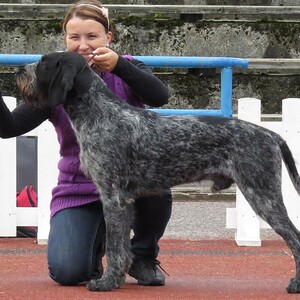
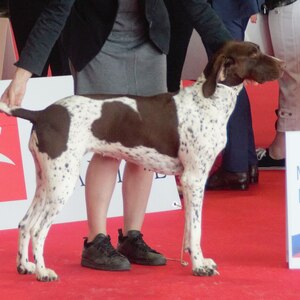
The undercoat is short and fine and is usually shed in summer. The topcoat is about 4 cm long, harsh, straight and lying flat. On the muzzle it forms a soft moustache, and above the eyes there are pronounced eyebrows.
| Feature | Slovakian Wirehaired Pointer |
|---|---|
| Size | Large |
| Height at the withers | males: 62–68 cm; females: 57–64 cm |
| Weight | 23–29 kg (AKC) |
| Coat | Harsh, with a moustache |
| Colour | “Grey” |
| Type | Pointing dog |
The basic colour is a shaded sable brown, called “grey”, with lighter and darker shades, with no white markings or with white markings on the legs and chest. “Grey” with larger or smaller patches, possibly ticked, is also accepted.
Training and socialisation
The standard says it is obedient and easy to train. The AKC describes it as lively, cheerful and eager to please, very intelligent but quickly bored, so lessons should be fun, interesting and short.
It needs a firm, consistent hand, with clear rules and boundaries. The AKC says harsh methods do not work.
Tips for effective training
- Keep lessons short. It gets bored quickly.
- Be firm and consistent. It needs clear rules.
- Avoid harshness. The AKC says it does not work.
- Let it run in a fenced area. Its hunting instinct is strong.
Activity needs and lifestyle
The AKC says it is happiest when doing things with its owner, so it makes a good partner for hiking, cycling or running. It is essential that it can run freely, preferably in a securely fenced area, as its hunting instinct is very strong.
| Activity | How often | Why it matters |
|---|---|---|
| Running or cycling | daily | Energy |
| Free running in a fenced area | several times a week | Instinct |
| Hunting or retrieving | weekly | Work |
Tips for a balanced life
- Suits active owners.
- The fence must be secure.
- Give it work: retrieving, tracking.
Care and health
Coat and skin care
The AKC says it needs very little grooming: between baths, a wipe with a damp cloth is enough. During moulting, a grooming mitt helps. The nails are trimmed every four weeks.
Common health problems
There are no known diseases specific to the breed. As with any large, active hunting dog, it is worth watching for:
| Condition | Description | Common symptoms |
|---|---|---|
| Hip dysplasia | The hip joint forms incorrectly and, over time, arthritis develops | Limping, difficulty getting up or jumping, hip pain |
| Gastric dilatation-volvulus (bloat) | The stomach fills with gas and may twist; this is a veterinary emergency | Swollen belly, trying to vomit without success, drooling, restlessness |
| Ear infections | Infections of the ears | Head shaking, bad smell |
Other care
- Ask for the parents' hip tests.
- Check it for wounds after hunting.
- Trim the nails every four weeks.
Diet and nutrition
The AKC says that when it is working it needs a nutrient-rich diet, different from that of a sedentary dog. It is very greedy, so its weight should be watched.
Tips for a healthy diet
The table gives a starting estimate, calculated with the formula from the Merck Veterinary Manual. The first two calorie columns show the calories per day for a healthy adult dog. The last column shows what this means in dry food with 3,500–4,000 kcal per kilogram.
| Dog's weight | Calories per day (neutered) | Calories per day (not neutered) | Dry food per day (approximate) |
|---|---|---|---|
| 23 kg | 1,180 kcal | 1,320 kcal | 300–380 g |
| 26 kg | 1,290 kcal | 1,450 kcal | 320–410 g |
| 29 kg | 1,400 kcal | 1,570 kcal | 350–450 g |
- Adjust the portion to its level of effort.
- Do not let it run right after a meal.
- A dog is at the right weight when you can feel its ribs without pressing hard.
Foods to avoid
Some human foods are dangerous for dogs: chocolate, coffee, grapes and raisins, onions, garlic, xylitol (a sweetener used in chewing gum), macadamia nuts and alcohol.
Reproduction and development
Physical and emotional maturity
In dogs, sexual maturity usually comes between 6 and 12 months, but in large breeds it can be delayed until about two years. The body also reaches its adult form later than in small breeds.
Mating and pregnancy
Pregnancy lasts about 63 days, counted from ovulation. Mating a female on her first heat is not recommended. The FCI standard requires that only healthy dogs of typical breed appearance are used for breeding.
Caring for the puppies
In large breeds, a litter has around 7 puppies on average. Socialisation starts in the first weeks: gentle handling, everyday noises and new people.
Interesting facts
- “Wire-haired Weimaraner”. The German club refused this name.
- Three parent breeds. The German Wirehaired Pointer, the Weimaraner and the Český Fousek.
- The “grey” colour. It is actually a shaded sable brown.
- Greedy. The AKC says it is highly food-motivated.
- A young breed. Created after the Second World War.
Frequently asked questions
Which breeds does it come from?
The German Wirehaired Pointer, the Weimaraner and the Český Fousek.
Is it easy to train?
Yes, but lessons should be short and fun.
How big does it get?
Males measure 62–68 cm, females 57–64 cm.
How long does it live?
The AKC gives 12–15 years.