Boston TerrierCharacteristics, history, training and care
The Boston Terrier is a compact companion dog developed in the United States. Its short coat and characteristic white markings are familiar features. Its short muzzle can be associated with breathing and heat-related health problems.
Quick facts
| Common name | Boston Terrier |
| Scientific name | Canis lupus familiaris |
| Country of origin | United States of America |
| Official Recognition | Recognized by AKC in 1893; also recognized by FCI |
| Typical lifespan | About 11-15 years |
| Dimensions (Male) | About 38-43 cm / 7-11 kg |
| Dimensions (Female) | About 36-41 cm / 6-9 kg |
| Coat type | Short, smooth, glossy |
| Common colours | Black and white, brindle and white, seal and white |
| Energy Level | Moderate to high |
| Suitable for an apartment? | Depends on exercise, training, health and the individual dog |
| Temperament | Friendly, affectionate, intelligent |
| Behaviour towards unfamiliar people and dogs | Individual behaviour varies; socialisation, training and management matter |
| Compatibility with children | Depends on the individual; adult supervision and suitable handling are essential |
| Compatibility with other animals | Depends on socialisation, prey drive and the animals involved |
| Health considerations | Breathing problems, eye problems, patellar luxation |
- Primary category:Dog breeds
- Explore this animal's categories:
History and Origin
The Boston Terrier is an American breed, developed in the late 19th century from crosses between the English Bulldog and the now-extinct white English Terrier.
Evolution of the breed
- Origins in Boston, Massachusetts - The breed traces back to a dog called Hooper's Judge, imported to Boston around 1870; early dogs were heavier and used in dog fighting, but breeders soon made them smaller, gentler companions.
- Early recognition - In 1893 it became one of the first American breeds recognised by the AKC.
- The nickname "American Gentleman" - Its black-and-white markings look like a tuxedo, which earned it this nickname.
Breed Evaluation
The Boston Terrier is a small, clever and friendly dog, suitable for families, single people and city life. These are general editorial ratings, not measured scores; individual dogs vary.
| Characteristic | Stars |
|---|---|
| Training and Intelligence | ★★★★☆ |
| Easy to train | ★★★★★ |
| Intelligence | ★★★★★ |
| Level of independence | ★★★☆☆ |
| Level of stubbornness | ★★★☆☆ |
| Behavior and Temperament | ★★★★★ |
| Affectionate with family | ★★★★★ |
| Friendly with children | ★★★★★ |
| Compatible with other dogs | ★★★★☆ |
| Compatible with cats and other animals | ★★★★☆ |
| Degree of loyalty | ★★★★★ |
| Tendency to be aggressive | ★☆☆☆☆ |
| Tendency to bark | ★★★☆☆ |
| Needs and Care | ★★★☆☆ |
| Shedding level | ★★★☆☆ |
| Requires frequent care | ★★☆☆☆ |
| Activity and Lifestyle | ★★★★☆ |
| Energy level | ★★★★☆ |
| Daily exercise requirement | ★★★★☆ |
| Suitable for apartment living | ★★★★★ |
| Health and Longevity | ★★★☆☆ |
| Life expectancy | ★★★★★ |
| Predisposition to genetic diseases | ★★★★☆ |
| Work and Utility Features | ★★★★☆ |
| Good guard dog | ★★☆☆☆ |
| Good companion dog | ★★★★★ |
Physical Characteristics
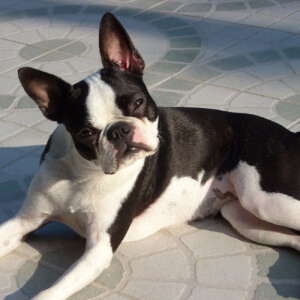
The Boston Terrier is a small, compact and muscular dog with a square outline and a friendly expression.
General appearance
- A short, compact, muscular body with a broad chest.
- A short, fine, glossy coat with no undercoat.
- A square, flat-topped head and a short muzzle, typical of brachycephalic (short-faced) breeds.
- Large, round, dark eyes set wide apart, giving an alert, kind expression.
- Small, erect ears and a short, naturally straight or screw-shaped tail.
| Characteristic | Boston Terrier |
|---|---|
| Size | Small (about 38-43 cm at the shoulder) |
| Weight | About 6-11 kg, in three weight classes |
| Coat | Short, fine and glossy |
| Muzzle | Short and square |
| Shedding tendency | Low |
| Build | Compact and sturdy |
The Boston Terrier is a cheerful, lively breed, well suited to apartment life and active families.
Training and Socialization
The Boston Terrier is intelligent and usually easy to train, but it can be stubborn at times, so consistency and patience are needed.
Tips for effective training
- Start early - Socialisation and obedience training should start as early as possible.
- Use positive methods - It responds best to rewards, praise and play; harsh methods make it unwilling to cooperate.
- Teaching calm - It can be very excitable, so it helps to teach it to settle on command.
- Wide socialisation - Although it is friendly by nature, it should meet many places, sounds and people to become a balanced adult.
- Lead training - It can get very excited on walks, so it should learn not to pull and to come when called; a harness is often better than a collar for short-faced dogs.
The Boston Terrier learns quickly and responds very well to reward-based training, which makes it a good choice for first-time dog owners.
Activity and Lifestyle Needs
The Boston Terrier is lively, but it does not need very intense exercise, so it suits city life and apartments.
| Activity | Recommended duration |
|---|---|
| Daily walks | About 30-60 min |
| Obedience training | About 10-15 min |
| Interactive games | About 20-30 min |
| Dog sports (agility, trick training) | Short sessions, in cool weather |
Recommendations for a balanced lifestyle
- Good for apartments - It suits small homes, but still needs regular exercise to prevent boredom.
- Careful in the heat - Because of its short muzzle, the Boston Terrier can have trouble breathing in hot weather, so intense exercise in summer should be avoided.
- Loves people - It does not like being alone and needs plenty of attention and affection.
- Friendly - It is usually not aggressive, but good socialisation helps prevent over-excited or protective behaviour.
The Boston Terrier is lively and curious, but does not need a very demanding lifestyle, so it suits people with a balanced routine.
Care and Health
The Boston Terrier is easy to groom, but its breathing and eyes need careful monitoring.
Fur and skin care
- Occasional brushing - Its short coat needs brushing about once a week to remove dead hair.
- Baths only when needed - It can have sensitive skin, so it should be washed only when dirty.
- Face care - The folds around the nose should be kept clean and dry to prevent infections.
Common health problems
| Condition | Description | Common symptoms |
|---|---|---|
| Breathing problems (BOAS) | The short muzzle can narrow the airways | Snoring, heavy panting, tiring quickly, overheating |
| Eye disorders | Its large, prominent eyes are prone to corneal ulcers, cataracts and injuries | Watery eyes, squinting, sensitivity to light |
| Patellar luxation | A slipping kneecap | Limping, skipping a step |
Other aspects of care
- Regular veterinary checks - The Boston Terrier's breathing and eyes should be monitored.
- Protection from cold and heat - With its short coat and short muzzle, it does not tolerate extreme temperatures well.
- Weight control - It gains weight easily, so food should be carefully measured.
The Boston Terrier can live a long, healthy life, but it needs special care for its eyes, joints and breathing.
Diet and Nutrition
The Boston Terrier needs a balanced diet to prevent digestive problems and weight gain.
Recommendations for a healthy diet
Choose a complete, balanced diet suited to age, size and health. Plan home-prepared diets and supplements with a qualified veterinarian; raw pet food can carry harmful bacteria.
| Food type | Daily Amount (Adults) | Frequency |
|---|---|---|
| Premium dry food | Individual amount; follow complete-food guidance and veterinary advice | 2 meals/day |
| Home cooked food | Individual amount; follow complete-food guidance and veterinary advice | 2 meals/day |
| Raw food: bacterial contamination is a concern | Individual amount; follow complete-food guidance and veterinary advice | 2 meals/day |
Forbidden foods
Chocolate, grapes and raisins, onions and xylitol - toxic to dogs. / Cooked bones - can splinter and cause intestinal blockage. / Fatty and fried foods - can cause serious digestive problems. / Overfeeding - the Boston Terrier tends to eat more than it needs, which leads to weight gain.
The Boston Terrier should be fed according to its activity level, avoiding rich food and overfeeding.
Reproduction and Development
Breeding requires veterinary planning, suitable health screening and care for the mother and puppies. Pregnancy and birth can involve complications.
Physical and emotional maturity
- Physical maturity: The Boston Terrier reaches adult size at about 10-12 months, but continues to fill out until about 18 months.
- Emotional maturity: It often stays playful and energetic well after 2 years of age.
Mating and Gestation
- Breeding decisions require veterinary assessment of maturity, health and suitable screening; reaching a fixed age does not establish that breeding is appropriate.
- Duration of gestation: Approximately 58-68 days, usually about 63 days.
- Average number of puppies: Usually about 3-5 puppies; because puppies have large heads, many births need a Caesarean section.
Puppy care
- The first 3 weeks: Puppies depend completely on their mother for warmth and milk, which supports their immune system.
- Between 4-8 weeks: Play with littermates and people begins; this is a key time for social development.
- Moving to a new home: When puppies go to their new homes, gentle training can start right away, as they learn quickly.
Breeding Boston Terriers needs special care, but with good care the puppies grow up healthy and balanced.
Curiosities and Interesting Facts
- An early American breed - The Boston Terrier was one of the first breeds developed in the United States and was recognised by the AKC in 1893.
- From fighter to companion - Early dogs were heavier and used for fighting, but breeders soon selected smaller, gentler dogs.
- "The American Gentleman" - Its black-and-white coat looks like a tuxedo.
- Very loyal - Boston Terriers are very attached to their owners and often follow them around the house.
- Funny faces - With its short muzzle and big eyes, it is known for very expressive, almost "human" faces.
- Quiet for a terrier - It usually barks less than many other terriers.
- A state dog - The Boston Terrier became the official state dog of Massachusetts in 1979, and Boston University's mascot, Rhett, is a Boston Terrier.
The Dog in Popular Culture
The Boston Terrier is a symbol of Boston and one of America's best-loved city dogs.
Importance in modern culture
- Sergeant Stubby - The most famous dog of the First World War, Sergeant Stubby, is often described as a Boston Terrier or Boston Terrier mix; he served with American troops in France.
- A city favourite - Thanks to its small size and friendly nature, it is one of the most popular breeds in big cities.
- Dog sports - Although not a working dog, the Boston Terrier does well in trick training and obedience.