LarkInteresting facts and information
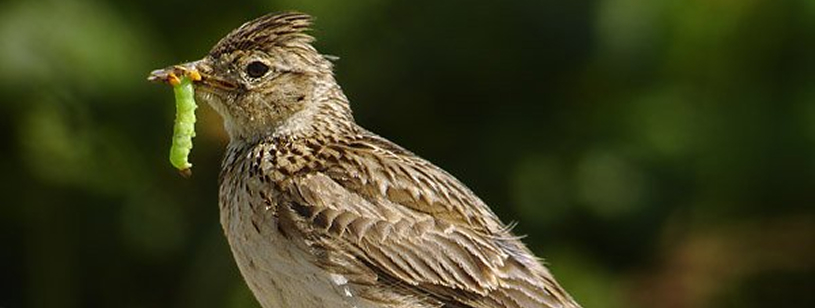
This lark profile focuses on the Eurasian skylark (Alauda arvensis), a bird of open country. It is known for singing during display flights and nests on the ground. Other birds called larks belong to different species and should not share all of its measurements or behaviour.
Skylarks use open habitats for feeding, nesting and display flights. Their familiar song has inspired cultural works, but display height and duration vary.
Quick facts
| Common name | Eurasian skylark |
| Scientific name | Alauda arvensis |
| Typical lifespan | Usually a few years in the wild; up to about 10 years |
| Length | About 16-18 cm |
| Wingspan | About 30-36 cm |
| Weight | About 30-45 g |
| Diet type | Omnivorous (seeds, insects, leaves, worms) |
| Main predators | Birds of prey, foxes, polecats, wild cats and other predators, depending on life stage |
| Conservation status | Least Concern (IUCN); declining in many European countries |
| Distribution | Europe, Asia and North Africa; introduced to New Zealand, Australia and Hawaii |
| Living environment | Open grassland, farmland, steppes, dunes, moorland and other open habitats |
Interesting facts
- A long song in the air - A male skylark often sings for several minutes without a break while flying, and some song flights last much longer.
- Singing high in the sky - It often sings at heights of 50-100 metres or more, so high that it can be hard to see.
- Hovering - The skylark rises almost vertically, hovers while singing and then drops back to the ground.
- Mostly males sing - Song flights are performed mainly by males to attract females and defend territory.
- A nest on the ground - The skylark nests on the ground, which makes it vulnerable to predators and farm machinery.
Records and remarkable features
- The Eurasian skylark sings during display flights over open habitats.
Physical characteristics and adaptations
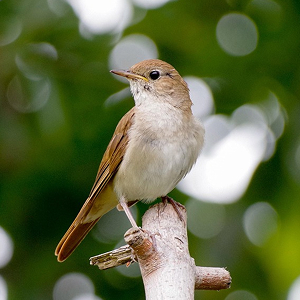
The skylark is a small bird well adapted to life in open country. Its plumage blends in with the ground, and its wings allow it to rise steeply and hover while it sings.
Key physical adaptations
- Camouflaged plumage - Brown with darker streaks on the back and breast, it helps the bird hide in grass and on bare ground.
- A small crest - It can raise a short crest on the top of its head.
- Broad wings with a white trailing edge - Allow it to climb, hover and sing in the air for a long time.
- A long hind claw - The very long claw on its hind toe gives it stability when walking on the ground.
- A short, strong bill - Suitable for both seeds and insects.
- White outer tail feathers - Visible when it flies.
Dimensions and variations between sexes
| Characteristic | Males | Females |
|---|---|---|
| Body length | About 16-18 cm | About 16-17 cm |
| Weight | About 33-45 g | About 30-40 g |
| Plumage colour | Brown with dark streaks | Similar to the male |
| Wing size | Slightly longer | Slightly shorter |
Habits and behaviour
The skylark is active by day and is territorial in the breeding season, when males perform their famous song flights.
Daily life
- It is active by day and spends a lot of time on the ground, where it feeds.
- It lives alone or in pairs in the breeding season, but forms flocks in winter.
- It walks and runs on the ground, hiding in vegetation, and flies up to sing or when disturbed.
- Many populations in western and southern Europe stay all year, while northern and eastern populations migrate south and west for the winter.
Communication
- A complex, continuous song - Males use it to attract females and mark their territory.
- Calls - It has a rippling flight call and sharp alarm calls.
- Song flights - Males climb steeply, hover high in the air while singing and then descend.
Defence techniques
- Camouflage - Its colours allow it to hide well on the ground.
- Keeping still - When threatened, it often crouches and stays still, relying on camouflage.
- Fast take-off - When discovered, it flies off quickly.
Habitat and geographic distribution
The skylark is a bird of open country and avoids dense forests and built-up areas.
Distribution context
| Region | Population information |
|---|---|
| Europe | Still very common, but declining in many countries |
| Asia | Widespread from Central Asia to Siberia and Japan |
| North Africa | Smaller populations in the north-west |
| Introduced populations | Introduced to New Zealand, Australia, Hawaii and Vancouver Island (Canada) |
Habitat types
- Grassland and steppe - It prefers open land with low vegetation.
- Farmland - It is common in cereal fields and pastures.
- Coastal dunes and moorland - It also lives in dunes, heaths and upland moors.
- Open ground near forests - It may use clearings and young plantations.
Environmental change
- Agricultural intensification - Pesticides reduce insects and weed seeds, and dense crops leave fewer nesting places.
- Farm machinery - Mowing and harvesting can destroy nests on the ground.
- Autumn-sown cereals - Crops sown in autumn grow too tall and dense for nesting by late spring.
- Loss of grassland - Building and changes in land use reduce open habitats.
Diet and feeding
The skylark is omnivorous, feeding mainly on seeds and insects; its diet changes with the seasons.
What does the lark eat?
| Food group | Examples and context |
|---|---|
| Insects | Beetles, ants, caterpillars, grasshoppers, flies |
| Worms and invertebrates | Earthworms, spiders, small snails |
| Seeds and grain | Weed seeds, grass seeds, spilled cereal grain |
| Green plants | Leaves of clover, young cereals and other plants, especially in winter |
Feeding methods
- Searching the ground - It walks slowly and picks up insects and seeds.
- Pecking at plants - In winter it eats a lot of green leaves.
- Choosing seeds - It eats small weed and grass seeds and grain.
- Seasonal diet - It eats more insects in summer, especially when feeding chicks, and more seeds and leaves in winter.
Reproduction and life cycle
The skylark has a long breeding season, from spring to late summer.
Breeding season
- It usually starts in April and can continue until August.
- Males perform song flights to attract females.
- The female chooses the nest site and builds the nest.
Nest and chicks
| Characteristic | Details |
|---|---|
| Place of the nest | On the ground, in a shallow scrape hidden in grass or crops |
| Materials used | Grass and roots, lined with finer grass |
| Eggs | Usually 3-5 eggs per clutch |
| Incubation | About 11-12 days (by the female only) |
| Feeding chicks | Both parents bring food |
| Independence | Chicks leave the nest at about 8-10 days and can fly at about 3 weeks |
Raising young
- The eggs are greyish or greenish-white with dense brown spots, which help camouflage them.
- The chicks depend completely on their parents in the first days.
- They leave the nest before they can fly and hide in the surrounding vegetation, where the parents keep feeding them.
- A pair can raise two or three broods in one season.
Name and history
Origin of the name
- The English word "lark" comes from Old English lāwerce.
- The scientific name Alauda arvensis comes from Latin: alauda means "lark" (a word the Roman writer Pliny said came from the Gauls), and arvensis means "of the fields".
- In English, it is usually called the "skylark" because it sings high in the sky.
Taxonomic classification
| Classification | Name |
|---|---|
| Kingdom | Animalia |
| Phylum | Chordata |
| Class | Aves |
| Order | Passeriformes |
| Family | Alaudidae |
| Genus | Alauda |
| Species | Alauda arvensis |
Evolution and fossils
- The lark family includes about 100 species, most of them in Africa.
- Only one lark, the horned lark, is native to the Americas, and only one, Horsfield's bushlark, to Australia.
- Other European larks include the woodlark, the crested lark and the calandra lark.
Cultural significance and mythology
The skylark has long been a symbol of spring, joy and freedom and is mentioned in poetry, music and folklore in many cultures.
The lark in myths and symbolism
- Ancient Greece - In Aristophanes' comedy "The Birds" (414 BC), the lark is said to be older than the earth, so it had to bury its father in its own head, which explains its crest.
- Dawn - In European poetry, the lark is the bird of daybreak, because it sings early in the morning.
- Romania - "Ciocârlia" (The Lark), a famous instrumental piece imitating birdsong, is one of the best-known works of Romanian folk music, played on the violin or pan flute.
- Food - Larks were once widely caught and eaten in Europe; the French children's song "Alouette" is about plucking a lark.
The lark in modern symbolism
- Freedom - The lark rising into the sky is a common image of freedom.
- Creativity and inspiration - Many poets and composers have used the lark as a symbol of artistic inspiration.
- Skylarks are associated with open habitats, but their presence alone does not prove that an ecosystem is healthy.
Conservation status and threats
The skylark is listed as Least Concern by the IUCN because it is still very widespread, but its numbers have fallen sharply in many European countries.
Conservation status
| Region | Population information | Trends |
|---|---|---|
| Western Europe | Still common, but much reduced | In Britain, more than halved since the 1970s |
| Eastern Europe | Large populations | Mixed trends |
| Asia | Widespread | Not well known |
| North Africa | Smaller populations | Not well known |
| New Zealand (introduced species) | Common | Widespread in farmland |
Main pressures
- Intensive agriculture - Pesticides and large single-crop fields reduce insects and seeds.
- Farm machinery - Tractors and mowers destroy nests on the ground.
- Changes in crops - Autumn-sown cereals are too dense for nesting later in the season.
- Loss of grassland - Building and infrastructure reduce open habitats.
- Predators - Foxes, crows, cats and other predators take eggs and chicks.
Protection measures
- Skylark plots - Small unsown patches in cereal fields give skylarks places to land and feed.
- Fewer pesticides - Wildlife-friendly farming helps keep insects and weed seeds.
- Later mowing - Mowing grassland later gives chicks time to leave the nest.
- Monitoring - Bird surveys follow skylark population trends.
In popular culture
The lark is one of the most celebrated birds in literature and music.
The lark in literature
- "To a Skylark" (1820) - Percy Bysshe Shelley's famous poem begins "Hail to thee, blithe Spirit!"
- "Romeo and Juliet" - William Shakespeare - The lark, which sings at dawn, signals that Romeo must leave Juliet.
- Sonnet 29 - Shakespeare compares his mood to "the lark at break of day arising".
The lark in music
- "The Lark Ascending" (1914, revised 1920) - Ralph Vaughan Williams's piece for violin and orchestra, inspired by George Meredith's poem, is one of the most popular works of English classical music.
- "The Lark" String Quartet - Joseph Haydn's String Quartet Op. 64 No. 5 is nicknamed "The Lark".
- "The Lark" - Mikhail Glinka's song, later arranged for piano by Mily Balakirev.
The lark in film
- "Larks on a String" (1969) - A Czech film by Jiří Menzel.
- "The Lark Farm" (2007) - A film by the Taviani brothers.
- Nature documentaries often show the skylark's song flight over meadows.
The lark as mascot and symbol
- Spring and hope - The lark is often used in art and on stamps as a sign of spring.
- Music - The lark is a popular name and symbol for choirs and music groups.
- "Ciocârlia" - The name is also used by Romanian folk ensembles and music festivals.