LeonbergerCharacteristics, history, training and care
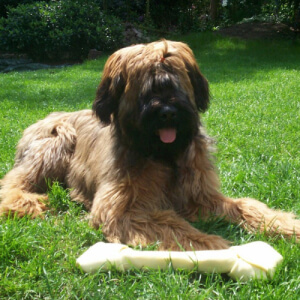
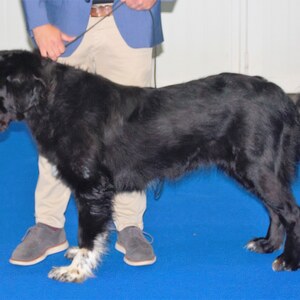
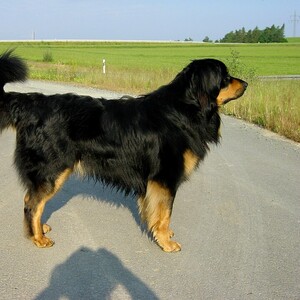
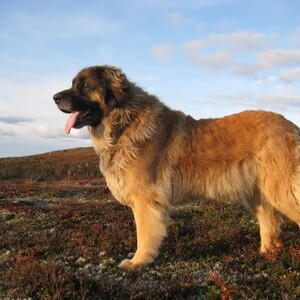
Leonberger. · Kurre92 / Wikimedia Commons, CC BY-SA 4.0. Cropped and resized.
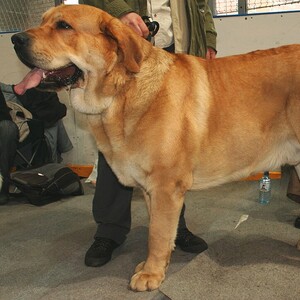
The Leonberger is a very large, strong and muscular yet elegant German dog, with a long lion-yellow or reddish coat and a black mask. It was created in Leonberg, near Stuttgart, to look like a lion, the animal on the town's coat of arms. The standard describes it as friendly with children, obedient and fearless.
Quick facts
| Common name | Leonberger (Leo) |
| Scientific name | Canis lupus familiaris |
| Country of origin | Germany |
| Official recognition | FCI, definitively since 17 February 1955 (group 2, mountain molossoid breeds; standard no. 145); also recognised by the AKC |
| Lifespan | about 7 years, according to the AKC |
| Size (males) | 72–80 cm at the withers (recommended average 76 cm); 50–77 kg according to the AKC |
| Size (females) | 65–75 cm at the withers (recommended average 70 cm); 41–64 kg according to the AKC |
| Coat type | Long, abundant, with a dense undercoat; a mane in males |
| Common colours | Lion yellow, red, reddish brown, sandy, always with a black mask |
| Energy level | Moderate |
| Suited to an apartment? | No |
| Temperament | Friendly, obedient, calm, fearless |
| Tendency to aggression | Low; neither shy nor aggressive |
| Good with children | Very good |
| Good with other animals | Average |
| Genetic predispositions | Polyneuropathy, leukoencephalomyelopathy, hip and elbow dysplasia, bloat |
- Primary category:Dog breeds
- Explore this animal's categories:
History and origin
The FCI standard says that at the end of the 1830s and the beginning of the 1840s, Heinrich Essig, a town councillor of Leonberg, mated a black and white Newfoundland bitch with a “Barry” male from the Great St Bernard hospice. Later a Pyrenean Mountain Dog was also added. Essig's aim was a dog that would look like a lion, the town's heraldic animal.
The first dogs truly called “Leonberger” were born in 1846 and were soon sold all over the world as status symbols. At the end of the 19th century it was the favourite farm dog in Baden-Württemberg, valued for guarding and draught work. During the two world wars, the number of breeding dogs fell dramatically.
How the breed developed
- Late 1830s – Heinrich Essig begins crossbreeding in Leonberg.
- 1846 – The first dogs called Leonberger are born.
- Late 19th century – The favourite farm dog in Baden-Württemberg.
- The world wars – The number of dogs falls dramatically.
- 17 February 1955 – The FCI recognises the breed.
Breed rating
| Feature | Stars |
|---|---|
| Training and intelligence | ★★★★☆ |
| Easy to train | ★★★★★ |
| Intelligence | ★★★★☆ |
| Independence | ★★☆☆☆ |
| Stubbornness | ★★☆☆☆ |
| Behaviour and temperament | ★★★★★ |
| Affectionate with family | ★★★★★ |
| Friendly with children | ★★★★★ |
| Good with other dogs | ★★★☆☆ |
| Good with cats and other animals | ★★★☆☆ |
| Loyalty | ★★★★★ |
| Tendency to be aggressive | ★☆☆☆☆ |
| Tendency to bark | ★★★☆☆ |
| Needs and care | ★★★★☆ |
| Shedding | ★★★★☆ |
| Needs frequent grooming | ★★★★☆ |
| Activity and lifestyle | ★★★☆☆ |
| Energy level | ★★★☆☆ |
| Daily exercise needs | ★★★★☆ |
| Suited to apartment life | ★☆☆☆☆ |
| Health and longevity | ★★★☆☆ |
| Life expectancy | ★★☆☆☆ |
| Predisposition to genetic diseases | ★★★★☆ |
| Working abilities and uses | ★★★★☆ |
| Good guard dog | ★★★★☆ |
| Good companion dog | ★★★★★ |
Indicative rating: 5 stars means the highest level. It is based on the ratings the American Kennel Club gives the breed and on the FCI standard.
Physical characteristics
The standard describes it as a large, strong, muscular yet elegant dog, with a balanced build and a confident calm, but quite lively. Males are particularly powerful. The AKC says a male can weigh as much as an adult human.
General appearance
The coat is long, abundant, straight or slightly wavy, with a dense undercoat, and forms a mane on the neck and chest, especially in males. The front legs have feathering and the hind legs abundant “trousers”. The AKC mentions the triangular ears, the bushy tail and the black mask.
| Feature | Leonberger |
|---|---|
| Size | Very large |
| Height at the withers | males: 72–80 cm; females: 65–75 cm |
| Weight | males: 50–77 kg; females: 41–64 kg (AKC) |
| Coat | Long, water-resistant, with a mane |
| Mask | Always black |
| Tail | Bushy |
The accepted colours are lion yellow, red, reddish brown and sandy (pale yellow, cream), with all combinations between them, always with a black mask. Black tips on the hairs are permitted, but black must not be the base colour.
Training and socialisation
The standard says that, as a family dog, it is a pleasant partner for modern life, can be taken anywhere without problems and is very friendly with children. It is neither shy nor aggressive; it is obedient and fearless in every situation.
The AKC says that, as it is very large and strong and the puppies are very enthusiastic, proper training is essential. Puppies should be gently socialised before 20 weeks of age, and group obedience classes help a lot.
Tips for effective training
- Socialise it before 20 weeks. The advice comes from the AKC.
- Teach it to walk nicely on the lead. As an adult it will be very strong.
- Be calm and consistent. It learns easily and remembers well.
- Go to group classes. The AKC says they help a lot.
Activity needs and lifestyle
The AKC says it is not the right breed for a city flat or a small yard. Adults are usually calm, but they need sustained daily exercise; they can jog or go hiking with their owner.
| Activity | How often | Why it matters |
|---|---|---|
| Long walk or hike | daily | Sustained exercise |
| Swimming | in summer | A water-resistant coat |
| Play in a large yard | daily | Space |
Tips for a balanced life
- It needs a house with a large yard.
- In summer, keep it out of the heat.
- Moderate, controlled exercise for puppies.
Care and health
Coat and skin care
The AKC says the Leonberger sheds a lot, and even more twice a year. It needs daily brushing, especially behind the ears and on the back of the legs, and once a week it needs a full grooming session, which takes quite a long time.
Common health problems
The AKC says that, like other large dogs, it can suffer from bloat. Responsible breeders test their dogs for:
| Condition | Description | Common symptoms |
|---|---|---|
| Hip dysplasia | The hip joint forms incorrectly and, over time, arthritis develops | Limping, difficulty getting up or jumping, hip pain |
| Elbow dysplasia | The elbow joint develops incorrectly and arthritis appears | Limping on the front legs, especially after exercise |
| Polyneuropathy (LPN1, LPN2) | A hereditary nerve disease | Unsteady gait, weakness, noisy breathing |
| Leukoencephalomyelopathy (LEMP) | A hereditary disease of the spinal cord | Unsteady gait, poor coordination |
| Gastric dilatation-volvulus (bloat) | The stomach fills with gas and may twist; this is a veterinary emergency | Swollen belly, trying to vomit without success, drooling, restlessness |
Other care
- Check the ears regularly.
- Ask for the parents' DNA tests.
- Trim the nails regularly.
Diet and nutrition
The AKC says some dogs gain weight easily, so calories and weight should be watched.
Tips for a healthy diet
The table gives a starting estimate, calculated with the formula from the Merck Veterinary Manual. The first two calorie columns show the calories per day for a healthy adult dog. The last column shows what this means in dry food with 3,500–4,000 kcal per kilogram.
| Dog's weight | Calories per day (neutered) | Calories per day (not neutered) | Dry food per day (approximate) |
|---|---|---|---|
| 45 kg | 1,950 kcal | 2,190 kcal | 490–630 g |
| 60 kg | 2,410 kcal | 2,720 kcal | 600–780 g |
| 75 kg | 2,850 kcal | 3,210 kcal | 710–920 g |
- Split the food into two meals a day to reduce the risk of bloat.
- Do not let it run right after a meal.
- Puppies need growth food suited to very large breeds.
Foods to avoid
Some human foods are dangerous for dogs: chocolate, coffee, grapes and raisins, onions, garlic, xylitol (a sweetener used in chewing gum), macadamia nuts and alcohol.
Reproduction and development
Physical and emotional maturity
In dogs, sexual maturity usually comes between 6 and 12 months, but in large breeds it can be delayed until about two years. Very large breeds become adults only at around 2 years.
Mating and pregnancy
Pregnancy lasts about 63 days, counted from ovulation. Mating a female on her first heat is not recommended. The FCI standard requires that only healthy dogs of typical breed appearance are used for breeding.
Caring for the puppies
In large breeds, a litter has around 7 puppies on average. The puppies grow very fast, so they need growth food suited to large breeds. Socialisation starts in the first weeks.
Interesting facts
- Like a lion. Essig wanted a dog that looked like the lion on the coat of arms of Leonberg.
- A status symbol. The first dogs were sold all over the world as status symbols.
- As heavy as a person. The AKC says a male can weigh as much as an adult human.
- Noise does not frighten it. The standard requires a Leonberger to be indifferent to noise.
- A farm dog. At the end of the 19th century it guarded farms and pulled carts.
Frequently asked questions
Where does the name come from?
From the town of Leonberg, near Stuttgart.
How big does it get?
Males measure 72–80 cm and females 65–75 cm at the withers.
Is it good with children?
Yes. The standard says it is very friendly with children.
How long does it live?
The AKC gives a life expectancy of about 7 years.