SalukiCharacteristics, history, training and care
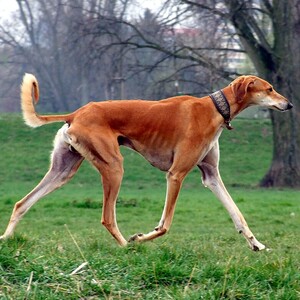
Saluki. · r. / Wikimedia Commons, CC BY-SA 3.0. Cropped and resized.
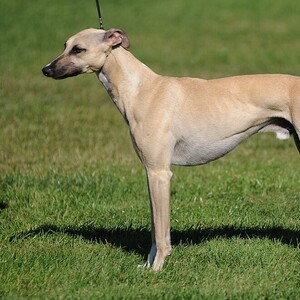
The Saluki is an elegant, graceful sighthound from the Middle East, slim, long-legged, very strong and balanced, with a soft, silky coat, usually with feathering on the ears and legs. The standard describes it as reserved with strangers, but not nervous or aggressive, dignified, intelligent and independent.
Quick facts
| Common name | Saluki (Persian Greyhound, Arabian Greyhound) |
| Scientific name | Canis lupus familiaris |
| Country of origin | Middle East; patronage: Great Britain |
| Official recognition | FCI, definitively since 8 April 1966 (group 10, long-haired or fringed sighthounds; standard no. 269); also recognised by the AKC |
| Lifespan | 10–17 years, according to the AKC |
| Size (males) | on average 58–71 cm at the withers; 18–29 kg according to the AKC |
| Size (females) | proportionally smaller |
| Coat type | Smooth, soft, silky, with feathering (or without, in the smooth variety) |
| Common colours | Any colour or combination; brindle undesirable |
| Energy level | High |
| Suited to an apartment? | Not really |
| Temperament | Dignified, intelligent, independent, reserved with strangers |
| Tendency to aggression | Very low |
| Good with children | Average |
| Good with other animals | Poor with small animals; sighthound instinct |
| Genetic predispositions | Heart disease, some cancers, autoimmune and blood diseases |
- Primary category:Dog breeds
- Explore this animal's categories:
History and origin
The FCI standard says the Saluki varies in type, and this variation is desirable. The reason is its special place in Arab tradition and the vast expanse of the Middle East, where it has been used as a sighthound for thousands of years. Each tribe had the dogs best suited to the game in its area.
According to Middle Eastern tradition, a Saluki is not bought or sold but given as a mark of honour. As a result, the dogs that reached Europe came from very different terrains and climates. The British standard of 1923 was the first official European standard for the breed. The AKC says images of Salukis appear in Egyptian tombs as early as 2100 BC.
How the breed developed
- 2100 BC – Images of Salukis in Egyptian tombs, according to the AKC.
- Thousands of years – The hunting sighthound of the Middle Eastern tribes.
- 1923 – The first official European standard, in Great Britain.
- 8 April 1966 – The FCI recognises the breed.
Breed rating
| Feature | Stars |
|---|---|
| Training and intelligence | ★★★☆☆ |
| Easy to train | ★★★☆☆ |
| Intelligence | ★★★★☆ |
| Independence | ★★★★★ |
| Stubbornness | ★★★★☆ |
| Behaviour and temperament | ★★★★☆ |
| Affectionate with family | ★★★★★ |
| Friendly with children | ★★★☆☆ |
| Good with other dogs | ★★★☆☆ |
| Good with cats and other animals | ★☆☆☆☆ |
| Loyalty | ★★★★★ |
| Tendency to be aggressive | ★☆☆☆☆ |
| Tendency to bark | ★★★☆☆ |
| Needs and care | ★★☆☆☆ |
| Shedding | ★★☆☆☆ |
| Needs frequent grooming | ★☆☆☆☆ |
| Activity and lifestyle | ★★★★☆ |
| Energy level | ★★★★☆ |
| Daily exercise needs | ★★★☆☆ |
| Suited to apartment life | ★★★☆☆ |
| Health and longevity | ★★★★☆ |
| Life expectancy | ★★★★☆ |
| Predisposition to genetic diseases | ★★☆☆☆ |
| Working abilities and uses | ★☆☆☆☆ |
| Good hunting dog | ★★★★★ |
| Good companion dog | ★★★★☆ |
Indicative rating: 5 stars means the highest level. It is based on the ratings the American Kennel Club gives the breed and on the FCI standard.
Physical characteristics
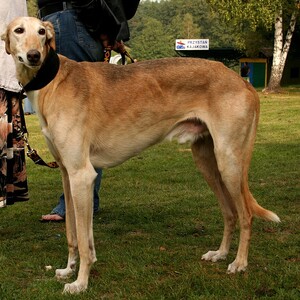
The standard says the overall appearance should give an impression of grace and symmetry, great speed and endurance, combined with strength and activity. The AKC says it is slim and long-legged, yet very strong and perfectly balanced, like a great athlete or dancer.
General appearance
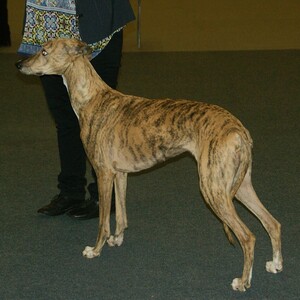
The head is long and narrow, noble. The coat is smooth, soft and silky, with feathering on the legs and the backs of the thighs; the smooth variety has no feathering. The AKC says the large, oval eyes are warm and intelligent.
| Feature | Saluki |
|---|---|
| Size | Large |
| Height at the withers | on average 58–71 cm |
| Weight | 18–29 kg (AKC) |
| Coat | Silky, with feathering |
| Head | Long, narrow |
| Type | Sighthound |
Any colour or combination of colours is permitted; brindle is undesirable.
Training and socialisation
The standard describes it as reserved with strangers, but not nervous or aggressive, dignified, intelligent and independent. The AKC says it has an independent, almost cat-like mind.
The AKC recommends three kinds of training: crate training, basic obedience and dog sports, for mental stimulation and exercise.
Tips for effective training
- Always walk it on the lead. The AKC says it should always be kept on the lead.
- Be patient. It has an independent mind.
- Get it used to a crate. The AKC recommends it.
- Try lure coursing. It provides physical and mental activity.
Activity needs and lifestyle
The AKC says it needs regular exercise, with daily walks, always on the lead. It loves to run and needs a well-fenced yard. When bored, it may escape or chew things.
| Activity | How often | Why it matters |
|---|---|---|
| Walks on the lead | daily | Physical and mental fitness |
| Running in a well-fenced yard | several times a week | The need for speed |
| Coursing | occasionally | Sighthound instinct |
Tips for a balanced life
- The fence must be high and solid.
- In winter, protect it from the cold.
- Do not let it get bored.
Care and health
Coat and skin care
The AKC says both coat types are easy to care for, with a weekly brush; the long feathering on the ears and tail needs more attention. Salukis are very clean dogs with no doggy smell.
Common health problems
The AKC says the breed has no serious genetic diseases, but the following can occur:
| Condition | Description | Common symptoms |
|---|---|---|
| Heart disease | Valve disease, arrhythmias, enlarged heart | Tires quickly, breathes with difficulty |
| Cancers | Hemangiosarcoma, osteosarcoma, lymphoma | Lumps, weight loss, limping |
| Autoimmune and blood diseases | Rare disorders of the immune system | Various signs |
Other care
- Use a snood at mealtimes so the feathering does not get into the bowl.
- Check its paws after running.
- Trim the nails regularly.
Diet and nutrition
The AKC recommends good-quality food suited to its age. In sighthounds the ribs are easily visible, and what matters is that the dog is not too thin.
Tips for a healthy diet
The table gives a starting estimate, calculated with the formula from the Merck Veterinary Manual. The first two calorie columns show the calories per day for a healthy adult dog. The last column shows what this means in dry food with 3,500–4,000 kcal per kilogram.
| Dog's weight | Calories per day (neutered) | Calories per day (not neutered) | Dry food per day (approximate) |
|---|---|---|---|
| 18 kg | 980 kcal | 1,100 kcal | 240–310 g |
| 23 kg | 1,180 kcal | 1,320 kcal | 300–380 g |
| 29 kg | 1,400 kcal | 1,570 kcal | 350–450 g |
- Split the food into two meals a day.
- Do not let it run right after a meal.
- Ask your vet for advice if it seems too thin.
Foods to avoid
Some human foods are dangerous for dogs: chocolate, coffee, grapes and raisins, onions, garlic, xylitol (a sweetener used in chewing gum), macadamia nuts and alcohol.
Reproduction and development
Physical and emotional maturity
In dogs, sexual maturity usually comes between 6 and 12 months, but in large breeds it can be delayed until about two years. The body also reaches its adult form later than in small breeds.
Mating and pregnancy
Pregnancy lasts about 63 days, counted from ovulation. Mating a female on her first heat is not recommended. The FCI standard requires that only healthy dogs of typical breed appearance are used for breeding.
Caring for the puppies
In large breeds, a litter has around 7 puppies on average. Socialisation starts in the first weeks: gentle handling, everyday noises and new people.
Interesting facts
- It is not sold. By tradition, it is given as a mark of honour.
- In Egyptian tombs. The AKC says it appears in tombs from 2100 BC.
- Like a cat. It has an independent, cat-like mind.
- A snood for meals. Many owners use a snood to keep the feathering clean.
- Very clean. The AKC says it has no doggy smell.
Frequently asked questions
Is a Saluki ever sold?
In Arab tradition it is given, not sold.
How big does it get?
Males measure 58–71 cm on average; females are smaller.
Can it be let off the lead?
Only in fully fenced areas; the AKC recommends always keeping it on the lead.
How long does it live?
The AKC gives 10–17 years.