BologneseCharacteristics, history, training and care
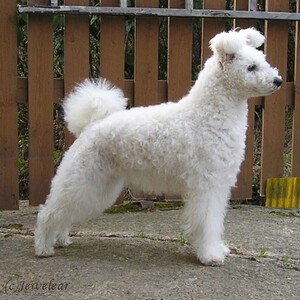
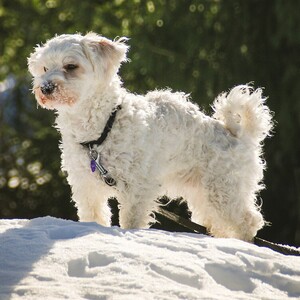
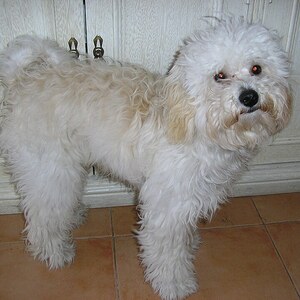
Bolognese. · Mgazzo / Wikimedia Commons, CC BY-SA 3.0. Cropped and resized.
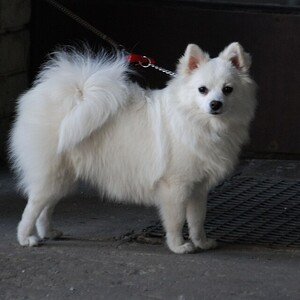
The Bolognese is a small dog of 2.5–4 kg, with a long, fluffy white coat like cotton wool. It comes from Bologna in Italy and was for centuries a precious gift among kings and nobles. It is calm, very attached to its owner and does not like being left alone.
Quick facts
| Common name | Bolognese (Bichon Bolognese) |
| Scientific name | Canis lupus familiaris |
| Country of origin | Italy (Bologna) |
| Official recognition | FCI, definitively since 5 March 1956 (Group 9, companion dogs; standard no. 196); also recognised by the AKC |
| Lifespan | 12–14 years |
| Size (males) | 27–30 cm at the withers |
| Size (females) | 25–28 cm at the withers |
| Weight | 2.5–4 kg |
| Coat type | Long, fluffy, in loose curls, no undercoat |
| Common colours | Pure white; very light shades of ivory are accepted |
| Energy level | Low |
| Suited to an apartment? | Yes, very well suited |
| Temperament | Calm, loyal, gentle, playful |
| Tendency to aggression | Very low |
| Good with children | Very good |
| Good with other animals | Very good |
| Genetic predispositions | No breed-specific diseases are known |
- Primary category:Dog breeds
- Explore this animal's categories:
History and origin
The origins of the Bolognese are intertwined with those of the Maltese. Their ancestors are the small dogs that Aristotle called, in Latin, “canes melitenses”. The Bolognese was already known in Roman times.
For centuries it was a highly prized gift among the powerful. Cosimo de' Medici took eight of these dogs to Brussels as gifts for Belgian nobles. King Philip II of Spain, after receiving two, wrote to the Duke d'Este that they were “the most royal gifts that can be made to an emperor”.
How the breed developed
- Antiquity – Aristotle mentions the small dogs called “canes melitenses”.
- 15th century – Cosimo de' Medici gives eight Bolognese to Belgian nobles.
- 16th century – King Philip II of Spain receives two Bolognese from the Duke d'Este.
- 5 March 1956 – The FCI recognises the breed.
- 1990 – The breed reaches England.
- 2002 – The Bolognese appears at Crufts for the first time.
Breed rating
| Feature | Stars |
|---|---|
| Training and intelligence | ★★★★★ |
| Easy to train | ★★★★★ |
| Intelligence | ★★★★☆ |
| Independence | ★★☆☆☆ |
| Stubbornness | ★★☆☆☆ |
| Behaviour and temperament | ★★★★★ |
| Affectionate with family | ★★★★★ |
| Friendly with children | ★★★★★ |
| Good with other dogs | ★★★★★ |
| Good with cats and other animals | ★★★★★ |
| Loyalty | ★★★★★ |
| Tendency to be aggressive | ★☆☆☆☆ |
| Tendency to bark | ★☆☆☆☆ |
| Needs and care | ★☆☆☆☆ |
| Shedding | ★☆☆☆☆ |
| Needs frequent grooming | ★★★☆☆ |
| Activity and lifestyle | ★☆☆☆☆ |
| Energy level | ★☆☆☆☆ |
| Daily exercise needs | ★☆☆☆☆ |
| Suited to apartment life | ★★★★★ |
| Health and longevity | ★★★★☆ |
| Life expectancy | ★★★★☆ |
| Predisposition to genetic diseases | ★★☆☆☆ |
| Working abilities and uses | ★★☆☆☆ |
| Good guard dog | ★☆☆☆☆ |
| Good companion dog | ★★★★★ |
Indicative rating: 5 stars means the highest level. It is based on the ratings the American Kennel Club gives the breed and on the FCI standard.
Physical characteristics
It is a small, stocky, compact dog with a square body: its length equals its height. The head is one third of the dog's height.
General appearance
The large, round eyes are dark, with black eyelid rims. The long ears hang down, but are stiff at the base, so they lift the hair slightly away from the head and make it look bigger. The tail is carried curved over the back.
| Feature | Bolognese |
|---|---|
| Size | Very small |
| Height at the withers | males: 27–30 cm; females: 25–28 cm |
| Weight | 2.5–4 kg |
| Coat | Long, fluffy, in loose curls; shorter on the muzzle |
| Eyes | Large, round, dark |
| Tail | Curved over the back |
The only accepted colour is pure white. Very light shades of ivory do not disqualify, but patches of another colour do.
Training and socialisation
The AKC gives it top marks for trainability: it learns easily and wants to please its owner. It can be shy with strangers, but opens up quickly if it is socialised.
Watch out for separation anxiety: the Bolognese finds it hard to be left alone for many hours.
Tips for effective training
- Socialise it from an early age. New people and new places help it not to be shy.
- Use praise and rewards. It is sensitive and responds well to gentleness.
- Get it used to being alone gradually. Start with a few minutes and slowly increase the time.
- Teach it tricks. It enjoys quiet games and learning new things.
Activity needs and lifestyle
It is a calm, low-energy dog. The AKC says it is very well suited to a flat and as a companion for retired people, as long as it still gets moderate exercise.
| Activity | How often | Why it matters |
|---|---|---|
| Short walks | daily | Exercise and new smells |
| Indoor games (hide and seek, ball) | daily | A good activity for a calm dog |
| Learning tricks | several times a week | Keeps its mind active |
Tips for a balanced life
- It is not suitable for people who are away from home all day.
- Protect it from cold and great heat.
- A garden, if there is one, must be fenced.
Care and health
Coat and skin care
The white coat, soft as cotton wool, has no undercoat and hardly sheds, so it bothers people with mild allergies less. If it is kept long, it needs regular grooming. Many owners keep it short, about 2.5 cm, leaving the head fluffy.
Common health problems
There are no known hereditary diseases specific to the breed. Annual vet check-ups and dental care remain important, as with all small dogs.
Other care
- Trim the hair around the eyes, for hygiene.
- Trim the nails regularly.
- Brush its teeth often.
Diet and nutrition
Choose a good-quality food for small breeds, suited to its age. The AKC warns that some dogs put on weight easily, especially from treats.
Tips for a healthy diet
The table gives a starting estimate, calculated with the formula from the Merck Veterinary Manual. The first two calorie columns show the calories per day for a healthy adult dog. The last column shows what this means in dry food with 3,500–4,000 kcal per kilogram.
| Dog's weight | Calories per day (neutered) | Calories per day (not neutered) | Dry food per day (approximate) |
|---|---|---|---|
| 2.5 kg | 220 kcal | 250 kcal | 55–71 g |
| 3 kg | 260 kcal | 290 kcal | 65–83 g |
| 4 kg | 320 kcal | 360 kcal | 80–103 g |
- Give its food in two or three small meals a day.
- Training treats count towards the daily portion.
- A dog is at the right weight when you can feel its ribs without pressing hard.
Foods to avoid
Some human foods are dangerous for dogs: chocolate, coffee, grapes and raisins, onions, garlic, xylitol (a sweetener used in chewing gum), macadamia nuts and alcohol.
Reproduction and development
Physical and emotional maturity
In dogs, sexual maturity usually comes between 6 and 12 months. Small breeds become adults faster than large ones, usually at around one year.
Mating and pregnancy
Pregnancy lasts about 63 days, counted from ovulation. Mating a female on her first heat is not recommended. The FCI standard requires that only healthy dogs of typical breed appearance are used for breeding.
Caring for the puppies
In small breeds, a litter has 3–4 puppies on average. The puppies are very small and fragile in the first weeks, so they must be kept warm and handled with care. Socialisation starts early: gentle handling, everyday noises and new people.
Interesting facts
- “The most royal gift”. King Philip II of Spain called it the most royal gift that can be made to an emperor.
- It posed for great painters. It appears in paintings by Titian, Pieter Bruegel the Elder and Goya.
- It had famous owners. Catherine the Great, Madame de Pompadour and Empress Maria Theresa all had these dogs.
- It has no undercoat. Its coat is single, which is why it hardly sheds.
- It differs from the Maltese. Its coat is in fluffy curls, not straight and silky.
In popular culture
In the paintings of the great masters
Dogs like the Bolognese appear in paintings by Titian, Pieter Bruegel the Elder and Goya. Titian painted Duke Federico Gonzaga with one of these dogs.
Frequently asked questions
How big does a Bolognese get?
It stands 25–30 cm at the withers and weighs 2.5–4 kg.
Does it shed?
Hardly at all, because it has no undercoat.
Can it be left home alone?
Not for long. It is prone to separation anxiety.
Is it suited to an apartment?
Yes. It is calm and needs only moderate exercise.
How does it differ from the Maltese?
The Bolognese has a coat of fluffy curls, while the Maltese has a straight, silky one.