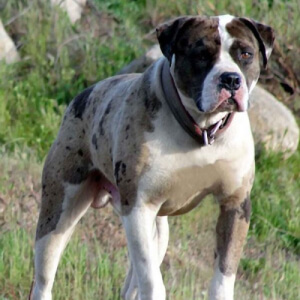
Alapaha Blue Blood BulldogCharacteristics, history, training and care
The Alapaha Blue Blood Bulldog is an American bulldog-type breed maintained through specialist breed organisations. It is associated with guarding and farm work. Recognition by a specialist registry should not be confused with recognition by every major kennel organisation.
Quick facts
| Common name | Alapaha Blue Blood Bulldog |
| Scientific name | Canis lupus familiaris |
| Country of origin | United States (Georgia) |
| Official Recognition | Registered by specialist breed organisations, including the Alapaha Blue-Blood Bulldog Association |
| Typical lifespan | About 12-15 years |
| Dimensions (Male) | About 53-61 cm / 32-45 kg |
| Dimensions (Female) | About 50-58 cm / 25-35 kg |
| Coat type | Short, close and smooth |
| Common colours | Mostly white with patches of brown, black, blue, red or brindle |
| Energy Level | Moderate |
| Suitable for an apartment? | Depends on exercise, training, health and the individual dog |
| Temperament | Loyal, protective, strong-willed |
| Behaviour towards unfamiliar people and dogs | Individual behaviour varies; socialisation, training and management matter |
| Compatibility with children | Depends on the individual; adult supervision and suitable handling are essential |
| Compatibility with other animals | Depends on socialisation, prey drive and the animals involved |
| Health considerations | Hip dysplasia, deafness, entropion |
- Primary category:Dog breeds
- Explore this animal's categories:
History and Origin
The Alapaha Blue Blood Bulldog is a rare American bulldog breed from southern Georgia, developed to be an athletic working dog rather than a heavy, short-faced show bulldog.
Evolution of the breed
- Old plantation bulldogs - The breed descends from working bulldogs kept on farms and plantations in the American South, used to guard property and catch cattle and hogs.
- The Lane family - The breed was preserved by the Lane family near the Alapaha River in Georgia; Lana Lou Lane continued her grandfather Buck Lane's breeding programme in the 20th century.
- A guardian and companion - It was bred to be a protective farm dog that is also devoted to its family.
- Specialist breed organisations maintain Alapaha records. This should not be presented as verified UKC recognition in 2001.
Breed Evaluation
The Alapaha Blue Blood Bulldog is a strong watchdog, but it needs an experienced owner and a well-organised home. These are general editorial ratings, not measured scores; individual dogs vary.
| Characteristic | Stars |
|---|---|
| Training and Intelligence | ★★★★☆ |
| Easy to train | ★★★☆☆ |
| Intelligence | ★★★★☆ |
| Level of independence | ★★★★☆ |
| Level of stubbornness | ★★★★☆ |
| Behavior and Temperament | ★★★★★ |
| Affectionate with family | ★★★★★ |
| Friendly with children | ★★★★★ |
| Compatible with other dogs | ★★★☆☆ |
| Compatible with cats and other animals | ★★★☆☆ |
| Degree of loyalty | ★★★★★ |
| Tendency to be aggressive | ★★★☆☆ |
| Tendency to bark | ★★★☆☆ |
| Needs and Care | ★★★☆☆ |
| Shedding level | ★★☆☆☆ |
| Requires frequent care | ★★☆☆☆ |
| Activity and Lifestyle | ★★★★☆ |
| Energy level | ★★★★☆ |
| Daily exercise requirement | ★★★★☆ |
| Suitable for apartment living | ★★☆☆☆ |
| Health and Longevity | ★★★★☆ |
| Life expectancy | ★★★★☆ |
| Predisposition to genetic diseases | ★★★☆☆ |
| Work and Utility Features | ★★★★★ |
| Good guard dog | ★★★★★ |
| Good companion dog | ★★★★★ |
Physical Characteristics
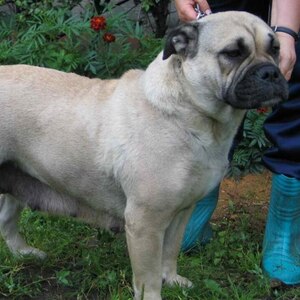
The Alapaha Blue Blood Bulldog is a powerful, muscular dog with a large head and an athletic build.
General appearance
- A muscular, athletic, well-proportioned body.
- A short, close, smooth coat that needs little care.
- A broad, square head with a short to medium muzzle, but less short than in the English Bulldog.
- Strong jaws, built for a firm grip.
- Medium-sized ears, folded or semi-erect.
- A long tail, thick at the base and tapering to a point.
- Eyes can be brown, amber or blue, and some dogs have "glass" (very pale blue) eyes or two different eye colours.
| Characteristic | Alapaha Blue Blood Bulldog |
|---|---|
| Size | Medium to large (about 50-61 cm at the shoulder) |
| Weight | About 25-45 kg |
| Coat | Short, smooth |
| Muzzle | Short to medium, strong |
| Shedding tendency | Low to moderate |
| Build | Strong, muscular |
The Alapaha Blue Blood Bulldog is a strong, impressive dog, suited to experienced people who want a loyal, protective guardian.
Training and Socialization
The Alapaha Blue Blood Bulldog is intelligent but independent, so training must be consistent. It is naturally protective, so early socialisation is essential to prevent excessive territorial behaviour.
Tips for effective training
- Start early - The Alapaha should begin training at about 8-10 weeks to learn basic commands and house rules.
- Rewards and clear rules - It responds well to positive training, but needs calm, consistent leadership, as it can be stubborn.
- Socialising with people and animals - Meeting different places, people and animals helps prevent aggression towards strangers.
- Managing the guarding instinct - Its natural protectiveness must be guided so that it can tell real threats from normal visitors.
- No physical punishment - It responds badly to harsh methods and better to a calm, confident owner with clear rules.
The Alapaha Blue Blood Bulldog is not recommended for beginners, but with good training and early socialisation it becomes a devoted, balanced companion.
Activity and Lifestyle Needs
The Alapaha Blue Blood Bulldog is an active, powerful dog that needs regular daily exercise to stay healthy and avoid boredom.
| Activity | Recommended duration |
|---|---|
| Daily walks | About 45-60 min |
| Mental stimulation games | About 20-30 min |
| Obedience training | About 15-20 min |
| Dog sports (tracking, weight pulling) | A few times a week, in cool weather |
Recommendations for a balanced lifestyle
- Best in a house with a garden - The Alapaha needs space and a secure fence and is not ideal for small apartments.
- Needs a routine - Too little exercise can lead to anxiety, destructive behaviour or weight gain.
- Enjoys mental games - It likes retrieving, searching and problem-solving games.
- A natural guardian - It will patrol its territory and react to what it sees as threats, so it needs good training.
The Alapaha Blue Blood Bulldog suits active, experienced families with time to train and exercise it daily.
Care and Health
The Alapaha Blue Blood Bulldog is generally a hardy breed, but some inherited disorders should be monitored.
Fur and skin care
- Weekly brushing - The short coat needs little care, but weekly brushing removes dead hair.
- Occasional baths - Baths are needed only when necessary, to avoid drying the skin.
- Skin and ear checks - The skin and ears should be checked regularly for irritation, allergies or infections.
Common health problems
| Condition | Description | Common symptoms |
|---|---|---|
| Hip dysplasia | Abnormal development of the hip joint | Difficulty walking, limping |
| Congenital deafness | More common in dogs with a lot of white in the coat | No reaction to sounds |
| Eyelid problems (entropion) | The eyelid rolls inwards and irritates the eye | Watery, red or squinting eyes |
| Bloat | The stomach swells and may twist; an emergency | Swollen belly, restlessness, drooling |
Other aspects of care
- Weekly eye and ear checks - help prevent infections.
- Weight control - With a big appetite, it can gain weight quickly, which worsens joint problems.
- Regular veterinary checks - A yearly check-up helps find health problems early.
The Alapaha Blue Blood Bulldog is generally healthy, but it needs monitoring for some inherited problems.
Diet and Nutrition
The Alapaha Blue Blood Bulldog needs a balanced diet with good-quality protein to maintain its muscles and energy.
Recommendations for a healthy diet
Choose a complete, balanced diet suited to age, size and health. Plan home-prepared diets and supplements with a qualified veterinarian; raw pet food can carry harmful bacteria.
| Food type | Daily Amount (Adults) | Frequency |
|---|---|---|
| Premium dry food | Individual amount; follow a complete diet’s guidance and veterinary advice | 2 meals/day |
| Home cooked food | Individual amount; follow a complete diet’s guidance and veterinary advice | 2 meals/day |
| Raw food: bacterial contamination is a concern | Individual amount; follow complete-food guidance and veterinary advice | 2 meals/day |
Forbidden foods
Chocolate, grapes and raisins, onions and xylitol - toxic to dogs. / Cooked bones - can splinter and cause intestinal blockage. / Fatty or fried foods - can upset digestion and cause pancreatitis. / Overfeeding - the Alapaha tends to gain weight, which can lead to joint and heart problems.
The Alapaha Blue Blood Bulldog should get a balanced diet in measured portions to avoid obesity and digestive problems.
Reproduction and Development
The Alapaha Blue Blood Bulldog is a rare breed with a small population, so breeding must be carefully managed, with health screening, to avoid inherited problems. Breeding can involve health risks, and veterinary advice is necessary.
Physical and emotional maturity
- Physical maturity: The Alapaha reaches adult height at about 12-18 months, but continues to fill out until about 2 years.
- Emotional maturity: Its behaviour usually becomes fully settled at about 2-3 years.
Mating and Gestation
- Breeding decisions require veterinary assessment of maturity, health and suitable screening; reaching a fixed age does not establish that breeding is appropriate.
- Duration of gestation: Approximately 58-68 days, usually about 63 days.
- Average number of puppies: Usually about 5-9 puppies.
Puppy care
- The first 3 weeks: Puppies depend completely on their mother for warmth and milk.
- Between 4-8 weeks: They begin to develop their personality and play more with people and littermates; early socialisation is essential.
- Moving to a new home: When puppies go to their new homes, basic training should begin so they learn house rules.
Good socialisation and early training are essential for the Alapaha to become a well-balanced, well-mannered dog.
Curiosities and Interesting Facts
- A plantation guardian - The Alapaha's ancestors guarded farms and plantations in the American South and helped catch half-wild cattle and hogs.
- "Blue blood" - The name refers to the breed's "noble" old bloodlines, not to a blue coat colour.
- Very rare - Compared with the English or American Bulldog, the Alapaha is little known, with only a small number of breeders.
- Protective and affectionate - Although powerful and imposing, it is very loyal and affectionate with its family.
- Moderate energy - Unlike some heavy bulldogs, the Alapaha is athletic and active, but it does not need extreme exercise.
- Unusual eyes - Some Alapahas have blue or "glass" eyes, or two different eye colours.
- Not for beginners - It can be strong-willed and needs an experienced owner.
The Dog in Popular Culture
The Alapaha Blue Blood Bulldog is little known in popular culture, but it is valued by fans of rare working bulldogs.
Bulldog Alapaha in modern media and culture
- A rare breed - It is mostly known through breed clubs and specialist books about American bulldog breeds.
Importance in modern culture
- A family guardian - Many owners choose the Alapaha for its natural watchfulness and devotion to the family.
- Southern heritage - The breed is part of the rural history of southern Georgia and the American South.