Scottish DeerhoundCharacteristics, history, training and care
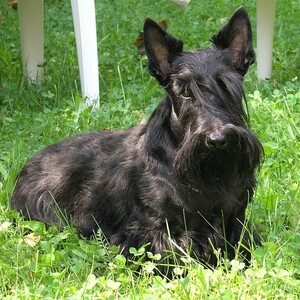
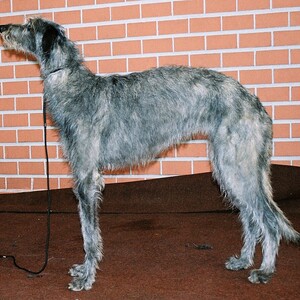
Scottish Deerhound. · Pleple2000 / Wikimedia Commons, CC BY-SA 3.0. Cropped and resized.
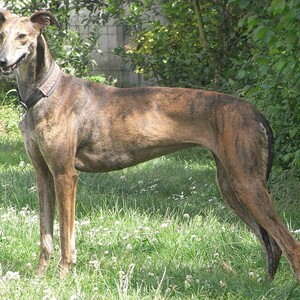
The Deerhound (Scottish Deerhound) is a very large, rough-coated Scottish sighthound, bred for centuries to hunt red deer. The FCI standard says it resembles a rough-coated greyhound of larger size and bone, combining speed, power and endurance with an air of gentle dignity. It is gentle, friendly, obedient and never suspicious, aggressive or nervous.
Quick facts
| Common name | Deerhound (Scottish Deerhound) |
| Scientific name | Canis lupus familiaris |
| Country of origin | United Kingdom (Scotland) |
| Official recognition | FCI, definitively since 29 April 1955 (group 10, sighthounds; standard no. 164); also recognised by the AKC |
| Lifespan | 8–11 years, according to the AKC |
| Size (males) | at least 76 cm at the withers; about 45.5 kg |
| Size (females) | at least 71 cm at the withers; about 36.5 kg |
| Coat type | Harsh, wiry, 8–10 cm on the body |
| Common colours | Dark blue-grey, shades of grey, brindle, yellow, sandy red |
| Energy level | Average; needs free running |
| Suited to an apartment? | No |
| Temperament | Gentle, friendly, dignified, obedient |
| Tendency to aggression | Very low |
| Good with children | Good, but its play may frighten small children |
| Good with other animals | Very good with other dogs; may chase small animals |
| Genetic predispositions | Dilated cardiomyopathy, osteosarcoma, cystinuria, bloat, liver shunt |
- Primary category:Dog breeds
- Explore this animal's categories:
History and origin
The FCI standard says the origins of the breed are shrouded in mystery; there is reason to believe it was brought to Scotland by Phoenician traders, and that running hounds were already there when the Romans arrived. The breed has hunted red deer for a thousand years and has stayed much the same over the centuries.
Wikipedia says deer hunting with Deerhounds lasted until the late 19th century. Then, with modern rifles and smaller forests, slower dogs that tracked wounded game were preferred, and the breed was left in the care of a few enthusiasts, who made it a show breed. The Deerhound was also used to rebuild the Irish Wolfhound in the late 19th century.
How the breed developed
- Middle Ages – Red deer hunting in the Highlands.
- Early 19th century – The name Scottish Deerhound becomes known.
- Late 19th century – Hunting with Deerhounds dies out; it becomes a show breed.
- 29 April 1955 – The FCI recognises the breed.
Breed rating
| Feature | Stars |
|---|---|
| Training and intelligence | ★★★☆☆ |
| Easy to train | ★★★★★ |
| Intelligence | ★★★★☆ |
| Independence | ★★★☆☆ |
| Stubbornness | ★★★☆☆ |
| Behaviour and temperament | ★★★★★ |
| Affectionate with family | ★★★☆☆ |
| Friendly with children | ★★★☆☆ |
| Good with other dogs | ★★★★☆ |
| Good with cats and other animals | ★☆☆☆☆ |
| Loyalty | ★★★★★ |
| Tendency to be aggressive | ★★★☆☆ |
| Tendency to bark | ★★★★★ |
| Needs and care | ★★★☆☆ |
| Shedding | ★★★☆☆ |
| Needs frequent grooming | ★☆☆☆☆ |
| Activity and lifestyle | ★★★☆☆ |
| Energy level | ★★★☆☆ |
| Daily exercise needs | ★★★★☆ |
| Suited to apartment life | ★★★☆☆ |
| Health and longevity | ★★★☆☆ |
| Life expectancy | ★★★☆☆ |
| Predisposition to genetic diseases | ★★☆☆☆ |
| Working abilities and uses | ★★★☆☆ |
| Good companion dog | ★★★☆☆ |
| Good companion dog | ★★★★★ |
Indicative rating: 5 stars means the highest level. It is based on the ratings the American Kennel Club gives the breed and on the FCI standard.
Physical characteristics
The standard describes it as a rough-coated greyhound of larger size and greater bone. Wikipedia says that although it is not as fast as the Greyhound on smooth, firm ground, it can outrun it on rough or difficult terrain. It is one of the tallest sighthounds.
General appearance
The coat is shaggy but not overcoated; a woolly coat is not wanted. The hair on the body, neck and rump is harsh and wiry, 8–10 cm long, while that on the head, chest and belly is much softer. It has a moustache and a slight beard.
| Feature | Scottish Deerhound |
|---|---|
| Size | Giant |
| Height at the withers | males: at least 76 cm; females: at least 71 cm |
| Weight | males: ~45.5 kg; females: ~36.5 kg |
| Coat | Harsh, wiry |
| Ears | Small, dark, folded |
| Type | Sighthound |
The standard accepts dark blue-grey, darker or lighter shades of grey, brindle, yellow, sandy red or red fawn with black points. A white chest, white toes and a white tail tip are permitted. Wikipedia says that today the breed is almost always grey and other colours are very rare.
Training and socialisation
The standard describes it as gentle and friendly, obedient and easy to train because it is eager to please. It is docile and good-tempered, never suspicious, aggressive or nervous.
The AKC says it is sensitive and responds best to positive methods. As a sighthound, it has the instinct to chase anything that moves, so the recall needs a lot of practice.
Tips for effective training
- Use positive methods. It is sensitive.
- Keep it on a lead. It chases anything that moves.
- Do not leave it alone all day. The AKC says it does not thrive in a kennel.
- Take care with small children. Its play can be too rough.
Activity needs and lifestyle
The AKC says it is a quiet dog at home that sleeps a lot, but it needs to run free every day in a large, securely fenced area. Puppies need a playmate and plenty of space, and up to 18 months exercise should suit their age.
| Activity | How often | Why it matters |
|---|---|---|
| Free running in a fenced area | daily | Sighthound instinct |
| Long walks | daily | Stamina |
| Lure coursing | occasionally | Simulated hunting |
Tips for a balanced life
- It needs a house with a large fenced yard.
- Do not let it run after a meal.
- Moderate exercise up to 18 months.
Care and health
Coat and skin care
The AKC says the harsh coat is easy to look after: brushing and combing about once a week. The nails should be trimmed every few weeks if they do not wear down naturally.
Common health problems
The AKC says that although it is a giant breed, many Deerhounds live to old age. A 2024 British study, cited by Wikipedia, found a life expectancy of 10.5 years. Problems to watch for:
| Condition | Description | Common symptoms |
|---|---|---|
| Dilated cardiomyopathy | The heart muscle weakens | Tiredness, coughing, laboured breathing |
| Osteosarcoma | Bone cancer | Limping, swellings on the legs |
| Cystinuria | Stones in the bladder | Difficult or bloody urination |
| Gastric dilatation-volvulus (bloat) | The stomach fills with gas and may twist; this is a veterinary emergency | Swollen belly, trying to vomit without success, drooling, restlessness |
| Sensitivity to anaesthesia | It metabolises some drugs slowly; delayed bleeding | Tell the vet before any surgery |
Other care
- Tell the vet it is a sighthound before anaesthesia.
- Have regular heart check-ups.
- Trim the nails regularly.
Diet and nutrition
The AKC recommends good-quality food suited to the dog's age, and attention to its weight.
Tips for a healthy diet
The table gives a starting estimate, calculated with the formula from the Merck Veterinary Manual. The first two calorie columns show the calories per day for a healthy adult dog. The last column shows what this means in dry food with 3,500–4,000 kcal per kilogram.
| Dog's weight | Calories per day (neutered) | Calories per day (not neutered) | Dry food per day (approximate) |
|---|---|---|---|
| 36 kg | 1,650 kcal | 1,850 kcal | 410–530 g |
| 41 kg | 1,810 kcal | 2,040 kcal | 450–580 g |
| 46 kg | 1,980 kcal | 2,230 kcal | 500–640 g |
- Split the food into two meals a day.
- Do not let it run right after a meal.
- A dog is at the right weight when you can feel its ribs without pressing hard.
Foods to avoid
Some human foods are dangerous for dogs: chocolate, coffee, grapes and raisins, onions, garlic, xylitol (a sweetener used in chewing gum), macadamia nuts and alcohol.
Reproduction and development
Physical and emotional maturity
In dogs, sexual maturity usually comes between 6 and 12 months, but in large breeds it can be delayed until about two years. Very large breeds become adults only at around 2 years.
Mating and pregnancy
Pregnancy lasts about 63 days, counted from ovulation. Mating a female on her first heat is not recommended. The FCI standard requires that only healthy dogs of typical breed appearance are used for breeding.
Caring for the puppies
In large breeds, a litter has around 7 puppies on average. The puppies grow very fast, so they need growth food suited to large breeds. Socialisation starts in the first weeks.
Interesting facts
- A deer hunter. It has hunted red deer for a thousand years, the standard says.
- Faster on rough ground. On uneven terrain it can outrun the Greyhound.
- A queen's gift. Anne of Denmark sent such dogs to her brother, King Christian IV.
- Lazy at home. The AKC says it sleeps a lot at home.
- Ancestor of the Irish Wolfhound. It was the basis of the modern Irish Wolfhound.
In popular culture
Maida, Walter Scott's dog
Wikipedia says Maida, the Deerhound of the writer Sir Walter Scott, appears on his statue in Perth, Scotland.
Frequently asked questions
How big does it get?
Males measure at least 76 cm and weigh about 45.5 kg.
Is it aggressive?
No; the standard says it is never aggressive or nervous.
How long does it live?
The AKC gives 8–11 years.
Can it live in a flat?
It is not suitable; it needs a lot of space to run.
Is it hard to groom?
No; brushing once a week is usually enough.