GooseInteresting facts and information
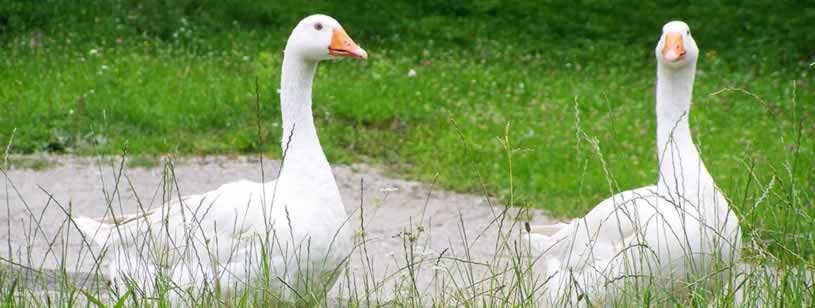
Geese are waterbirds related to ducks and swans. The group includes species of Anser and Branta. Wild species differ in their migrations and habitats, while domestic geese descend from wild ancestors.
Many wild geese are migratory, travelling thousands of kilometres between their northern breeding grounds and warmer wintering areas. Domestic geese, descended from wild species such as the greylag goose (Anser anser) and the swan goose (Anser cygnoides), are raised around the world for meat, feathers and eggs.
Geese are intelligent birds with an excellent memory and a remarkable sense of direction. They are also territorial and protective, which is why they have long been used as "guard birds" on farms.
Quick facts
| Common name | Goose |
| Scientific name | Anser and Branta (true geese) |
| Typical lifespan | About 10-25 years (depending on species and conditions) |
| Maximum flight speed | Usually about 60-90 km/h |
| Dimensions | 50 - 110 cm long |
| Weight | 1 - 10 kg (depending on species) |
| Diet type | Herbivore (grass, seeds, roots, water plants) |
| Main predators | Foxes, wolves, eagles and other birds of prey, humans |
| Conservation status | Most species are Least Concern; some are Vulnerable |
| Distribution | Mainly the Northern Hemisphere; domestic geese worldwide |
| Habitat | Wetlands, lakes, rivers, meadows, farmland |
Interesting facts
- Geese have an excellent memory - They remember people, places and migration routes for years.
- They are among the most faithful birds - Most geese pair for life. If one partner dies, the other may stay alone for a long time before finding a new mate.
- They make long migrations - Species such as the red-breasted goose (Branta ruficollis) fly thousands of kilometres every year between the Siberian tundra and their wintering grounds around the Black Sea.
- Flying in a "V" saves energy - Each bird flies slightly behind and to the side of the one in front, catching rising air from its wingtips; the birds take turns at the front.
- Geese communicate a lot - They use many different calls, including alarm calls, flight calls and greetings between partners.
- Geese saved Rome - According to legend, in 390 BC the sacred geese of the goddess Juno woke the defenders of the Capitol in Rome during a night attack by the Gauls.
- They can live a long time - Wild geese can live for 20 years or more, and some domestic geese live even longer.
- They make good guards - Geese have been kept for centuries on farms, and even at military sites, to raise the alarm when strangers approach.
- They are sensitive to people's behaviour - Geese learn to recognise people who treat them well or badly and react accordingly.
Records and remarkable features
- Geese are waterbirds related to ducks and swans. The group includes species of Anser and Branta. Wild species differ in their migrations and habitats, while domestic geese descend from wild ancestors.
Characteristics
Geese are large waterbirds adapted both to long-distance flight and to life on land. Their features help them survive in many environments, from lakes and rivers to farmland.
Main physical features:
| Feature | Details |
|---|---|
| Size | 50 - 110 cm long |
| Weight | 1 - 10 kg (depending on species) |
| Wingspan | About 120 - 180 cm |
| Plumage | Usually grey, white, black or brown, depending on the species |
| Bill length | About 4 - 10 cm |
| Movement | Walk well on land and swim well |
| Flight speed | Usually about 60 - 90 km/h |
| Lifespan | About 10 - 25 years in the wild |
Special adaptations:
- Webbed feet - Let them swim efficiently and still walk well on land.
- Excellent memory - They remember migration routes and feeding places for years.
- Complex communication - Their calls range from alarm calls to greetings between individuals.
- Wide field of view - With eyes on the sides of the head, geese can see almost all around them without moving their head.
- Dense, waterproof feathers - Protect them from cold and water.
Habits and behaviour
Geese are extremely social birds that form well-organised groups, both in the wild and on farms. Their behaviour includes migration strategies, defence of their territory and complex communication.
Social behaviour:
- Large flocks - Geese travel and feed in organised flocks with a social hierarchy.
- Pairs for life - Once they have chosen a partner, most geese stay together for life.
- Defending territory - Geese are territorial in the breeding season and can be aggressive towards intruders, including people and other animals.
- Constant communication - They use calls and body postures to coordinate the group.
Migration and navigation:
- V formations - Flying in a V reduces air resistance, so the birds behind save energy.
- Learned routes - Young geese learn migration routes from their parents, and geese use the sun, stars, the Earth's magnetic field and landmarks to find their way.
- Flying at great heights - Bar-headed geese cross the Himalayas, flying at altitudes of more than 6,000 metres.
Defence and territorial behaviour:
- Effective guards - Geese hiss and honk loudly and attack with their bills and wings when they sense danger.
- Fierce parents - The male and female work together to drive predators away from their goslings.
- Warning calls - Different calls warn the flock of danger, call others to food or coordinate flight.
Habitat and geographic distribution
Wild geese live mainly in the Northern Hemisphere, and domestic geese are kept on every inhabited continent. They prefer wetlands, but many have adapted to grasslands, plains and farmland.
Habitat types:
| Habitat | Example species |
|---|---|
| Lakes and rivers | Greylag goose (Anser anser), snow goose (Anser caerulescens) |
| Grasslands and plains | Canada goose (Branta canadensis), lesser white-fronted goose (Anser erythropus) |
| Farms | Domestic goose (Anser anser domesticus) |
| Arctic tundra (breeding) | Red-breasted goose (Branta ruficollis), greater white-fronted goose (Anser albifrons) |
Geographic distribution:
- North America - Large populations of Canada geese and snow geese.
- Europe and Asia - Greylag geese and white-fronted geese are among the most common species.
- Africa and the Middle East - Some species migrate here to spend the winter in warmer places.
- Australia and New Zealand - Introduced populations, mainly of Canada geese and domestic geese, have adapted to local conditions.
Impact of climate change and human activities:
- Changing migration - Rising temperatures are changing traditional migration patterns.
- Habitat loss - Draining wetlands and the spread of towns reduce places where geese can nest and feed.
- Hunting - In some countries, geese are hunted for meat, feathers or sport.
Geese are resilient birds, but human impacts on the environment continue to affect their populations around the world.
Diet and feeding
Geese are opportunistic herbivores that feed both on land and in water. They eat many kinds of plants, seeds and roots, and goslings also eat some small invertebrates in their first weeks of life.
Types of food:
| Food group | Examples |
|---|---|
| Grasses and leaves | Grass, alfalfa, clover |
| Water plants | Algae, pondweeds and other aquatic plants |
| Seeds and grain | Wheat, barley, oats, maize, rice |
| Roots and tubers | Roots of marsh plants, sedges |
| Fruit and vegetables | Apples, carrots, pumpkins (in captivity) |
| Invertebrates (occasionally) | Snails, small insects, larvae |
Feeding methods:
- Grazing - Geese use their broad bills to crop grass and short plants.
- Dipping their heads underwater - They reach water plants below the surface.
- Feeding in groups - Geese prefer to feed together, with some birds keeping watch.
- Learning from parents - Goslings feed themselves from the start, but follow their parents to good feeding places.
Domestic geese are usually fed grain, greens and supplements, with a more varied and controlled diet.
Reproduction and life cycle
Geese are monogamous and usually stay with the same partner for life. They nest in sheltered places near water, and both parents fiercely defend their young.
Life cycle stages:
| Stage | Approximate timing | What happens |
|---|---|---|
| Egg | 25 - 30 days | The female lays about 4 to 10 eggs and incubates them herself. |
| Gosling | 1 - 2 months | Fluffy and dependent on its parents; can swim within a day of hatching. |
| Young goose | 2 - 6 months | Grows adult feathers and learns to fly. |
| Adult | 2 - 3 years | Ready to breed and find a lifelong partner. |
Breeding and parental care:
- The female incubates the eggs for about 28 days, while the male guards the nest.
- Goslings can swim soon after hatching but stay close to their parents for protection.
- Goose families often stay together until the next breeding season and migrate together.
- Parents are extremely protective, using warning calls and attacking predators.
Thanks to careful parents and life in flocks, many goslings survive to adulthood.
Name and history
Geese have been known and respected for thousands of years and play an important role in ancient cultures and folklore. They were domesticated at least 3,000 years ago, for meat, feathers and as guard animals.
Origin of the name:
- The English word "goose" comes from Old English gōs and is related to similar words in many European languages, such as the German Gans.
- The scientific names Anser (from the Latin word for goose) and Branta are used for the two main groups of true geese.
Taxonomic classification:
| Taxonomic rank | Name |
|---|---|
| Kingdom | Animalia |
| Phylum | Chordata |
| Class | Aves |
| Order | Anseriformes |
| Family | Anatidae |
| Genera | Anser, Branta |
Geese in history and culture:
- Ancient Egypt - Geese were kept and honoured, and they often appear in Egyptian paintings, such as the famous "Meidum Geese".
- Ancient Rome - The "Capitoline geese" became famous for warning the city's defenders of a night attack in 390 BC.
- China and Japan - Wild geese symbolised loyalty and family harmony and were linked with faithful marriage.
- Medieval Europe - Geese were common farm birds; in France, they are well known for foie gras.
- Folk tales - Geese often appear in fairy tales, such as "The Goose that Laid the Golden Eggs".
Geese have had a deep influence on farming and culture and were among the first birds domesticated for food and protection.
Cultural significance and mythology
Geese have played an important role in mythology, religion and culture, where they are linked with loyalty, protection and wisdom. Throughout history, they have been seen as sacred birds, and their orderly behaviour has inspired many legends and superstitions.
Geese in mythology and beliefs:
- Ancient Egypt - The goose was linked with the earth god Geb, who was sometimes shown with a goose on his head and was called the "Great Cackler".
- Ancient Rome - The famous Capitoline geese, sacred to Juno, were said to have saved Rome in 390 BC by waking its defenders during a night attack by the Gauls.
- China and Japan - Because geese keep the same mate for life, they became symbols of faithful marriage and are often shown in pairs in traditional art.
- Weather lore - In many European traditions, the behaviour of geese was used to predict the weather; early migration was thought to mean a hard winter.
- "The Goose that Laid the Golden Eggs" - This famous fable warns that greed can destroy a source of wealth.
What geese symbolise:
- Loyalty and faithfulness - Geese are seen as symbols of marriage and commitment.
- Protection and vigilance - Their watchful nature made them guardians since ancient times.
- Wisdom and teamwork - Their organised migrations and long-distance navigation are seen as signs of intelligence and cooperation.
Conservation status and threats
Many geese are adaptable and common, but some wild populations are declining because of habitat destruction, pollution and hunting.
Conservation status
| Species | Status (IUCN) |
|---|---|
| Red-breasted goose (Branta ruficollis) | Vulnerable |
| Lesser white-fronted goose (Anser erythropus) | Vulnerable |
| Canada goose (Branta canadensis) | Least Concern |
| Greylag goose (Anser anser) | Least Concern |
Main threats:
- Habitat destruction - Farming and urban development reduce nesting and feeding areas.
- Overhunting - In some regions, geese are hunted heavily for meat, feathers or sport.
- Water pollution - Pesticides and toxic substances affect water quality and the geese's food.
- Climate change - Changes migration routes and food supplies.
- Hybridisation and competition - In some places, domestic or introduced geese compete with native species or breed with them.
Conservation efforts:
- Protected areas for migrating geese - Important wintering and breeding areas are protected and monitored.
- Hunting rules - Many countries have strict limits on how many geese can be hunted each year.
- Reintroduction - Breeding and release programmes have been started for the lesser white-fronted goose.
- Education - Conservation programmes promote the protection of wetlands, which are essential for geese.
In popular culture
Geese in literature:
- "The Goose that Laid the Golden Eggs" - A classic fable about greed and losing wealth through impatience.
- Charlotte's Web (E. B. White, 1952) - The goose and gander are among the farm animals who help save Wilbur the pig.
- Mother Goose - The imaginary author of many traditional English nursery rhymes.
Geese in film and television:
- Kung Fu Panda (2008) - Mr Ping, a goose, is Po's adoptive father and runs a noodle restaurant.
- Fly Away Home (1996) - A film about a girl who teaches a flock of orphaned Canada geese to migrate by leading them with a light aircraft.
Geese in video games:
- Untitled Goose Game (2019) - A hugely successful game in which the player is a mischievous goose causing chaos in a village.
Geese as a cultural symbol:
- Good luck - In some cultures, a goose wandering into a yard is said to bring good luck and prosperity.
- Heraldry - Geese appear on some coats of arms as symbols of vigilance and protection.