Great DaneCharacteristics, history, training and care
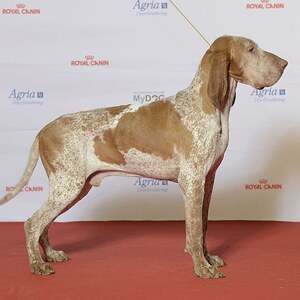
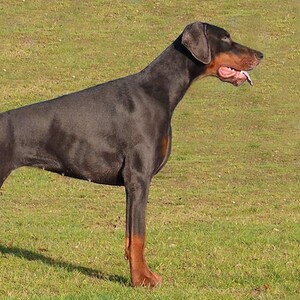
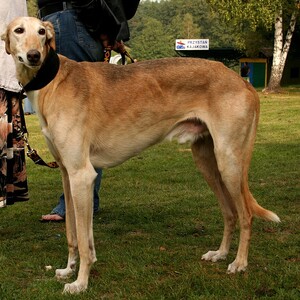
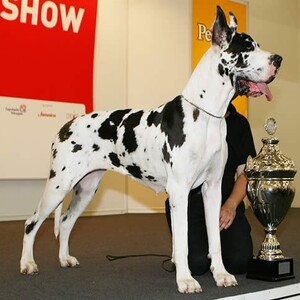
Great Dane. · Markovade.pero / Wikimedia Commons, CC BY-SA 3.0 rs. Cropped and resized.
The Great Dane (Deutsche Dogge) is one of the tallest dogs in the world, an elegant, balanced giant. It descends from the hunting dogs of the Middle Ages, used on bears, wild boar and deer, and from the guard dogs of German nobles. It is friendly, loving and devoted to its owners, calm and hard to provoke.
Quick facts
| Common name | Great Dane (Deutsche Dogge) |
| Scientific name | Canis lupus familiaris |
| Country of origin | Germany |
| Official recognition | FCI, definitively since 18 November 1961 (group 2, molossoid breeds, mastiff type; standard no. 235); also recognised by the AKC |
| Lifespan | 7–10 years, according to the AKC; a 2024 British study found 10.6 years |
| Size (males) | 80–90 cm at the withers; about 64–79 kg (AKC) |
| Size (females) | 72–84 cm at the withers; about 50–64 kg (AKC) |
| Coat type | Very short, dense, smooth, glossy, without an undercoat |
| Common colours | Fawn, brindle, harlequin (white with black), merle, black, blue |
| Energy level | Moderate to high |
| Suited to an apartment? | It can adapt, but it needs a lot of room |
| Temperament | Friendly, loving, devoted, calm, hard to provoke |
| Tendency to aggression | Low; the standard does not accept aggression |
| Good with children | Average; it is very big |
| Good with other animals | Average |
| Genetic predispositions | Bloat, heart disease, hip dysplasia, eye diseases, autoimmune thyroiditis |
- Primary category:Dog breeds
- Explore this animal's categories:
History and origin
The FCI standard says the ancestors of the Great Dane are the old “Bullenbeisser” and the boar-hunting dogs, which stood midway between the powerful English Mastiff and the swift sighthound. The word “Dogge” originally meant simply a large, powerful dog, and the dogs went by different names: Ulmer Dogge, Englische Dogge, Saupacker and others.
In 1878, a committee of seven breeders and judges, chaired by Dr Bodinus, decided in Berlin that all these varieties should be called “Deutsche Doggen”. In 1880 the first standard was drawn up. Wikipedia says that in the 16th and 17th centuries, the nobles' favourite dogs slept in their masters' rooms and wore ornate collars.
How the breed developed
- 16th century – European nobles bring large dogs from England and Ireland.
- 17th century – The dogs are bred at the courts of German nobles.
- 1878 – A committee in Berlin unites the varieties under the name “Deutsche Dogge”.
- 1880 – The first standard is drawn up.
- 18 November 1961 – The FCI recognises the breed.
- 21 August 2024 – The current FCI standard is published.
Breed rating
| Feature | Stars |
|---|---|
| Training and intelligence | ★★★★☆ |
| Easy to train | ★★★☆☆ |
| Intelligence | ★★★★☆ |
| Independence | ★★★☆☆ |
| Stubbornness | ★★★☆☆ |
| Behaviour and temperament | ★★★★☆ |
| Affectionate with family | ★★★★★ |
| Friendly with children | ★★★☆☆ |
| Good with other dogs | ★★★☆☆ |
| Good with cats and other animals | ★★★☆☆ |
| Loyalty | ★★★★★ |
| Tendency to be aggressive | ★☆☆☆☆ |
| Tendency to bark | ★★★☆☆ |
| Needs and care | ★★★★☆ |
| Shedding | ★★★☆☆ |
| Needs frequent grooming | ★☆☆☆☆ |
| Activity and lifestyle | ★★★★☆ |
| Energy level | ★★★★☆ |
| Daily exercise needs | ★★★☆☆ |
| Suited to apartment life | ★★★★☆ |
| Health and longevity | ★★★★☆ |
| Life expectancy | ★☆☆☆☆ |
| Predisposition to genetic diseases | ★★★★☆ |
| Working abilities and uses | ★★★★★ |
| Good guard dog | ★★★★★ |
| Good companion dog | ★★★★☆ |
Indicative rating: 5 stars means the highest level. It is based on the ratings the American Kennel Club gives the breed and on the FCI standard.
Physical characteristics
The AKC says Great Danes reach 81 cm at the withers and, standing on their hind legs, are taller than most people. They are the picture of elegance and balance, with a smooth, easy stride.
General appearance
The head is long, narrow, well chiselled and expressive. The very short, glossy coat must never be harsh or double. The best-known pattern is probably the harlequin, white with black patches.
| Feature | Great Dane |
|---|---|
| Size | Very large |
| Height at the withers | males: 80–90 cm; females: 72–84 cm |
| Weight | males: about 64–79 kg; females: 50–64 kg |
| Coat | Very short, glossy |
| Head | Long, narrow, expressive |
| Movement | Smooth, elegant |
The FCI accepts three colour groups: fawn and brindle; harlequin (white with black patches), merle (grey with black patches) and black; blue. In fawn dogs a black mask is desirable.
Training and socialisation
The standard describes it as friendly, loving and devoted to its owners, perhaps reserved with strangers, but self-assured, fearless, easy to handle, docile, very hard to provoke and without aggression.
The AKC says that, for such a large and powerful breed, obedience training is a must, and puppy socialisation and puppy classes are recommended. Great Danes are sociable, friendly and eager to please.
Tips for effective training
- Start training it as a puppy. As an adult, it will weigh as much as a person.
- Socialise it thoroughly. The standard places great value on social behaviour.
- Use rewards. It is eager to please you.
- Do not overwork it before the age of 2. The AKC says its joints are still growing.
Activity needs and lifestyle
The AKC says Great Danes seem calm, but they need daily exercise suited to their age: two or three brisk walks a day may be enough. They can be jogging or hiking companions, but only after the age of 2. Because of the risk of bloat, intense exercise should be avoided around mealtimes.
| Activity | How often | Why it matters |
|---|---|---|
| Brisk walks | 2–3 times a day | Exercise suited to a giant |
| Play in a fenced yard | daily | Uses up energy |
| Obedience exercises | daily | Control over a very large dog |
Tips for a balanced life
- No intense exercise before or after meals.
- You need a car and a home with room for it.
- Keep a cloth handy: it drools quite a lot.
Care and health
Coat and skin care
The AKC says the short coat sheds little for most of the year, but at its size, there is still quite a lot of hair. A weekly brush with a medium-bristle brush, a rubber grooming mitt or a hound glove keeps shedding under control.
Common health problems
The AKC says bloat is the leading cause of death in Great Danes. Many owners choose a preventive operation (gastropexy). It is worth watching for:
| Condition | Description | Common symptoms |
|---|---|---|
| Gastric dilatation-volvulus (bloat) | The stomach fills with gas and may twist; this is a veterinary emergency | Swollen belly, trying to vomit without success, drooling, restlessness |
| Heart disease | Heart conditions, including cardiomyopathy | Tiredness, coughing, fainting |
| Hip dysplasia | The hip joint forms incorrectly and, over time, arthritis develops | Limping, difficulty getting up or jumping, hip pain |
| Autoimmune thyroiditis | The body attacks the thyroid gland | Weight gain, tiredness, dull coat |
Other care
- Ask your vet about preventive gastropexy.
- Trim the nails regularly.
- Brush its teeth regularly.
Diet and nutrition
The AKC says Great Danes grow quickly and have growing pains, and good food is essential. Table scraps should be given rarely or not at all, especially cooked bones and fatty food.
Tips for a healthy diet
The table gives a starting estimate, calculated with the formula from the Merck Veterinary Manual. The first two calorie columns show the calories per day for a healthy adult dog. The last column shows what this means in dry food with 3,500–4,000 kcal per kilogram.
| Dog's weight | Calories per day (neutered) | Calories per day (not neutered) | Dry food per day (approximate) |
|---|---|---|---|
| 50 kg | 2,110 kcal | 2,370 kcal | 530–680 g |
| 65 kg | 2,560 kcal | 2,880 kcal | 640–820 g |
| 80 kg | 3,000 kcal | 3,370 kcal | 750–960 g |
- Divide the food into two or three meals a day to reduce the risk of bloat.
- Do not let it run before or after meals.
- A dog is at the right weight when you can feel its ribs without pressing hard.
Foods to avoid
Some human foods are dangerous for dogs: chocolate, coffee, grapes and raisins, onions, garlic, xylitol (a sweetener used in chewing gum), macadamia nuts and alcohol.
Reproduction and development
Physical and emotional maturity
In dogs, sexual maturity usually comes between 6 and 12 months, but in large breeds it can be delayed until about two years. Very large breeds become adults only at around 2 years.
Mating and pregnancy
Pregnancy lasts about 63 days, counted from ovulation. Mating a female on her first heat is not recommended. The FCI standard requires that only healthy dogs of typical breed appearance are used for breeding.
Caring for the puppies
In large breeds, a litter has around 7 puppies on average. The puppies grow very fast, so they need growth food suited to large breeds. Socialisation starts in the first weeks.
Interesting facts
- The height record. Wikipedia says Zeus, a black Great Dane, measured 111.8 cm at the withers.
- Bedroom dogs. The nobles' favourite dogs slept in their master's bedroom.
- A misleading name. Although it is called the “Great Dane”, the breed is German, not Danish.
- Three colour groups. The FCI breeds them separately: fawn/brindle, harlequin/merle/black and blue.
- Taller than a person. Standing on its hind legs, it is taller than most people.
In popular culture
The tallest dog
Wikipedia says that over the years, the tallest living dog has usually been a Great Dane. Record holders have included Gibson, Titan and Giant George, and the record was broken by Zeus, a black Great Dane measuring 111.8 cm at the withers.
Frequently asked questions
Is the Great Dane Danish?
No. Despite its English name, “Great Dane”, the breed is German.
How big does it get?
Males measure 80–90 cm at the withers and females 72–84 cm.
Is it aggressive?
No. The standard wants it friendly, docile and very hard to provoke.
What is the greatest danger to its health?
The AKC says bloat is the leading cause of death in Great Danes.
How long does it live?
The AKC gives 7–10 years; a 2024 British study found 10.6 years.