American BulldogCharacteristics, history, training and care
The American Bulldog is a working bulldog breed associated with the United States. It is strong and athletic, with differences between breeding lines. It needs responsible breeding, training, socialisation and appropriate management.
Quick facts
| Common name | American Bulldog |
| Scientific name | Canis lupus familiaris |
| Country of origin | United States |
| Official Recognition | Recognised by UKC in 1999 |
| Typical lifespan | About 10-15 years |
| Dimensions (Male) | About 56-69 cm / 34-55 kg |
| Dimensions (Female) | About 51-64 cm / 27-41 kg |
| Coat type | Short, close and smooth |
| Common colours | Mostly white, or white with brindle, fawn, red, brown or black patches |
| Energy Level | High |
| Suitable for an apartment? | Depends on exercise, training, health and the individual dog |
| Temperament | Loyal, protective, energetic |
| Behaviour towards unfamiliar people and dogs | Individual behaviour varies; socialisation, training and management matter |
| Compatibility with children | Depends on the individual; adult supervision and suitable handling are essential |
| Compatibility with other animals | Depends on socialisation, prey drive and the animals involved |
| Health considerations | Hip and elbow dysplasia, deafness, NCL, ichthyosis |
- Primary category:Dog breeds
- Explore this animal's categories:
History and Origin
The American Bulldog is a breed developed in the United States from working bulldogs brought by British settlers. These dogs were used on farms for guarding, catching livestock and hunting.
Evolution of the breed
- Colonial bulldogs - From the 17th century, settlers brought bulldogs to America, where they were used to catch half-wild cattle and hogs and to guard farms.
- Bred for work - Farmers in the American South kept the strongest, most useful dogs, creating a tough, athletic working bulldog.
- Saved after the Second World War - By the 1940s these dogs had become rare; breeders such as John D. Johnson and Alan Scott collected the remaining dogs and revived the breed.
- Official recognition - The United Kennel Club (UKC) recognised the American Bulldog in 1999; today it is popular as a guardian and family dog.
Breed Evaluation
The American Bulldog is an excellent watchdog, but it needs an experienced owner and an active lifestyle. These are general editorial ratings, not measured scores; individual dogs vary.
| Characteristic | Stars |
|---|---|
| Training and Intelligence | ★★★★☆ |
| Easy to train | ★★★☆☆ |
| Intelligence | ★★★★☆ |
| Level of independence | ★★★★☆ |
| Level of stubbornness | ★★★★☆ |
| Behavior and Temperament | ★★★★★ |
| Affectionate with family | ★★★★★ |
| Friendly with children | ★★★★★ |
| Compatible with other dogs | ★★★☆☆ |
| Compatible with cats and other animals | ★★★☆☆ |
| Degree of loyalty | ★★★★★ |
| Tendency to be aggressive | ★★★☆☆ |
| Tendency to bark | ★★★☆☆ |
| Needs and Care | ★★★☆☆ |
| Shedding level | ★★☆☆☆ |
| Requires frequent care | ★★☆☆☆ |
| Activity and Lifestyle | ★★★★★ |
| Energy level | ★★★★★ |
| Daily exercise requirement | ★★★★★ |
| Suitable for apartment living | ★★☆☆☆ |
| Health and Longevity | ★★★★☆ |
| Life expectancy | ★★★★☆ |
| Predisposition to genetic diseases | ★★★☆☆ |
| Work and Utility Features | ★★★★★ |
| Good guard dog | ★★★★★ |
| Good companion dog | ★★★★★ |
Physical Characteristics
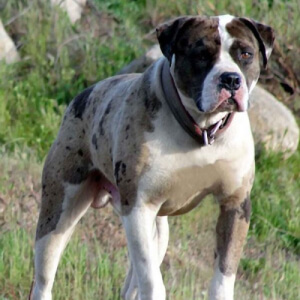
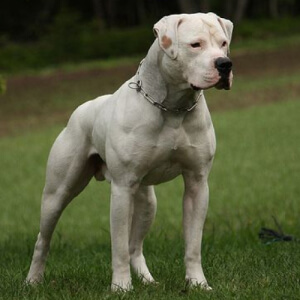
The American Bulldog is a powerful, muscular and athletic dog.
General appearance
- A strong, well-proportioned body with well-defined muscles.
- A short, close, slightly glossy coat that needs little care.
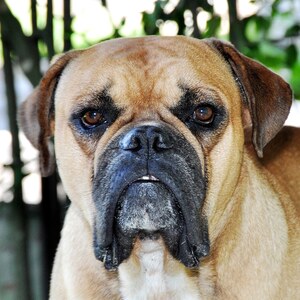
- A large head with a broad muzzle and strong jaws; "bully" types have shorter muzzles, "standard" types longer ones.
- A powerful bite and firm grip, from its history of catching livestock.
- Small to medium ears, folded or semi-erect.
- A long tail, thick at the base and carried low.
- Brown or amber eyes with an alert expression.
| Characteristic | American Bulldog |
|---|---|
| Size | Medium to large (about 51-69 cm at the shoulder) |
| Weight | About 27-55 kg |
| Coat | Short, smooth |
| Muzzle | Broad, strong, short to medium length |
| Shedding tendency | Moderate |
| Build | Strong, muscular |
The American Bulldog is a strong, athletic dog, suited to people with experience in training and an active lifestyle.
Training and Socialization
The American Bulldog is intelligent but independent, so training must be consistent and well structured. As a natural guardian, it needs early socialisation to avoid excessive territorial behaviour.
Tips for effective training
- Start early - The American Bulldog should begin training at about 8-10 weeks to learn basic commands and build a good relationship with its owner.
- Rewards and clear rules - It responds well to positive training, but needs calm, confident leadership, as it can be stubborn.
- Socialising with people and animals - It should get used to new situations, people and animals to prevent over-protective reactions.
- Managing the guarding instinct - It must learn to tell real threats from normal situations.
- No physical punishment - It has a strong personality, and harsh methods can lead to defensive or aggressive behaviour.
The American Bulldog is not a breed for inexperienced owners, but with proper training and socialisation it becomes a protective, loyal and obedient dog.
Activity and Lifestyle Needs
The American Bulldog is an active, energetic breed that needs regular exercise for its physical and mental health.
| Activity | Recommended duration |
|---|---|
| Daily walks | About 60 min |
| Interactive games | About 30 min |
| Obedience training | About 15-20 min |
| Dog sports (weight pulling, tracking, agility) | A few times a week, in cool weather |
Recommendations for a balanced lifestyle
- Needs space - The American Bulldog is not ideal for small apartments and needs a securely fenced garden.
- Needs a routine - If it does not use its energy, it may become destructive or anxious.
- Enjoys mental challenges - It likes retrieving games, scent games and puzzle toys.
- A natural guardian - It tends to patrol and defend its territory, so it needs good training.
The American Bulldog suits active owners who can give it both physical and mental stimulation.
Care and Health
The American Bulldog is a hardy breed, but some inherited disorders need monitoring.
Fur and skin care
- Weekly brushing - The short coat needs little care, but weekly brushing removes dead hair.
- Occasional baths - It needs washing only when very dirty.
- Skin and ear checks - It can be prone to skin allergies and irritation, especially dogs with a lot of white in the coat.
Common health problems
| Condition | Description | Common symptoms |
|---|---|---|
| Hip and elbow dysplasia | Abnormal development of the joints | Limping, difficulty walking |
| Congenital deafness | More common in mostly white dogs | No reaction to sounds |
| Inherited diseases (NCL, ichthyosis) | A nerve disease and a scaly skin disease that occur in the breed; DNA tests are available | Coordination problems; flaky, scaly skin |
| Skin allergies | Sensitivity to environmental or food factors | Redness, itching, hair loss |
Other aspects of care
- Weekly eye and ear checks - help prevent infections.
- Weight control - As a strong, heavy dog, it must stay active and lean to avoid joint problems and obesity.
- Regular veterinary checks - Yearly check-ups are recommended.
The American Bulldog can be a healthy dog, but it needs regular care, and breeding dogs should be health-tested.
Diet and Nutrition
The American Bulldog needs a balanced diet with good-quality protein to maintain its muscles and energy.
Recommendations for a healthy diet
Choose a complete, balanced diet suited to age, size and health. Plan home-prepared diets and supplements with a qualified veterinarian; raw pet food can carry harmful bacteria.
| Food type | Daily Amount (Adults) | Frequency |
|---|---|---|
| Premium dry food | Individual amount; follow complete-food guidance and veterinary advice | 2 meals/day |
| Home cooked food | Individual amount; follow a complete diet’s guidance and veterinary advice | 2 meals/day |
| Raw food: bacterial contamination is a concern | Individual amount; follow a complete diet’s guidance and veterinary advice | 2 meals/day |
Forbidden foods
Chocolate, grapes and raisins, onions and xylitol - toxic to dogs. ; Cooked bones - can splinter and cause intestinal blockage. ; Fatty or fried foods - can upset digestion and cause pancreatitis. ; Overfeeding - the American Bulldog can gain weight quickly, which can lead to joint and heart problems.
The American Bulldog should get a balanced diet in measured portions to stay healthy.
Reproduction and Development
Breeding requires veterinary planning, suitable health screening and care for the mother and puppies. Pregnancy and birth can involve complications.
Physical and emotional maturity
- Physical maturity: The American Bulldog reaches adult height at about 12-18 months, but continues to fill out until about 2 years.
- Emotional maturity: Its behaviour usually settles at about 2-3 years; until then it can be impulsive and boisterous.
Mating and Gestation
- Breeding decisions require veterinary assessment of maturity, health and suitable screening; reaching a fixed age does not establish that breeding is appropriate.
- Duration of gestation: Approximately 58-68 days, usually about 63 days.
- Average number of puppies: Usually about 6-10 puppies.
Puppy care
- The first 3 weeks: Puppies depend completely on their mother for warmth, milk and care.
- Between 4-8 weeks: They begin to develop their personality and play more; early socialisation helps prevent behaviour problems later.
- Moving to a new home: When puppies go to their new homes, basic training should begin.
The American Bulldog grows quickly, and early socialisation and training are essential for a disciplined, balanced dog.
Curiosities and Interesting Facts
- A farm dog - The American Bulldog was originally used to guard farms and catch livestock in the American South.
- Nearly lost - In the 1940s the breed almost disappeared, but American breeders revived it.
- Two main types - The "Johnson" or bully type is heavier with a shorter muzzle, while the "Scott" or standard type is lighter and more athletic.
- Athletic and strong - It is fast for its size and can pull heavy weights, so it is used in weight-pulling competitions.
- A great jumper - Many American Bulldogs can jump surprisingly high for such heavy dogs.
- Devoted to its family - Although it is an imposing guard dog, the American Bulldog is very affectionate with its family.
The Dog in Popular Culture
The American Bulldog has become better known thanks to films and its role as a working dog.
American Bulldog in Modern Media and Culture
- "Homeward Bound: The Incredible Journey" (1993) - Chance, the lively young dog in this Disney film, is an American Bulldog.
- Working dogs - Some American Bulldogs are trained as guard dogs and for protection sports.
Importance in modern culture
- A loyal, protective companion - The American Bulldog is very devoted, which makes it a good choice for experienced families who want an affectionate guardian.
- A working breed - Besides guarding, the American Bulldog takes part in weight pulling, agility and other dog sports.