GorillaInteresting facts and information
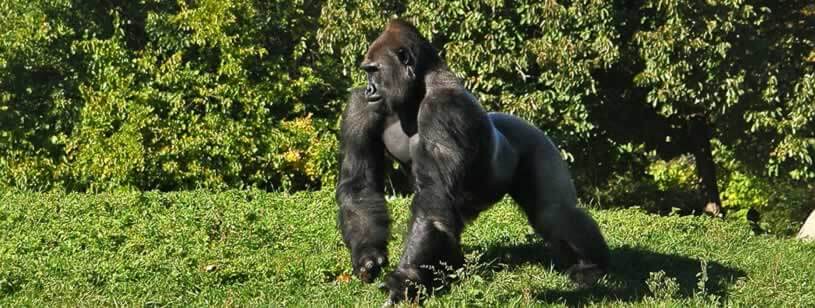
Gorillas (Gorilla) are great apes native to Africa. Western and eastern gorillas are separate species, with different populations and habitats. They feed mainly on plants and live in social groups.
There are two species of gorillas, each with two subspecies:
Gorilla gorilla (western gorilla) lives in the forests of West-Central Africa and includes the western lowland gorilla and the Cross River gorilla. Gorilla beringei (eastern gorilla) lives in East-Central Africa and includes the eastern lowland (Grauer's) gorilla and the mountain gorilla.
Although they are peaceful and very intelligent, gorillas are threatened by deforestation, hunting and diseases spread by people, and all of them are listed as Endangered or Critically Endangered.
Quick facts
| Common name | Gorilla |
| Scientific name | Gorilla gorilla (western gorilla); Gorilla beringei (eastern gorilla) |
| Typical lifespan | About 35-40 years in the wild, up to about 50-60 years in captivity |
| Maximum speed | About 30-40 km/h in short charges |
| Height | About 1.4-1.8 metres (standing) |
| Weight | About 100-230 kg (males), 70-100 kg (females) |
| Diet type | Mainly herbivore (leaves, stems, fruit, bark), with some insects |
| Main predators | Leopards (rarely); humans |
| Conservation status | Mountain gorilla Endangered; the other three subspecies Critically Endangered (IUCN) |
| Distribution | West-Central and East-Central Africa |
| Habitat | Tropical lowland forests, swamp forests and mountain forests |
- Primary category:Mammals
- Explore this animal's categories:
Interesting facts
- Gorillas share about 98% of their DNA with humans - They are among our closest living relatives and have rich social and emotional lives.
- They communicate with calls, gestures and facial expressions - Some gorillas in captivity, such as Koko, have learned to use hundreds of signs.
- Silverbacks lead the group - The dominant adult male protects the females and young of his group and decides where the group travels.
- They build new beds every night - Gorillas make nests of leaves and branches, in trees or on the ground, to sleep on.
- They are extremely strong - An adult male is many times stronger than a person, although exact comparisons are hard to measure.
- Knuckle-walking - Gorillas usually walk on all fours, leaning on the knuckles of their hands.
- Emotional animals - Gorillas show fear, joy, sadness and strong attachment to their family, and they even "laugh" when playing.
- Gardeners of the forest - By eating fruit and spreading the seeds, gorillas help forests regrow.
Records and remarkable features
- Gorillas (Gorilla) are great apes native to Africa. Western and eastern gorillas are separate species, with different populations and habitats. They feed mainly on plants and live in social groups.
- Gorillas are the largest living primates; big males can weigh more than 200 kg.
- Mountain gorillas are one of the few great apes whose numbers are rising, thanks to decades of conservation work.
Characteristics
Gorillas are the largest primates, with impressive bodies that make them very strong but also well adapted to their environment. Although they are huge, gorillas are agile and intelligent.
Main physical characteristics
| Feature | Details |
|---|---|
| Height (standing) | About 1.4-1.8 metres |
| Weight | About 100-230 kg (males), 70-100 kg (females) |
| Bite | Bite force depends on the individual and measurement method; a fixed species-wide figure is not given |
| Arm span | Up to about 2.5 metres in big males |
| Strength | Much stronger than a human, especially in the arms and shoulders |
| Sleep | About 12 hours a night |
Special adaptations
- Long, strong arms - Their arms are longer than their legs, which helps them knuckle-walk and climb.
- Powerful muscles - Give them great strength for self-defence and for displays against rivals.
- A big jaw and strong chewing muscles - Adapted for chewing tough leaves, stems, bark and bamboo; males have a bony crest on top of the head where these muscles attach.
- Thick dark hair - Protects them from cold and rain, especially in mountain forests, where mountain gorillas have longer fur.
- Silverbacks - Mature males develop a saddle of silver hair on their back, a sign of maturity.
Habits and behaviour
Gorillas are very social and intelligent and live in groups called troops, usually led by a dominant male, the silverback. They communicate with calls, facial expressions, gestures and body language.
Social behaviour
- Groups of about 5-30 gorillas - A typical group includes one silverback, several females and their young; some groups have more than one adult male.
- The silverback leads - He protects the group, decides when and where to travel and settles quarrels.
- Mothers raise the young - The silverback protects everyone, but the mothers care for their own babies, and silverbacks are often gentle and playful with youngsters.
- Young adults leave - Many young males leave their group and live alone or in all-male groups until they can form their own group; females also often move to other groups.
Communication and intelligence
- Many sounds - Gorillas use more than 20 kinds of calls, including grunts, barks, roars and soft rumbles.
- Gestures and expressions - Eye contact, posture and arm movements are important in their social life.
- Learning signs - Koko, a gorilla in California, learned to use about 1,000 signs and understood many spoken words.
Self-defence and conflict
- Rarely aggressive - Although they are powerful, gorillas usually avoid fights and rely on displays to scare rivals.
- Chest-beating - Males beat their chest with cupped hands to show their size and strength and to communicate over long distances.
- Protecting the group - When danger threatens, the silverback places himself between the threat and his group and may charge.
Habitat and geographic distribution
Gorillas live only in the forests of West-Central and East-Central Africa. Each species and subspecies is adapted to particular habitats, from lowland rainforests to high mountain forests.
Habitat types
| Habitat | Gorillas living there |
|---|---|
| Tropical lowland forests and swamps | Western lowland gorilla (Gorilla gorilla gorilla) |
| Mountain forests (over about 2,000 m) | Mountain gorilla (Gorilla beringei beringei) |
| Lowland and mountain forests of eastern DR Congo | Eastern lowland or Grauer's gorilla (Gorilla beringei graueri) |
| Hilly forests on the Nigeria-Cameroon border | Cross River gorilla (Gorilla gorilla diehli) |
Geographic distribution
- West-Central Africa (Cameroon, Gabon, Republic of the Congo, Central African Republic, Equatorial Guinea, Angola's Cabinda, Nigeria) - Home of the western gorilla.
- Eastern Democratic Republic of the Congo - Home of the eastern lowland gorilla.
- The Virunga Mountains (Rwanda, Uganda, DR Congo) and Bwindi forest (Uganda) - Home of the mountain gorilla.
Impact of human activities
- Deforestation - Farming, logging and mining destroy gorilla forests.
- Poaching - Gorillas are hunted for bushmeat, and babies are captured for the illegal trade.
- Human diseases - Gorillas can catch human diseases, and Ebola outbreaks have killed thousands of gorillas.
- Fragmented populations - Many groups are cut off from each other by habitat destruction, which reduces genetic diversity.
Despite conservation programmes, most gorilla populations are still declining and need urgent protection.
Diet and feeding
Gorillas are mainly herbivores, eating leaves, stems, fruit, bark and roots, as well as some insects. They play an important ecological role in tropical forests by spreading seeds.
Types of food
| Food group | Examples |
|---|---|
| Leaves, stems and shoots | Bamboo shoots, wild celery, nettles, vines |
| Fruit | Wild figs and many other forest fruits (especially for western gorillas) |
| Bark, pith and roots | Tree bark, the soft pith of plants, roots |
| Insects (occasionally) | Ants, termites |
| Flowers and seeds | Forest flowers and seeds |
Feeding methods
- Picking food by hand - Gorillas use their strong fingers to strip leaves, peel stems and break open fruit.
- Eating a lot - A big male can eat up to about 30 kg of plants a day.
- Choosing carefully - They pick the most nutritious leaves and fruit.
- Rarely drinking - They get most of the water they need from juicy plants and dew.
Reproduction and life cycle
Gorillas breed slowly, which makes their populations vulnerable. A female usually gives birth only once every 4-6 years, and the young depend on their mother for several years.
Life cycle stages
| Stage | Approximate timing | Details |
|---|---|---|
| Pregnancy | About 8.5 months | Similar to human pregnancy. |
| Newborn | 0-3 months | Weighs about 1.5-2 kg and depends completely on its mother. |
| Infant | 3 months - 3 years | Plays a lot and learns social skills; rides on its mother's back. |
| Juvenile | 3-6 years | Becomes more independent and finds its place in the group. |
| Maturity | Females about 8-10 years, males about 12-15 years | Males develop their silver back. |
| Adult | Up to about 35-40 years in the wild | Some males form their own groups. |
Reproductive behaviour
- Breeding males - In most groups, the silverback fathers most of the young.
- Protecting the young - The whole group watches over the young, and the silverback defends them.
- Long nursing - Mothers nurse their young for about 3-4 years and usually do not breed again during this time.
- Young males - Some stay in their birth group, while others leave and live alone or in all-male groups until they start their own families.
Because gorillas breed so slowly, losing even a few animals can have a big impact on a population.
Name and history
Gorillas became known to scientists relatively late, but their name comes from an ancient story about hairy "wild people" described by a Carthaginian explorer.
Origin of the name
- The word "gorilla" comes from the Greek Gorillai, the name that the Carthaginian explorer Hanno the Navigator, in the 5th century BC, gave to a tribe of hairy "wild people" he met on the coast of Africa.
- The scientific name comes from the 19th century: the gorilla was first described in 1847, and the genus Gorilla was named in 1852.
Taxonomic classification
| Taxonomic category | Name |
|---|---|
| Kingdom | Animalia |
| Phylum | Chordata |
| Class | Mammalia |
| Order | Primates |
| Family | Hominidae |
| Species | Gorilla gorilla (western gorilla), Gorilla beringei (eastern gorilla) |
The gorilla in history and culture
- Scientific discovery - The first scientific description of the gorilla was published in 1847 by Thomas Staughton Savage, an American missionary and naturalist, with the anatomist Jeffries Wyman.
- The age of exploration - In the 19th century, explorers such as Paul Du Chaillu hunted gorillas and described them as ferocious monsters, an image that lasted for a long time.
- Dian Fossey - From 1967 until her death in 1985, the scientist Dian Fossey studied and protected mountain gorillas in Rwanda and became a legendary figure in gorilla conservation.
For a long time, gorillas were wrongly seen as aggressive and dangerous, but modern research has shown that they are peaceful, intelligent and very social.
Cultural significance and mythology
Gorillas have fascinated people for centuries. In modern culture, they have become symbols of strength, protection and intelligence.
Gorillas in mythology and folk belief
- "People of the forest" - Local stories in Central Africa often describe gorillas as powerful forest beings, close to humans but wild.
- A monster myth - Explorers of the 19th century spread the false idea that gorillas were savage beasts that attacked people, which shaped the gorilla's image for decades.
- King Kong - The 1933 film created one of the most famous giant gorilla monsters in culture.
Gorilla symbolism
- Strength and protection - Silverbacks are symbols of power and responsibility for the family.
- Gentleness and calm - Because gorillas rarely use their strength without reason, they are also seen as "gentle giants".
- Our link with nature - As one of our closest relatives, the gorilla reminds people of their place in the natural world.
Conservation status and threats
All gorillas are threatened with extinction because of habitat loss, poaching and disease. Most populations have fallen sharply in recent decades, although mountain gorillas have recovered thanks to strong protection.
Conservation status
| Subspecies | Status (IUCN) |
|---|---|
| Mountain gorilla (Gorilla beringei beringei) | Endangered (improved from Critically Endangered in 2018) |
| Western lowland gorilla (Gorilla gorilla gorilla) | Critically Endangered |
| Eastern lowland gorilla (Gorilla beringei graueri) | Critically Endangered |
| Cross River gorilla (Gorilla gorilla diehli) | Critically Endangered |
Main threats
- Deforestation and habitat loss - Farming, illegal logging and mining destroy the forests where gorillas live.
- Illegal hunting - Gorillas are hunted for bushmeat and trophies and captured for the illegal wildlife trade.
- Human diseases - Gorillas are very vulnerable to diseases such as flu, other respiratory infections and Ebola.
- Armed conflict - Many areas where gorillas live have suffered from wars and armed groups.
- Fragmented populations - Habitat destruction has isolated many groups, reducing their genetic diversity and chances of survival.
Conservation efforts
- National parks - Parks in Rwanda, Uganda, the Democratic Republic of the Congo and West-Central Africa are essential for the survival of gorillas.
- International law - CITES bans international commercial trade in gorillas, and hunting them is illegal in all the countries where they live.
- Gorilla tourism - Carefully controlled visits to gorilla groups raise money for protection and provide jobs for local communities.
- Rescue centres - Sanctuaries care for orphaned gorillas, and some have been returned to the wild.
Thanks to conservation work, the number of mountain gorillas has risen to more than 1,000, a rare success story for an endangered species.
In popular culture
Gorillas in literature
- Tarzan of the Apes (Edgar Rice Burroughs, 1912) - Tarzan is raised in the jungle by a family of great apes.
- Gorillas in the Mist (Dian Fossey, 1983) - Fossey's book about her years studying and protecting mountain gorillas, made into a film in 1988.
- The One and Only Ivan (Katherine Applegate, 2012) - A children's novel based on the true story of a gorilla who lived for years in a shopping centre.
Gorillas in film and television
- King Kong (1933 and remakes) - The giant ape Kong is one of the most famous monsters in film history.
- Planet of the Apes (1968 - present) - A science-fiction series in which apes, including gorilla soldiers, rule the world.
- Tarzan (Disney, 1999) - Tarzan is raised by a family of gorillas led by Kerchak and Kala.
Gorillas in cartoons and video games
- Donkey Kong (Nintendo) - One of the best-known video game characters, a gorilla who first appeared in 1981.
- Harambe - A gorilla at the Cincinnati Zoo who was shot in 2016 after a child fell into his enclosure; his death caused worldwide debate and countless internet memes.
The gorilla as a cultural symbol
- Strength and courage - Many sports teams and companies use the gorilla as a symbol of power and determination.
- Conservation - Gorillas are flagship animals for protecting tropical forests and biodiversity.